A synthesised voice — not a recording of a person — saying عيد ميلاد مجيد
in ar-YE.
The Arabic name of the feast is the greeting, and it is Modern Standard Arabic rather than a Yemeni form: the same four syllables are said from Morocco to Oman, and they are what Yemen's Arabic-speaking Christians say to each other.
What is attested in Yemen is the phrase rather than a Yemeni version of it. A Yemeni news aggregator carried it on 24 December 2020 in a public message addressed to Christians: «عيد ميلاد مجيد للإخوة المسيحيين في كل مكان بالعالم», a glorious Christmas to our Christian brothers everywhere in the world, «وهي مناسبة عظيمة تجتمع فيها قلوب البشر على قيم المحبة والرحمة والتسامح», an occasion on which human hearts meet in the values of love, mercy and tolerance. It is one man's greeting to his Christian neighbours rather than a Yemeni church's words, and a church of its own is the thing Yemen's Christians mostly do not have to say it in.
More than ninety-nine per cent of Yemen is Muslim, and everybody else is counted together: «Hindus, Baha’is, Christians (many of whom are economic migrants to the country), and Jews together make up less than 1 percent of the population.»
Inside that fraction, the two available counts of Christians differ by a factor of several: «The database indicates there are 16,500 Christians, but the NGO Open Doors believes the number is only a few thousand, most of whom are converts from Islam.» A third figure is bigger again and belongs to an earlier moment. The US Commission on International Religious Freedom put it at «an estimated 41,000 Christians in Yemen, including Yemenis, refugees, and expatriates from abroad», and then said in 2025 that «the community has shrunk to only a few thousand» as people fled the war. So the low counts agree and the spread has a stated cause: «Exact figures are impossible to determine due to the lack of a census and the fear by many religious minorities of persecution».
The same report says most Yemeni Christians are converts who «practiced their faith in secret, meeting in small groups in homes or outdoors» — an assessment the department attributes to an advocacy organisation rather than to a count of its own. What follows from it is narrow: there is no public congregation in Yemen to describe.
A woman from Aden told a Catholic news agency in 2024 that the midnight Mass had been stopped outright: «The government officially prohibited us from celebrating midnight Mass on Christmas and New Year’s Eve.» She dates the change to the 1990s, names no decree, and is the only witness the report carries.
The church that would have held such a Mass is standing and shut. In Aden's Tawahi district, «the metal gates surrounding the St. Francis of Assisi church in the Tawahi neighbourhood of Aden are locked, riddled with bullet holes, rusting», and above them «a statue of Jesus, arms outstretched. The statue has no head.»
A long-time resident told the agency the building had been in use «from the days of the British (protectorate), and even before, for 140, 150 years». That is a neighbour's memory rather than a foundation date, and no other age for the building has been published.
On 4 March 2016 gunmen attacked a home for the elderly run by the Missionaries of Charity in Aden and killed four sisters — «Sr. Reginette and Sr. Margarita from Rwanda, Sr. Anselma from India, and Sr. Judith from Kenya» — along with twelve other people. A priest taken in the same attack, Fr Tom Uzhunnalil, «was freed after being kidnapped on March 4, 2016 in Yemen», eighteen months later.
Who did it has never been settled: Vatican News says a jihadist group, the BBC reported at the time that no group had claimed responsibility, and Yemeni officials blamed Islamic State.
The order did not leave. Ten years on, «the two communities in Yemen serve the poor in the cities of Hodeidah and Sana’a».
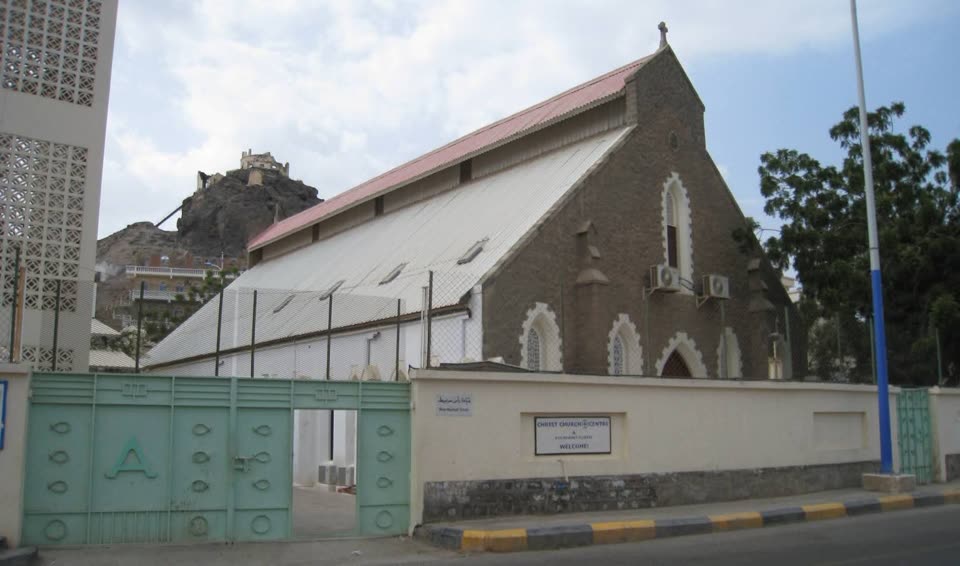
One church in Aden is still open, and it is open because of the clinic attached to it. The Anglican diocese's 2025 report on the Ras Morbat eye clinic, which treats patients regardless of faith, notes in passing of the building beside it that «the church also serves as a place of worship for Christians».
The best-documented Christmas event in Yemen in years is an arrest campaign. Human Rights Watch reported on 9 February 2026 that the Houthi authorities had «arbitrarily arrested over 20 Christians in Yemen over the last three months». It began in late November and early December 2025: seven Yemeni Christians were taken «at the start of December», and the authorities «then later expanded their arrests on December 24, Christmas Eve».
The counts do not agree, and the report says why. Two members of the community who were collecting the information knew of 24 and of 21 people; the National Council for Minorities in Yemen said «dozens». They came from Sanaa, Ibb and other governorates under Houthi control, no warrants were shown, and most of the cases «would appear to meet the definition of enforced disappearance». One man described it: «People were detained from streets, others from their houses», and «They raided houses, broke doors, and arrested people by force».
The other man described the community rather than the arrests, and his sentence is the reason a Yemeni Christmas is so hard to describe from outside: «We are hidden communities, marginalized and targeted by all authorities in Yemen, including religious authorities».
Human Rights Watch counted the churches of Aden while reporting what happened to two of them. St Joseph's was «one of four Christian churches in the city» when gunmen «stormed and burned down» it on 15 September 2015 — masked men «wearing white shirts with the Islamic State logo emblazoned in black» who arrived on motorbikes, and «By the time fire trucks arrived over 30 minutes later, most of the church had burned down».
Then: «On 9 December, an explosion destroyed Aden’s Immaculate Conception Catholic Church», and local residents blamed Islamists. That is sixteen days before Christmas.
What a Yemeni Christian's year can look like is in the same dispatch, told about a man given the name John. He ran a library in Taizz that stocked Christian books. On 23 February 2015 a shipment of «Bibles and other Christian literature» reached him at the city's airport and customs seized it; an official involved said other officials suggested burning the books because «they were offensive to the community and religion», and warned his lawyer about «reckless men concerned with their religion» who might set the library alight if the shipment reached the city.
He fled in April. On 27 September about fifteen armed men arrived in two pickup trucks, and a neighbour watched them «pack the Christian books in boxes» and load them into the cars, then burn them in Souq al-Sameel, a public market. On his living-room wall they left graffiti ending «God’s curse on Christians».
Every claim carries its own citation. They are collected below, so you
can see what the page rests on and how much of it comes from where.
Yemen's abandoned churches, remnants of a fading past — Agence France-Presse, carried by Pulse Kenya. Retrieved 2026-10-29.A news agency report of August 2024 from the Tawahi district of Aden: «The metal gates surrounding the St. Francis of Assisi church in the Tawahi neighbourhood of Aden are locked, riddled with bullet holes, rusting.» And above it: «Atop the church is a statue of Jesus, arms outstretched. The statue has no head.» A long-time resident, Mohammed Seif, tells the agency the building was in use «from the days of the British (protectorate), and even before, for 140, 150 years» — a neighbour's recollection rather than a foundation date.
Ras Morbat Eye Clinic, Report to Synod 2025 — Anglican Diocese of Cyprus and the Gulf. Retrieved 2026-10-29. archived 28 April 2025The diocese reporting on its own clinic in Aden, where the eye clinic and the church share a compound: «The church also serves as a place of worship for Christians.»
Yemen: Houthis Arbitrarily Detain, Disappear Christians — Human Rights Watch, 9 February 2026. Retrieved 2026-10-31. archived 9 October 2026Its researcher is named: «Niku Jafarnia», the organisation's Yemen and Bahrain researcher. It also carries the population figures: «an estimated 41,000 Christians in Yemen, including Yemenis, refugees, and expatriates from abroad», from the US Commission on International Religious Freedom, which said in 2025 that «the community has shrunk to only a few thousand».
Christians Among the Victims in an Unstable Yemen — Human Rights Watch, Belkis Wille, 10 May 2016, first published by openDemocracy. Retrieved 2026-10-31. archived 25 September 2026The Arabic edition of the dispatch is at https://www.hrw.org/ar/news/2016/05/11/289757 under the title «المسيحيون من ضحايا انعدام الاستقرار في اليمن», and it gives the church count in the same words: «وهي إحدى 4 دور عبادة مسيحية في المدينة».
2023 Report on International Religious Freedom: Yemen — United States Department of State, via ecoi.net. Retrieved 2026-10-29. archived 18 September 2026It gives the share — «Hindus, Baha’is, Christians (many of whom are economic migrants to the country), and Jews together make up less than 1 percent of the population» — and it gives two counts that disagree: «The database indicates there are 16,500 Christians, but the NGO Open Doors believes the number is only a few thousand, most of whom are converts from Islam.»
Remembering Missionaries of Charity killed in Aden in 2016 — Vatican News. Retrieved 2026-10-29. archived 7 March 2026Ten years after the attack, naming the four sisters killed — «Sr. Reginette and Sr. Margarita from Rwanda, Sr. Anselma from India, and Sr. Judith from Kenya» — and reporting that the order stayed: «the two communities in Yemen serve the poor in the cities of Hodeidah and Sana’a, in humility as a powerful sign of hope.»
محمد علي علاو : عيد ميلاد مجيد للإخوة المسيحيين في كل مكان بالعالم — أنباء يمنية (Anba Yamaniya, yemeninews.net), a Yemeni news aggregator, 24 December 2020. Retrieved 2026-10-31.The message runs in the aggregator's «مغردون» column — its page of posts lifted from social media — so what is dated to 16:40 on 24 December 2020 is a Yemeni writer's own greeting rather than a report about one.
قانون رقم (2) لسنة 2000م بشأن تحديد الإجازات والعطلات الرسمية — Law No. 2 of 2000 on Fixing Official Holidays, article 3 — النيابة العامة (Public Prosecution of Yemen), from the Official Gazette no. 2 of 2000. Retrieved 2026-10-31. archived 10 July 2025Article 3(a) fixes the official holidays as a list of nine, and it is a closed list: «مناسبة عيد الفطر المبارك وتبدأ من 29 رمضان وتنتهي في 3 شوال» and Eid al-Adha; «ذكرى الهجرة النبوية الشريفة أول يوم من شهر محرم», the Islamic New Year; the four national anniversaries of 22 May, 26 September, 14 October and «ذكرى يوم الاستقلال 30 نوفمبر»; Labour Day; and «يوم الجمعة من كل أسبوع», every Friday of the week.Article 3(b) then names three occasions that are marked without a day off — «تحديد المناسبات التي يتم الاحتفال فيها بدون إجازة رسمية» — and they are the Mawlid, al-Isra’ wal-Mi’raj and «ذكرى 7 يوليو».The law was signed «بتاريخ 19/شوال/1420هـ» — 25 January 2000 — by Ali Abdullah Saleh, and article 6 repeals «القانون رقم(42)لسنة1997م», the holiday law of 1997 that preceded it.