A synthesised voice — not a recording of a person — saying สุขสันต์วันคริสต์มาส
in th-TH.
สุขสันต์ means joyful and วัน means day, so the phrase is the frame Thai uses for every festival — the same one gives สุขสันต์วันสงกรานต์ for Songkran. คริสต์มาส is the English word, written in Thai script.
The Catholic church in Thailand calls the feast พระคริสตสมภพ, the Nativity, rather than คริสต์มาส.
Thai government and church reports of Christmas events say that an official or an archbishop gave a Christmas blessing and do not set down the words, so the written phrase rests on a national newspaper’s page of Christmas wishes rather than on an official text.
The Mass is at eight in the evening, because the congregation works in the morning
The most Thai thing about a Thai Christmas is the hour of it. Christmas Day is not a holiday, so the midnight Mass is not at midnight. AsiaNews reported from Bangkok in 2004 that «because December 25 is a working day in Thailand, they celebrate Christmas mass at 8 pm and not at midnight», among a Catholic population it put at the time at «There are some 290,000 Catholics in the whole of Thailand.»
What has not changed since is the premise: the Bank of Thailand’s list of statutory holidays for 2026 still has nothing on 25 December.
Sakon Nakhon’s star parade is in its forty-fourth year and a ministry helps run it
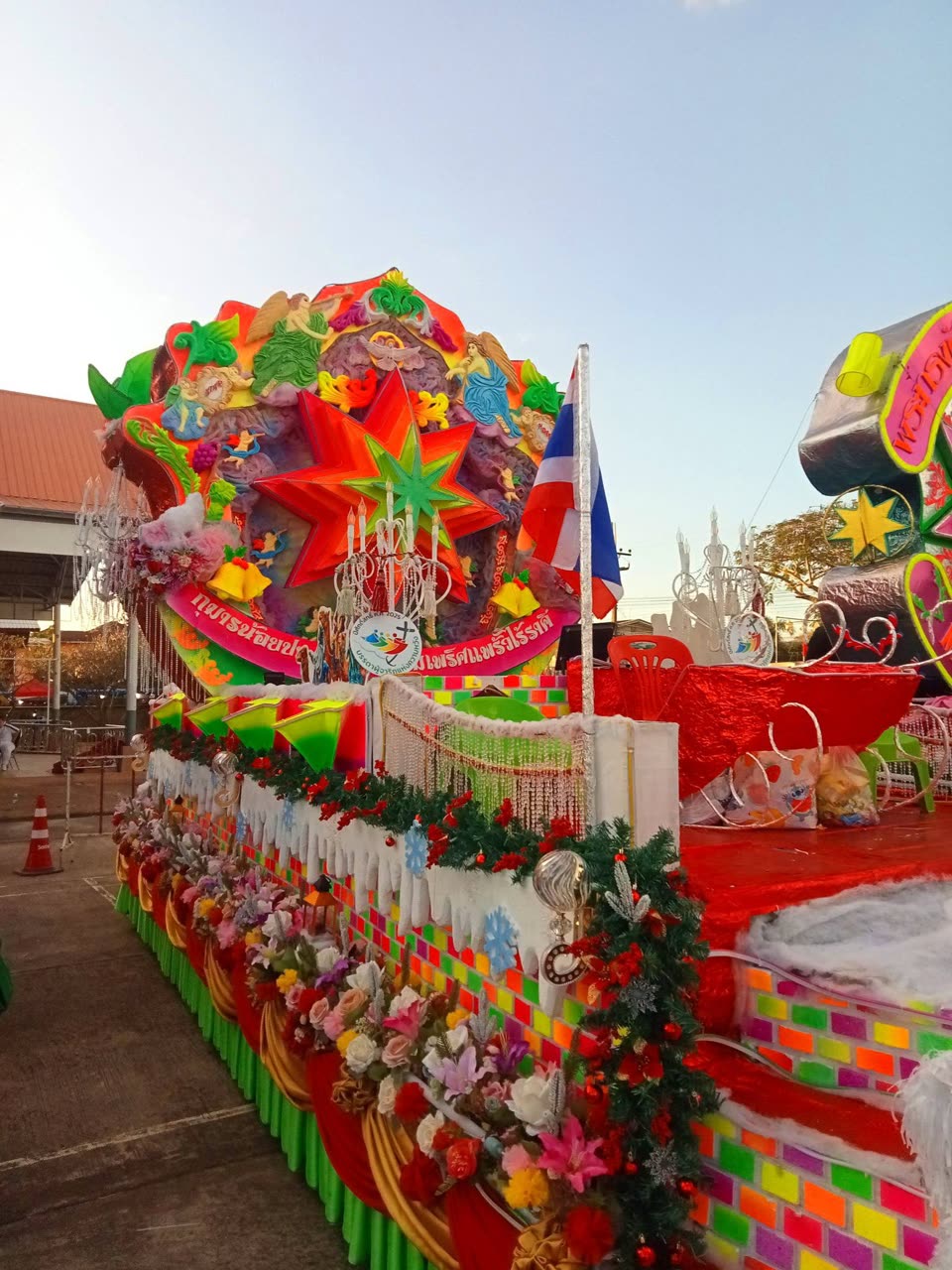
On Christmas Day 2025 the Public Relations Department reported that «ปีนี้เป็นการจัดงานครั้งที่ 44 แล้ว» — this was the forty-fourth time the parade had been held. A deputy interior minister opened it; the Director-General of the Department of Religious Affairs was there; the Ministry of Culture paid for a competition for the best Christmas-decorated house and ran a stand about the festival.
The procession is enormous. The floats came «ขบวนรถแห่ดาวใหญ่ จากอัครสังฆมณฑลท่าแร่ -หนองแสง 4 จังหวัด ประกอบด้วยจังหวัดสกลนคร กาฬสินธุ์ นครพนม และ มุกดาหาร จำนวน 167 คัน» — 167 of them, from the four provinces of the Tha Rae–Nong Saeng archdiocese, with 93 large stars besides. Priests and officials rode them scattering sweets, «เสมือนได้รับของขวัญจากซานตาคลอส», as though from Santa Claus.
Tha Rae holds its own star festival two nights earlier, with a drone show
The town the parade is named for runs a festival of its own. On the night of 23 December 2025 the Tha Rae municipality opened the เทศกาลแห่ดาวคริสต์มาส with the Governor of Sakon Nakhon presiding, and with the Apostolic Nuncio to Thailand and the Archbishop of Tha Rae–Nong Saeng giving the Christmas blessing.
It counted «ขบวนรถแห่ดาว ทั้งดาวใหญ่–ดาวเล็ก เข้าร่วมขบวนแห่ถึง 38 คัน» — 38 floats of stars large and small — and finished with a drone display spelling out letters over the town, under an English theme: «“Illuminated Faith: The Festival of Holy Stars”». The Tourism Authority of Thailand took part, and the report is written around raising a parish tradition to a national tourism event.
In the hills the Masses are in Karen, Hmong and Akha, and each village brings its own performance
Mae Hong Son in 2007, described by Sister Supin Sirisawang, herself Karen. The Masses of the season, she said, «are conducted in Thai and local languages. Most local Catholics are in fact ethnic Karen, Hmong, Akha or other groups.» And on Christmas Eve, «Each group has prepared its own cultural performance which will be presented in local school yards on Christmas Eve, both as a form of entertainment and as a path of inculturation.»
The parish priest of Hua-la gave the timescale. The village dates from 1962 and «Our first church was a hut made out of bamboo.»; forty-five years later, in 2007, «we can accommodate 4,000 tribal Catholics for next Christmas».
Chanthaburi lights its cathedral, for a congregation of Vietnamese descent
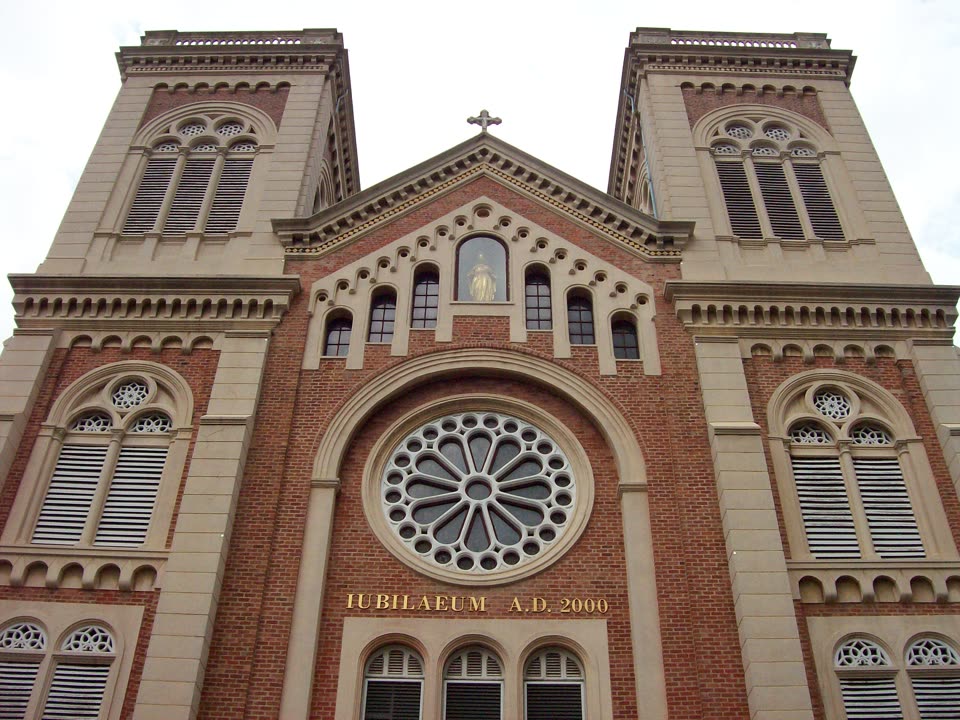
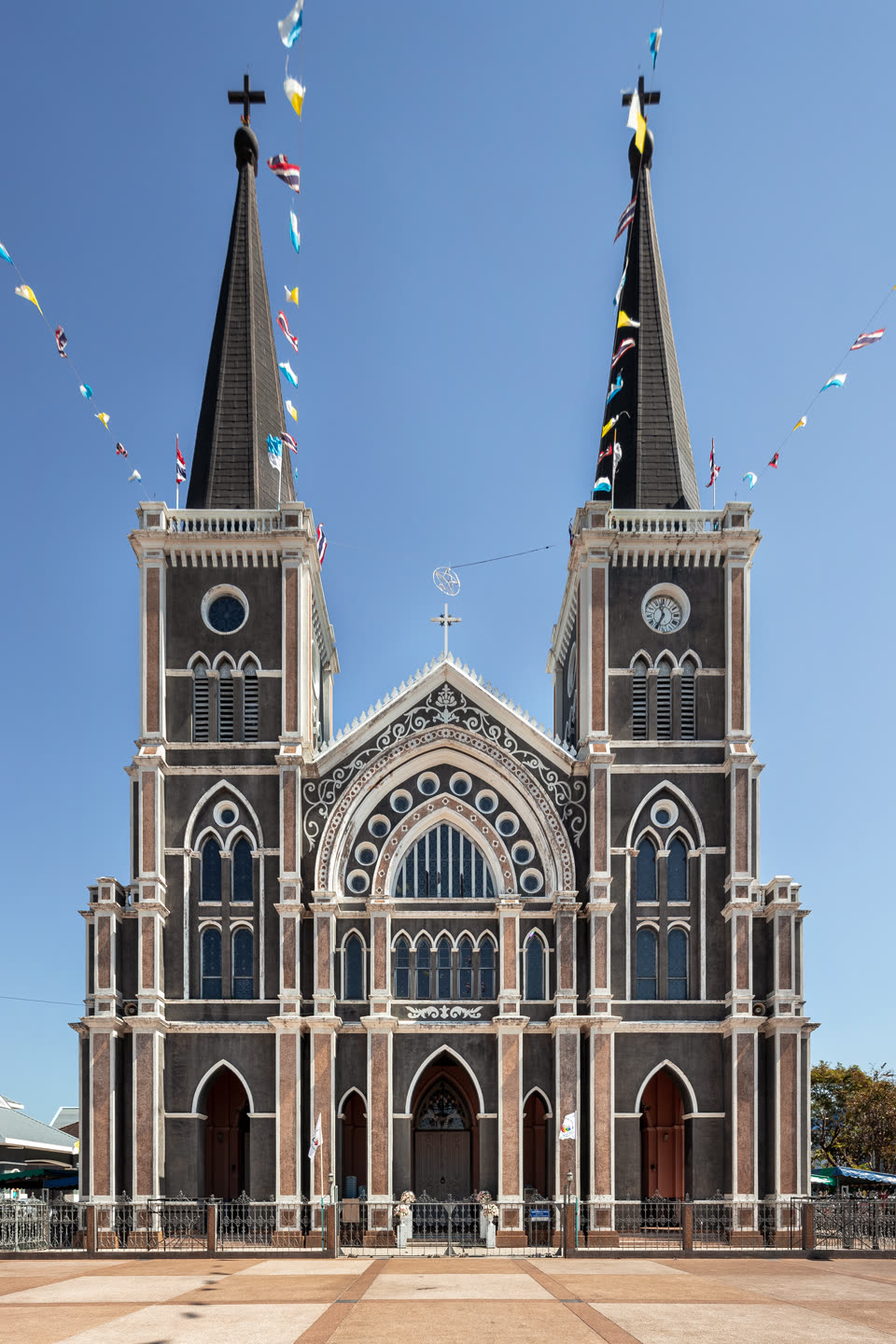
At the other end of the country, «residents organized the “Chantaburi Miracle Christmas 2017” celebration, involving lit displays at the century-old neo-Gothic Cathedral of the Immaculate Conception along with fireworks and light animations».
Who lights it is the part worth knowing: «Many Thais of Vietnamese descent are Catholics and their communities have been living in Chantaburi province for three centuries.» Thailand’s two great Christmas towns are both communities that arrived from somewhere else and stayed.
A good part of the congregation at a Christmas Mass is not Christian
AsiaNews put it at about one in seven in 2004: «About 15 per cent of those who will take part in the Christmas liturgy will in fact be non Christians, happy to share in the ritual even though they do not really know who Jesus is». The estimate is the reporter’s rather than anybody’s count, and the piece is built around two Buddhist schoolchildren at convent schools in Bangkok, one of whom goes to the cathedral to pray before examinations.
It is a report of 2004 and no later count has replaced it. What makes it plausible rather than merely charming is the school system: much of Thailand’s Catholic presence is educational, and the children in those classrooms are mostly Buddhist.
Widely repeated claims about Christmas in Thailand that do not survive
checking. Each one says what is actually the case, because a correction
with nothing in its place leaves you worse off than before.
Contradicted
Christmas Day is a public holiday in Thailand
What is actually the case. It is not, and two Thai government documents say so from opposite directions.
The Bank of Thailand’s statutory list for 2026, issued as «Notification of the Bank of Thailand No. 31/2568», runs to nineteen days. December holds the substitution for the late King’s birthday on the 7th, «Thursday 10 Constitution Day» and «Thursday 31 New Year’s Eve», and nothing else; the word Christmas is not on the page.
And the Royal Thai Embassy in Berlin, which closes for both countries’ holidays and says which is which, marks «25 Christmas Day (German)».
What confuses visitors is that the decorations are real and the season is visible. The day off is not. The clearest sign of it is in the churches: the Christmas Mass is said in the evening instead of at midnight, so that people can be at work the next morning.
The Bank of Thailand publishes the statutory holidays under «Notification of the Bank of Thailand No. 31/2568». The 2026 list runs to nineteen days and December holds three of them: a substitution on the 7th for the late King’s birthday, which is also National Day and Father’s Day; «Thursday 10 Constitution Day»; and «Thursday 31 New Year’s Eve».
That is the whole of December. The list is not silent about Christmas — it has no occasion to mention it.
The Royal Thai Embassy in Berlin publishes the days it closes, and because it serves two countries it marks each day with whose holiday it is. Good Friday, Easter Monday, Ascension, Whit Monday and 1 May are all «(German)», and so is «25 Christmas Day (German)».
The Thai column for December holds one entry, and it is the other end of the week: «31 New Year’s Eve (Thai)». A document written to tell staff when the office is shut turns out to be the cleanest statement there is of which of the two days Thailand keeps.
Catholic churches in Thailand are recognised one at a time, by number, on a schedule to an act of Siam whose royal decree is dated 27 August 1909.
The schedule is still live. On 20 November 2023 the Director-General of the Department of Religious Affairs signed three notices, published in the Royal Gazette the following March, confirming that St Anne’s Church at Bua Tha in Ubon Ratchathani is Catholic church number 5, that the Sacred Heart church at Si Than in Si Sa Ket is number 6, and that the Sacred Heart of Christ church at Wat Phleng in Ratchaburi is number 32.
They are not new recognitions, and that is the interesting part. The bishops asked for them because the names written into the 1909 schedule — which call each one the priest’s station at such and such a place, with the size of its land — are not the names the churches now go by, and the mismatch was getting in the way of dealing with government offices. A register opened under Rama V is still the thing a Thai parish has to be on.
The legal frame around all of this is unusually explicit. «The law officially recognizes five religious groups: Buddhists, Muslims, Brahmin-Hindus, Sikhs, and Christians.» The Department of Religious Affairs sets a quota for registered foreign missionaries by religion — «1,357 Christian, six Muslim, 20 Hindu, and 41 Sikh».
And the franchise is drawn along a line that has to be seen to be believed. Buddhist monks and novices may not vote at all; «Christian clergy may vote in elections as long as they are not wearing formal religious attire».
The community this governs is small and lopsided: «In December 2021, the Department of Religious Affairs reported the population is 92.5 percent Buddhist, 5.4 percent Muslim, and 1.2 percent Christian.» Of that 1.2 per cent, «The majority of Christians are ethnic Chinese and are also represented among ethnic tribal groups in the north. More than half of the Christian community is Roman Catholic.»
Every claim carries its own citation. They are collected below, so you
can see what the page rests on and how much of it comes from where.
An “ethnic” Christmas for Thai Catholics — AsiaNews, Weena Kowitwanij, 19 December 2007. Retrieved 2026-10-31.The Masses of the season «are conducted in Thai and local languages. Most local Catholics are in fact ethnic Karen, Hmong, Akha or other groups.» And what each group brings: «Each group has prepared its own cultural performance which will be presented in local school yards on Christmas Eve, both as a form of entertainment and as a path of inculturation.» The parish priest of Hua-la gives the measure of how recent it is: «Our first church was a hut made out of bamboo.», and forty-five years on «we can accommodate 4,000 tribal Catholics for next Christmas».
Buddhists and other non Christians will attend Christmas mass — AsiaNews, Weena Kowitwanij, 22 December 2004. Retrieved 2026-10-31.It gives the number of Catholics at the time — «There are some 290,000 Catholics in the whole of Thailand.» — and the consequence of the working day: «because December 25 is a working day in Thailand, they celebrate Christmas mass at 8 pm and not at midnight». Its estimate of the congregation is the reporter’s: «About 15 per cent of those who will take part in the Christmas liturgy will in fact be non Christians, happy to share in the ritual even though they do not really know who Jesus is».
Thai Christians Celebrate Christmas with Lights, Parades — Khaosod English, 24 December 2017. Retrieved 2026-10-31. archived 8 December 2022On Sakon Nakhon: «In Sakon Nakorn province’s The Rae tambon, a combined 20,000 locals and tourists took part in a Christmas parade Saturday night which included 40 mobile processions depicting the likes of Santa Claus and a local twist – Thai beauty queens.» On Chanthaburi: «residents organized the “Chantaburi Miracle Christmas 2017” celebration, involving lit displays at the century-old neo-Gothic Cathedral of the Immaculate Conception along with fireworks and light animations». And on who the Chanthaburi Catholics are: «Many Thais of Vietnamese descent are Catholics and their communities have been living in Chantaburi province for three centuries.».
วันหยุดราชการประจำปีพุทธศักราช ๒๕๖๙ / Official holidays B.E. 2569 (2026) — Royal Thai Embassy, Berlin, Ministry of Foreign Affairs of Thailand, as of 11 December 2025. Retrieved 2026-10-31.Good Friday, Easter Monday, Ascension, Whit Monday and 1 May are all «(German)». So is «25 Christmas Day (German)». The Thai column carries New Year’s Day, Chakri Memorial Day, Songkran, Coronation Day, Visakha Bucha, the royal birthdays, Asalha Bucha, the two King Bhumibol memorial days and «31 New Year’s Eve (Thai)».
2023 Report on International Religious Freedom: Thailand — United States Department of State. Retrieved 2026-10-31. archived 28 June 2026The population split: «In December 2021, the Department of Religious Affairs reported the population is 92.5 percent Buddhist, 5.4 percent Muslim, and 1.2 percent Christian.» Who the Christians are: «The majority of Christians are ethnic Chinese and are also represented among ethnic tribal groups in the north. More than half of the Christian community is Roman Catholic.» The legal frame: «The law officially recognizes five religious groups: Buddhists, Muslims, Brahmin-Hindus, Sikhs, and Christians.» The missionary quota: «1,357 Christian, six Muslim, 20 Hindu, and 41 Sikh». And the franchise: «Christian clergy may vote in elections as long as they are not wearing formal religious attire», where Buddhist monks and novices may not vote at all.
‘ท่าแร่’สว่างทั้งเมือง! เปิดยิ่งใหญ่‘เทศกาลแห่ดาวคริสต์มาส’ — แนวหน้า (Naewna), 24 December 2025. Retrieved 2026-10-31. archived 24 December 2025The paper counts «ขบวนรถแห่ดาว ทั้งดาวใหญ่–ดาวเล็ก เข้าร่วมขบวนแห่ถึง 38 คัน» — 38 floats of large and small stars — and a drone display under the English theme «“Illuminated Faith: The Festival of Holy Stars”».
มท.4 เปิดงานประเพณีแห่ดาวคริสต์มาสจังหวัดสกลนคร ค.ศ.2025 — สำนักงานประชาสัมพันธ์จังหวัดสกลนคร (Public Relations Department, Sakon Nakhon), 25 December 2025. Retrieved 2026-10-31.It is «ปีนี้เป็นการจัดงานครั้งที่ 44 แล้ว» — the 44th time it has been held. The Deputy Minister of the Interior opened it and the Director-General of the Department of Religious Affairs attended, and the floats came from four provinces: «ขบวนรถแห่ดาวใหญ่ จากอัครสังฆมณฑลท่าแร่ -หนองแสง 4 จังหวัด ประกอบด้วยจังหวัดสกลนคร กาฬสินธุ์ นครพนม และ มุกดาหาร จำนวน 167 คัน» — 167 of them, with 93 large stars besides. Priests and officials rode them throwing sweets to the crowd, «เสมือนได้รับของขวัญจากซานตาคลอส», as though receiving a present from Santa Claus.