«Blessed are we, that He has brought us to the light of His Nativity.» This is how the patriarch of the Eritrean Orthodox Tewahdo Church opens his Christmas blessing, and the same sentence is said back to the congregation a paragraph later in the addressed form — ኣብጸሓናን ኣብጸሓኩምን, brought us and brought you.
The construction is the Tigrinya cousin of the Amharic one on Ethiopia's page: እንቋዕ … ኣብጽሓና is «congratulations on having been brought to», the same «you have reached it» idea rather than «merry».
The country keeps two Christmases, and only one of them is a day off
«We celebrate two Christmases in Eritrea, one on December 25 and the other on January 7.» The state's own newspaper says it in those words, and the gap between the two is not denominational — it is generational, and it runs through families.
The 7 January feast is the one with standing. It is the Eritrean Orthodox Tewahdo Church's Lidet, 29 Tahsas, and it is the public holiday. The 25 December one is newer, urban and young: cafés, lights, a tree, a night out. «Even today, it is young people in the urban areas that celebrate it more. The elderly tend to be more attached to» the Geʽez Christmas.
A second writer in the same paper tells it as a scene rather than a fact. She comes home on 24 December with a cake and chocolate bars, shouts «Merry Christmas», and the elderly relative visiting from the countryside asks what in the delusional world she is talking about. «The older and younger generation celebrate Christmas and New Year on different days although the younger generation tend to celebrate Christmas twice.»
The part that sounds like a contradiction and is not: the two are kept differently on purpose. «People can go out partying on one Christmas eve and attend church services on the other.»
The Geʽez Christmas arrives at the end of a long fast, and the fast is the reason the meal matters. «For devout Christians who follow the Geez calendar it is now the fasting season, which ends a week from the New Year when Christmas is celebrated. After a month and two weeks of fasting, people celebrate Christmas by slaughtering an animal, which is commonly done on religious festivals.»
A month and two weeks is six weeks, and what is given up is meat and dairy. The other account names the rest of the day: the house cleaned before it, coffee, and the rounds of relatives. «The youth in Eritrea spend December 25 having fun on their own but they spend the Geez Christmas with their families doing all the things they are supposed to do during holidays, cleaning their houses prior to the big day and slaughtering a sheep, having coffee and wishing relatives a happy holiday.»
The Holiday Season — Sabrina Solomon, Ministry of Information of Eritrea (shabait.com)
The patriarch's blessing, published every 6 January
On the eve of the feast the Eritrean Orthodox Tewahdo Church issues a ቃለ ቡራኬ — a word of blessing — and the Ministry of Information publishes it. The archive holds one for every year from 2021 to 2026.
They are long, scriptural, and addressed by category rather than generally: to Christians at home and abroad, to the sick sheltering in hospital, to health workers, to the army «in the defence of the country and in development», and to prisoners under rehabilitation. The 2022 one closes by asking that God bring the country to the light of the Nativity in peace and then to the light of the Epiphany in peace, which is the same twelve-day span the holiday calendar marks.
The blessing is also how the date is published. It is headed with both calendars on one line, and that heading is the single clearest Eritrean source for when Christmas is.
The blessing matters enough that its ABSENCE is a political event. In January 2005 the patriarch’s Christmas message was not broadcast for the first time in the church’s history, and that silence was the first public sign that Abune Antonios was being removed — see «Worth knowing» below.
The December Christmas belongs to the street. «On December 25th, cafes, restaurants, bars and lounges are all decorated in breathtaking lights and Christmas posters. Christmas trees are placed on the sidewalks close to the cafes, like the famous Asmara Sweet Café on Harinet Avenue.»
The trees go up outside rather than only inside, along the avenue that runs through the middle of Asmara. Indoors there are lights and banners and a tree «placed in a prominent place», and on the eve itself «people exchange post cards and gifts to express their joy, friendship and happy wishes». The evening is spent out: «Christmas Eve is celebrated in the evening at recreational places with special events and special performances.»
New Year's Eve then falls seven days later, between the two Christmases, and ends with fireworks.
The Holiday Season — Sabrina Solomon, Ministry of Information of Eritrea (shabait.com)
Twelve days later, Timqet
The Nativity is the first of a pair. Twelve days after it comes ጥምቀት, Timqet, the Theophany — the baptism of Christ in the Jordan — and it is the second public holiday of the Eritrean Christmas season.
The church's own printed calendar gives the two together, in Geʽez and in both reckonings: ልደት, Lidet, the Nativity of our Lord Christ, 29 Tahsas, 7 January; ጥምቀት, Timqet, Theophany, 11 Tiri, 19 January. The embassy closure calendar lists «January 19 — Epiphany — Eritrean», which is the same day arrived at from an entirely different kind of document.
The patriarch's Christmas blessing ends by looking ahead to it: having been brought to the light of the Nativity in peace, may we be brought to the light of the Baptism in peace.
Both accounts describe the holiday weeks less as a day than as a social settling-up. «The holiday season in Eritrea is characterized by the visiting of relatives, rejoicing with neighbors, settling conflicts, forgiving friends and foes and looking forward to a new beginning.»
It is listed flatly, between visiting relatives and making resolutions, as one of the ordinary things the season is for.
The Holiday Season — Sabrina Solomon, Ministry of Information of Eritrea (shabait.com)
What is eaten
Generated illustration (Grok Imagine) —
no freely licensed photograph of this exists.
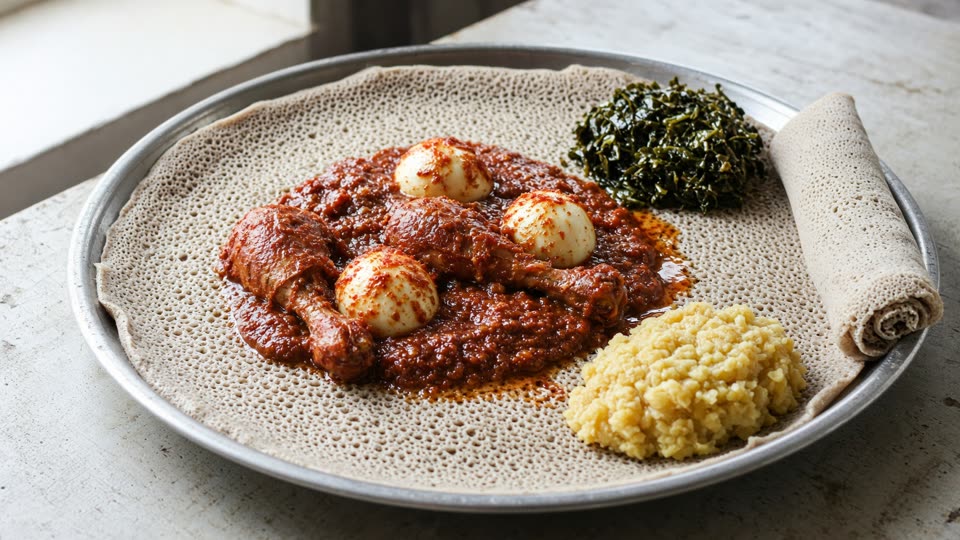
Dorho tsebhi
The chicken stew that ends the fast. ጸብሒ, tsebhi, is the Tigrinya word for a stew, and it is the centre of an Eritrean meal — poured onto the bread rather than served beside it. Dorho tsebhi is the chicken one, built on berbere, the spice mixture that «accompanies almost all dishes»; zigni is the same thing with beef, and alicha is the version made without berbere at all.
For the Geʽez Christmas, after six weeks without meat or dairy, a sheep is killed. What reaches the bread after that is the point of the fast rather than an accompaniment to it.
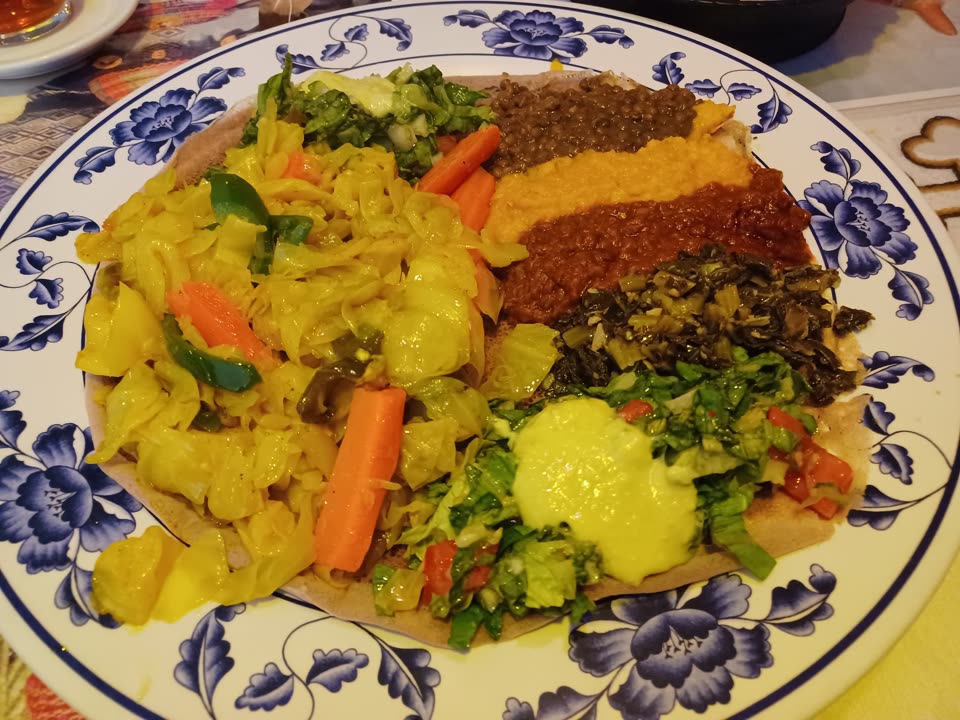
The bread is the plate. A wide sour pancake of fermented teff, spread over a tray, with the stews spooned straight onto it — there are no dishes under them and no cutlery over them. You tear the edge and lift the stew with it, and at the end the bread that has been under the food all along is itself the last course.
In Tigrinya it is ጣይታ, taita. English and Italian sources both call it injera when writing about Eritrea, and both words are in use.
Widely repeated claims about Christmas in Eritrea that do not survive
checking. Each one says what is actually the case, because a correction
with nothing in its place leaves you worse off than before.
Contradicted
Eritrea keeps Christmas on 7 January because it uses the Julian calendar, like Russia and Serbia.
What is actually the case. Eritrea uses the Geʽez calendar, which is not the Julian calendar. It has thirteen months — twelve of thirty days and a short one of five or six — it begins its year on 11 September, and it numbers its years seven or eight behind the Gregorian ones because it dates the Annunciation differently. The patriarch's Christmas blessing for 7 January 2022 is dated 29 Tahsas 2014.
The two systems do land on the same morning, and not by accident: both keep a leap day every fourth year with no century exception, so the thirteen-day gap between them is permanent. 29 Tahsas is 25 December Julian and always will be, and both move to 8 January in 2101. But arriving at the same place is not travelling by the same road, and Eritrea's road starts in Alexandria rather than in Rome.
Eritrean Christmas is Ethiopian Christmas — same church, same calendar, same country for most of its history.
What is actually the case. The calendar is shared and the liturgical tradition is shared. The church is not: the Eritrean Orthodox Tewahdo Church has been autocephalous since 1993, granted by Alexandria rather than by Addis Ababa, and the Ethiopian church objected to how it was done.
And the practice diverges where it matters to this page. Eritrea keeps two Christmases, a fortnight apart, and the December one is widespread enough that the state's own paper writes features about the generational split it causes. Ethiopia's record describes no such second date. Eritrea's festive stew is dorho tsebhi and not doro wat, because the language is Tigrinya. Its colonial language is Italian and the colony lasted from 1890 to 1941, where Ethiopia's Italian period was five years and left almost nothing.
The country is also about half Muslim, on contested figures: estimates of the Christian share run from 47 to 63 per cent depending on the source, against a 2010 government survey's 61.4.
The 25 December Christmas in Eritrea is the Catholic one, left behind by the Italians.
What is actually the case. Nothing found supports it, and one thing cuts against it. Eritrea's Catholics are not Latin-rite: the Eritrean Catholic Church celebrates in the Alexandrian Rite in Geʽez, and there is no Latin-rite diocese in the country at all. Its Ethiopian counterpart keeps the Nativity on 29 Tahsas, the same day as the Orthodox.
What the Eritrean sources actually describe is a secular and recent observance: trees outside cafés, parties, postcards, and a divide that runs by age rather than by denomination. «The Christmas celebrated on December 25 was not as popular as it is today. Even today, it is young people in the urban areas that celebrate it more.»
So the honest verdict is that the Catholic explanation is not established rather than disproved. How 25 December arrived in Eritrea is an open question, and this page does not pretend to answer it.
Eritrean Christmas is partly Italian, and the proof is on the menu. Sixty years of Colonia eritrea left a cuisine with «unique interpretations of classic Italian dishes» — Eritrean-style lasagna, cotoletta alla milanese, frittata, pasta al forno, pizza, gelato, and spaghetti bolognese which Italian Wikipedia describes as «pasta al sugo e berbere», bolognese cut with the Eritrean spice mix. Espresso and cappuccino are served «in practically every bar and coffee shop in the capital», alongside the Eritrean coffee ceremony rather than instead of it. The national brewery was built in Asmara in 1939 and was called Melotti.
And panettone is on the list — the Milanese Christmas bread, kept in the Horn of Africa by a colony that ended in 1941.
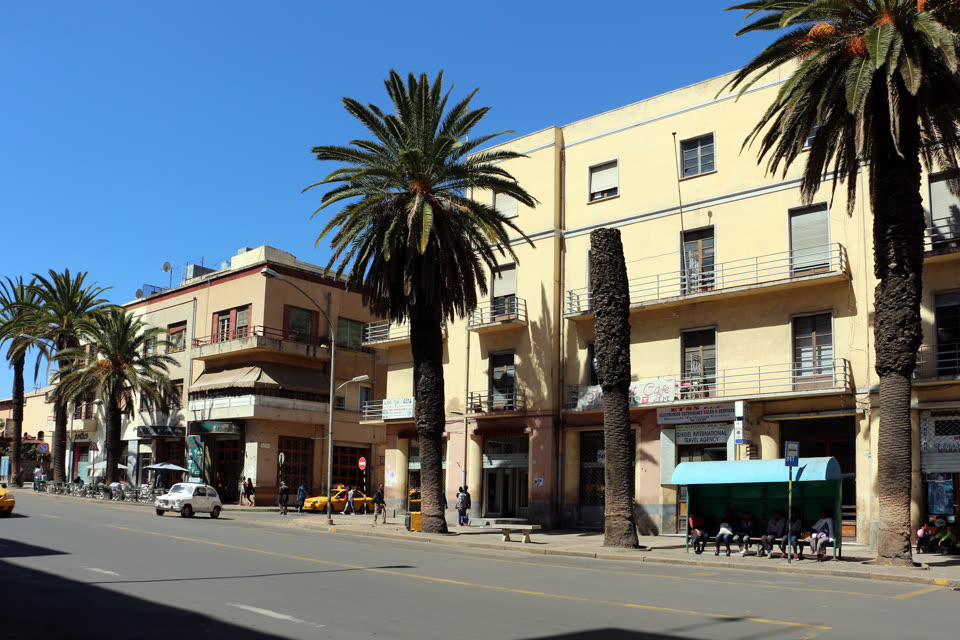
The street where the Christmas trees go up was called Viale Mussolini. Harnet Avenue — ጎደና ሓርነት, Freedom Avenue — runs through the middle of Asmara, and the city around it is so intact an example of 1930s Italian modernism that UNESCO inscribed it as a World Heritage Site on 8 July 2017: Eritrea's first. The cinema, the opera house, the palazzi and the cafés along it are the colonial city still standing, and in December the cafés put trees out on the pavement in front of them.
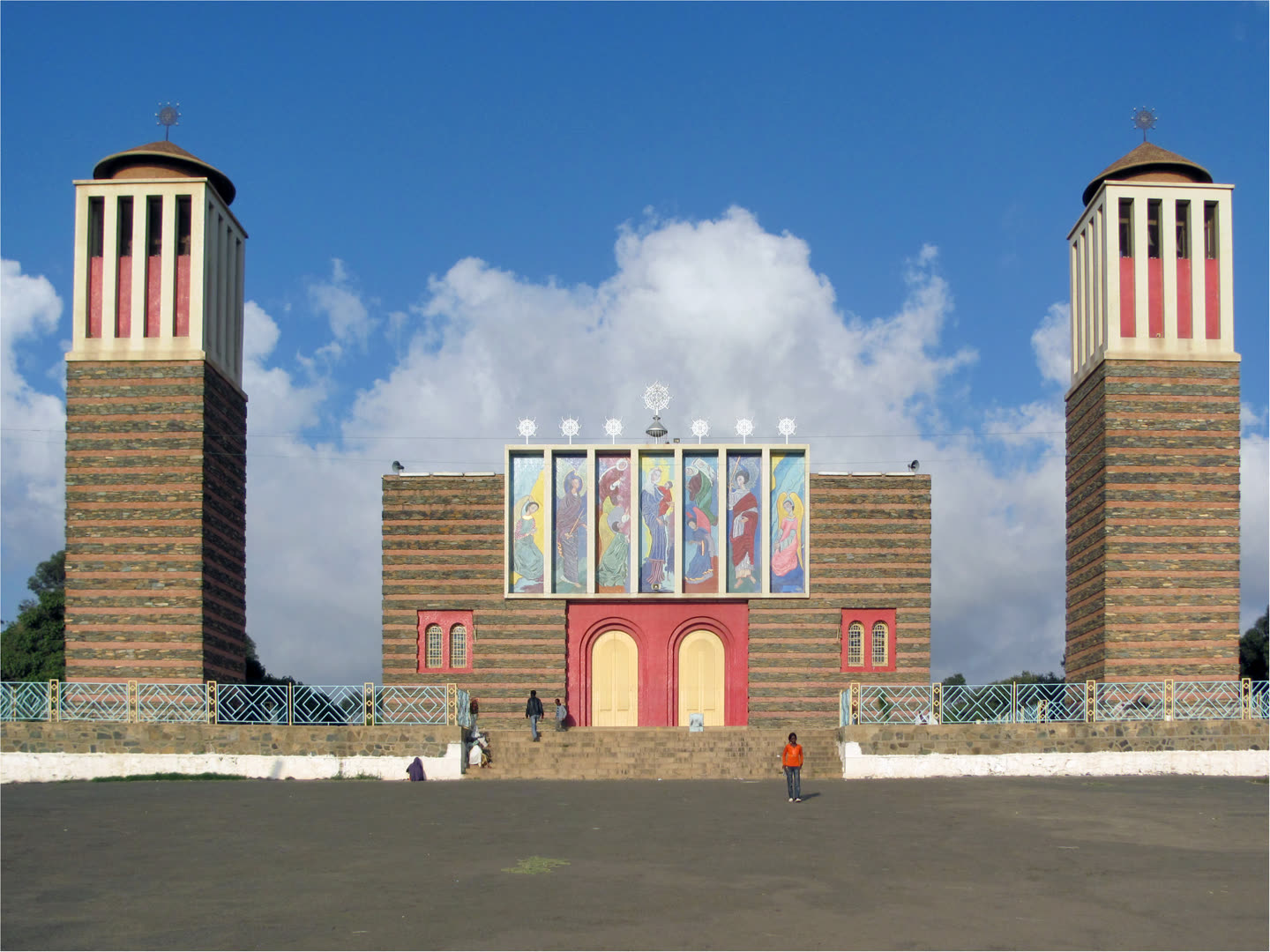
Eritrea's Catholics do not have a Latin-rite church to go to. The Eritrean Catholic Church was made a church in its own right only on 19 January 2015, when Francis separated it from the Ethiopian Catholic Church by the bull Multum fructum — four eparchies, Asmara, Barentu, Keren and Segeneiti. It celebrates in the Alexandrian Rite in Geʽez, the same liturgical language as the Orthodox Tewahdo church it is not in communion with, and there is no Latin-rite diocese anywhere in the country. The cathedral Italians built in Asmara in 1923, Our Lady of the Rosary, is still called the cathedral although the Latin vicariate it was built for was wound up in 1995.
The church that keeps this feast has been independent for barely thirty years. The Eritrean Orthodox Tewahdo Church was granted autocephaly by Shenouda III of Alexandria in 1993, after the country's independence, and it accords primacy of honour to the Coptic Church. Before that it was part of the Ethiopian church. The tradition is ancient and the institution is younger than most of the people keeping the feast — which is why nothing on this page is allowed to arrive by way of Ethiopia.
In Eritrea the way you learn that a patriarch is being removed is that his Christmas message does not come on. Abune Antonios was ordained third patriarch of the Eritrean Orthodox Tewahdo Church in April 2004 and spent his first year refusing things: refusing to excommunicate more than three thousand members of the Medhane Alem Sunday School movement, and demanding the release of three Orthodox priests imprisoned that November. In January 2005, for the first time ever, the traditional Orthodox Christmas message from the patriarch was not broadcast on Eritrean television or radio. Seven months later the Holy Synod stripped him of all administrative authority; in January 2006 it removed him altogether; and on 27 May 2007 he was taken from his home and held under house arrest at an undisclosed location, where he remained until he died on 9 February 2022 — a month after the ministry published his successor’s Christmas blessing.
It was not a one-off. When he appeared in public in July 2017 and was thought to have been freed, the thing that showed otherwise was the same: he did not deliver the televised Geʽez New Year blessing on 11 September.
Eritrea is in the year 2019. The Geʽez calendar it reckons the feast by runs seven to eight years behind the Gregorian one — the patriarch's 2022 Christmas message is dated 2014 — and its new year, Kudus Yohannes, falls on 11 September. Christmas is 29 Tahsas, the twenty-ninth day of the fourth month, and because the Geʽez calendar keeps the Julian leap rule, that date is locked to 25 December Julian permanently. Eritrea's Christmas and the Julian churches' Christmas land on the same morning by two routes that have nothing to do with each other, and will still be landing together in the year 3000.
Every claim on this page carries its own citation. They are collected
here so you can see what this page is built on, and how much of it comes from where.
Events Calendar 2026 — Embassy of the United States of America, Asmara. Retrieved 2026-10-11.The mission's own closure calendar, which marks every date as either «U.S.» or «Eritrean» because it has to close on both. «January 7 — Orthodox Christmas — Eritrean». «January 19 — Epiphany — Eritrean». And, tellingly, «December 25 — Christmas Day — U.S.», which is the embassy closing for its own country's holiday and not for Eritrea's.
This is NOT an Eritrean statute, and Ethiopia's record is sourced to the actual Negarit Gazette, so the difference should be stated plainly rather than smoothed over: Eritrea does not publish a gazette this project could reach, and shabait.com — the Ministry of Information, which does publish — carries no list of public holidays. A foreign mission's closure calendar is the best available and it is second-hand.
What makes it trustworthy enough to use is that it can be checked against the host state's own reporting, and it survives on three independent dates. The embassy lists Easter (Geez) on 12 April 2026, and shabait reports «Asmara, 12 April 2026 — Easter Holiday was colorfully celebrated nationwide today». It lists Kudus Yohannes on 11 September 2026, and shabait reports a public celebration for it in Gash Barka on 11 September 2026. It lists Epiphany on 19 January, and the Eritrean church's own printed calendar gives Timqet as 11 Tirr, which converts to 19 January. Three checks, three agreements, from three different kinds of source.
Eritrean cuisine — English Wikipedia. Retrieved 2026-10-11.«The main traditional food in Eritrean cuisine is tsebhi (stew), served with injera… Stews include zigni, made with beef; dorho tsebhi, made with chicken; alicha, a vegetable dish made without berbere; and shiro, a purée of various legumes.» The Tigrinya spelling ጸብሒ is from en:Wat (food), which gives the dish's names in three languages: «Wat or wet (Amharic: ወጥ) or ito (Oromo: Ittoo) or tsebhi (Tigrinya: ጸብሒ)». The slaughtered sheep is from «Eritrea's Christmas: Twin Holidays», shabait.com.
Injera — English Wikipedia. Retrieved 2026-10-11.«Injera, also known as taita (Amharic: እንጀራ; Tigrinya: ጣይታ; Oromo: buddeena), is a sour fermented pancake-like flatbread with a slightly spongy texture, traditionally made of teff flour.» en:Eritrean cuisine describes the Eritrean meal as «tsebhi (stew), served with injera (flatbread made from teff, wheat, or sorghum) and hilbet (paste made from legumes; mainly lentil and faba beans)».
Eritrean Catholic Church — English Wikipedia. Retrieved 2026-10-11.«In its liturgical services, it uses the Alexandrian Rite in the Geʽez language… the Eritrean Catholic Tewahedo Church is in full communion with the Pope of Rome, whereas the Eritrean Orthodox Tewahedo Church is not; both preserve the Geʽez Rite.» The absence of Latin-rite dioceses is it:Chiesa cattolica in Eritrea: «Poiché in Eritrea non ci sono diocesi di rito latino né di altri riti, la giurisdizione delle quattro eparchie si estende a tutti i cattolici.» The same article gives 155,463 baptised in a population of 5,748,000 at the end of 2010 — 2.7 per cent.
Eritrean Orthodox Tewahedo Church — English Wikipedia. Retrieved 2026-10-11.Autocephaly granted by Pope Shenouda III of the Coptic Orthodox Church of Alexandria in 1993. en:Christianity in Eritrea adds that the Ethiopian church has recognised the autocephaly «although it objected to the method in which the Coptic Church went about granting it», and that no Ethiopian representative attended the recognition.
Ethiopian calendar — English Wikipedia. Retrieved 2026-10-11.The Geʽez calendar used in Eritrea is the same calendar: «The Ethiopian calendar has twelve months, all thirty days long, and five or six epagomenal days». The correction is the same one Ethiopia's record carries, and it is repeated here rather than cross-referenced because a reader who arrives at Eritrea should not have to read about Ethiopia to be told the truth about Eritrea.
Christianity in Eritrea — English Wikipedia. Retrieved 2026-10-11.«various estimates placing Christianity (all denominations) as the religion of around 63% of the population». en:Religion in Eritrea gives Christian estimates of 47–53% against Muslim 37–52%, and cites the 2010 Eritrea Population and Health Survey (National Statistics Office with the Fafo Institute) at 61.4% Christian. The spread between the sources is itself the fact, and the page states it as a range rather than picking one.
The autocephaly is en:Eritrean Orthodox Tewahedo Church; the two Christmases are shabait.com.
Eritrean Orthodox Tewahdo Church Calendar — Holidays — Eritrean Orthodox Tewahdo Church, Diocese of the U.S.A and Canada. Retrieved 2026-10-11.A three-column table: the feast in Geʽez with its transliteration, the Geʽez date, the Gregorian date. Published by the North American diocese, so it is the Eritrean church speaking rather than the Eritrean state — fine for a feast, and the reason the public holiday on this record is cited to something else.
A trap on the way to it: the same church's English menu lists «The Nativity of Virgin Mary | Lideta leMaryam — May 9». ልደታ ለማርያም is MARY's nativity and a different feast, and a careless search for «Lidet» finds it first.
Asmara — Italian Wikipedia. Retrieved 2026-10-11.Inscribed 8 July 2017 for its modernist and rationalist architecture. The 1930s name is recorded on the Commons photograph «Viale Mussolini (today Harnet Avenue) in 1930s Asmara», from Bizen, H. and Sallinen, S., Asmara Beloved (Kimaathi Publishing House, 2002). The Christmas trees on the pavement are from Sabrina Solomon, «The Holiday Season», shabait.com, 25 December 2021.
Chiesa cattolica in Eritrea — Italian Wikipedia. Retrieved 2026-10-11.«Poiché in Eritrea non ci sono diocesi di rito latino né di altri riti, la giurisdizione delle quattro eparchie si estende a tutti i cattolici, indipendentemente dal rito di appartenenza.» The rite is en:Eritrean Catholic Church: «In its liturgical services, it uses the Alexandrian Rite in the Geʽez language.» The quoted description of 25 December is «Eritrea's Christmas: Twin Holidays», shabait.com.
ቃለ ቡራኬ በዓለ ልደት ጐይታናን መድኃኒናን ኢየሱስ ክርስቶስ — Ministry of Information of Eritrea (shabait.com), publishing the Eritrean Orthodox Tewahdo Church. Retrieved 2026-10-11.Signed ብጹዕ ወቅዱስ ኣቡነ ቄርሎስ ቀዳማይ, 5ይ ፓትርያርክ ኤርትራ ኦርቶዶክስ ተዋህዶ ቤተክርስቲያን, ኣስመራ — Abune Qerellos I, fifth patriarch, Asmara. Dated 29 Tahsas 2014 / 07/01/2022. The ministry carries one of these every 6 January; the archive holds 2021 through 2026.
ቃለ ቡራኬ ርእሰ ኣውደ ዓመት ቅዱስ ዮሓንስ ፳፻፲ወ፱ (2026) — Ministry of Information of Eritrea (shabait.com), publishing the Eritrean Orthodox Tewahdo Church. Retrieved 2026-10-11.The new-year blessing, published 10 September 2026, prints the Geʽez year beside the Gregorian: ፳፻፲ወ፱/2019. The embassy closure calendar lists «September 11 — Kudus Yohannes (Geez New Year) — Eritrean», and shabait reports a public celebration for it in Gash Barka on 11 September 2026. The Julian lock was computed from the calendar's own structure — 1 Meskerem is 29 August Julian, 29 Tahsas is 118 days later, which is 25 December Julian — and checked against three dates the ministry reported on the day and against the church's printed Timqet date.
Eritrea's Christmas: Twin Holidays — Natnael Yebio W., Ministry of Information of Eritrea (shabait.com). Retrieved 2026-10-11.Published 28 December 2023; the footer says «This Article was first published in 2019», and a 2019 copy is in the archive at the same site. The second writer is Sabrina Solomon, «The Holiday Season», shabait.com, 25 December 2021.
The Holiday Season — Sabrina Solomon, Ministry of Information of Eritrea (shabait.com). Retrieved 2026-10-11.Published 25 December 2021. The sheep and the house-cleaning are from the companion piece, «Eritrea's Christmas: Twin Holidays», same publisher.
Abune Antonios — Defending Freedoms Project — Tom Lantos Human Rights Commission, U.S. House of Representatives. Retrieved 2026-10-11.«In January 2005, the Patriarch’s annual Nativity message was not broadcast or televised and the Eritrean Holy Synod met in August 2005 with the main purpose of removing all executive authority from the Patriarch», and «Among the accusations brought against the Patriarch, were his reluctance to excommunicate 3,000 members of the Medhane Alem, an Orthodox Sunday School movement and his demands that the government release imprisoned Christians accused of treason.» Detained: May 27, 2007. No official charges, no official sentence.