Christmas Day in the United Kingdom is 25 December. It is a public holiday.
How to say it
English
Merry Christmas
Merry Christmas
A synthesised voice — not a recording of a person — saying Merry Christmas
in en-GB.
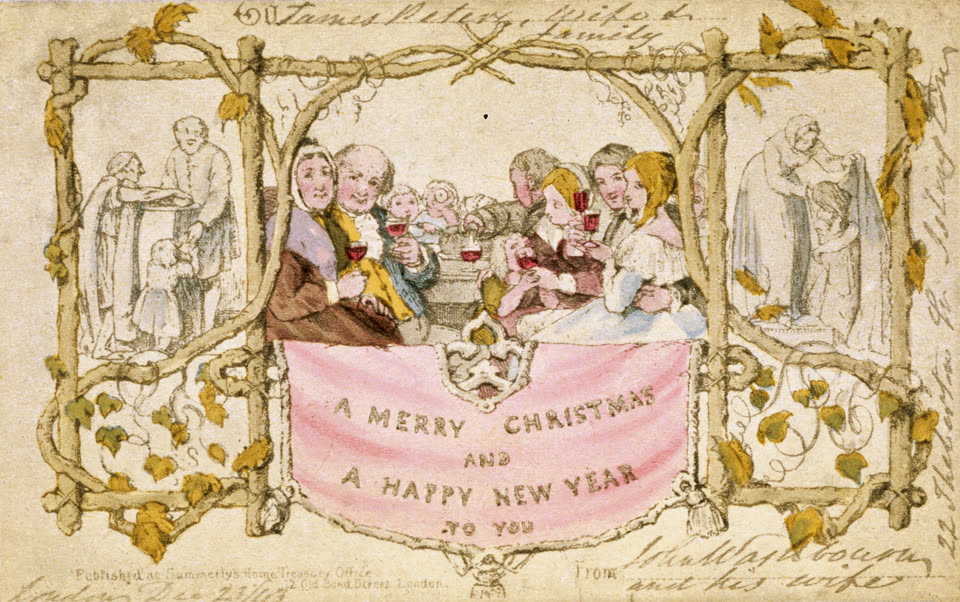
The formula is older than the card that mass-produced it, but the card is where it became something you post rather than something you say. The V&A, which holds the national collection of greetings cards, has one from 1860–80 catalogued under the words themselves.
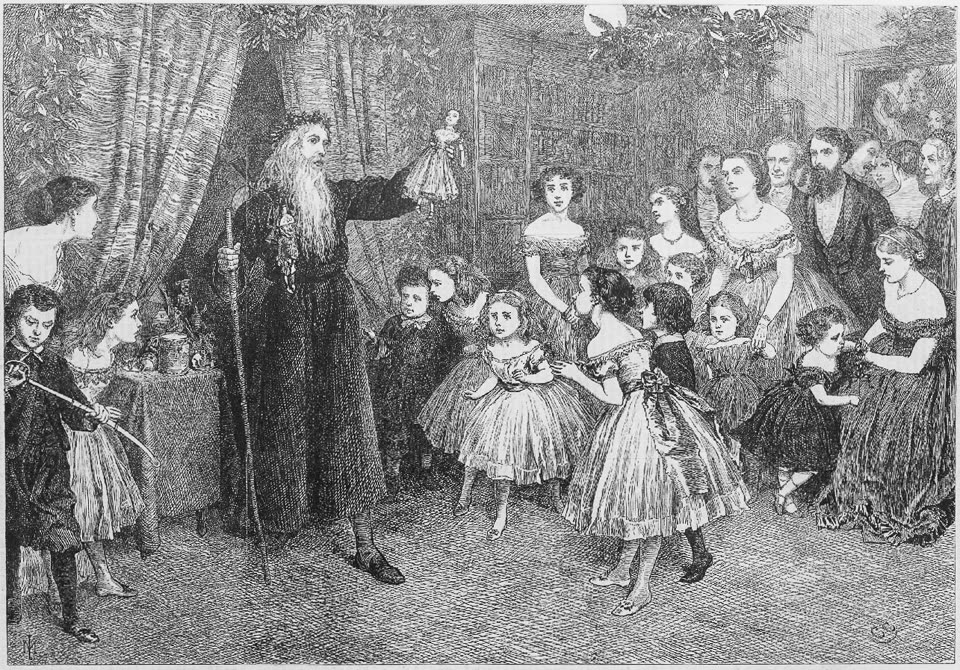
What turned him into a defendant was the attack on Christmas itself. In a pamphlet of 1645 a woman asks the Oxford town crier where old Father Christmas has gone, and is told that the poor old man was arraigned, condemned and cast into prison among the King's soldiers, in fear of being hanged. In 1658 he was put on trial for his life in print again — white beard, old-fashioned fur-trimmed gown — and acquitted by the jury. The gift-giving arrived much later, when Santa Claus crossed the Atlantic in the nineteenth century and the two figures merged.
The monarch speaks at three o'clock, and the hour was chosen by radio engineers
The Christmas Broadcast is the fixed point of the British Christmas afternoon, and the reason it is at three has nothing to do with lunch. The first one was George V's, on Christmas Day 1932, from a small office at Sandringham — the idea was the BBC's founder John Reith's, and its purpose was to inaugurate the Empire Service, now the World Service. Three o'clock was picked because it was the best time to reach most of the Empire by short wave from transmitters in Britain. Two rooms at Sandringham were converted, Post Office land lines ran to Broadcasting House, and from there to the Empire station at Daventry and its six short-wave transmitters. The text was written by Rudyard Kipling. It lasted two and a half minutes.
The carol service the world hears was written for a wooden shed in Truro
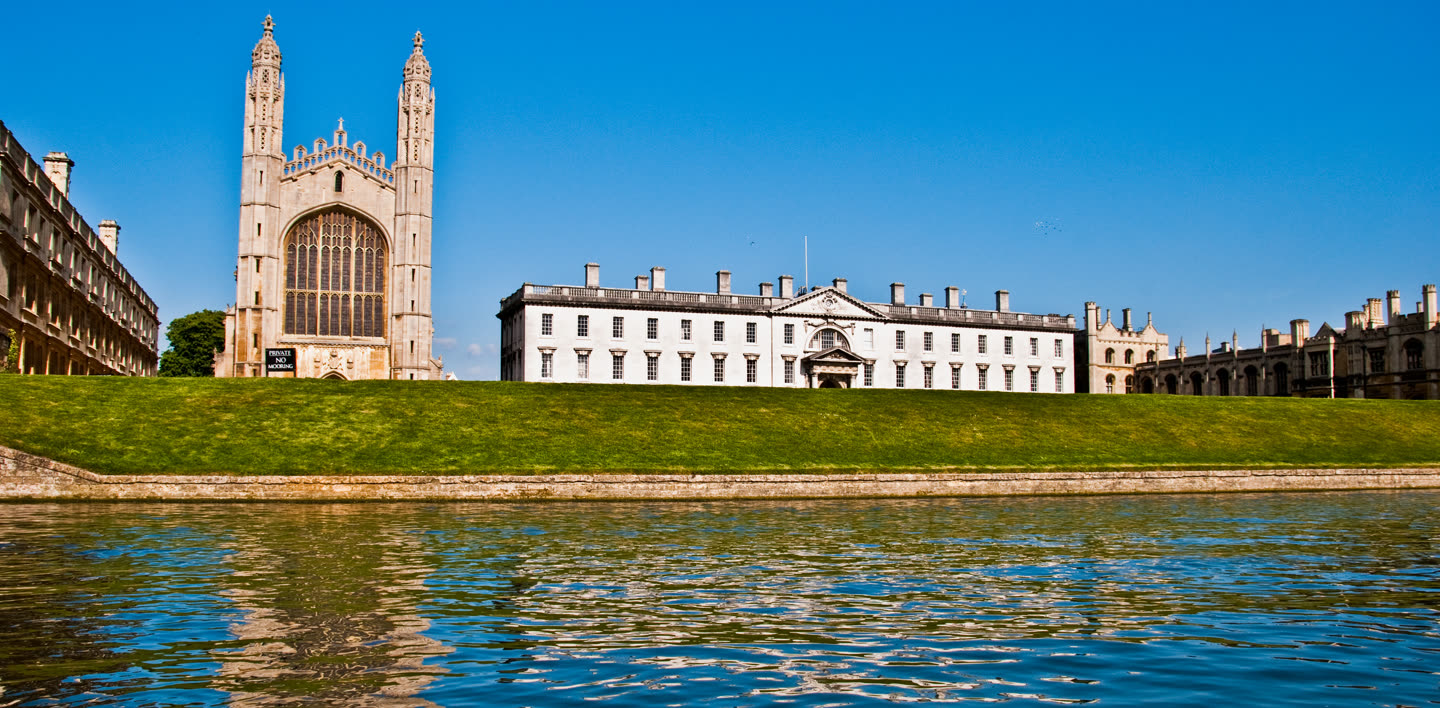
A Festival of Nine Lessons and Carols was first held at King's College, Cambridge on Christmas Eve 1918, planned by a 34-year-old newly appointed Dean, Eric Milner-White, whose time as an army chaplain had convinced him the Church of England needed more imaginative worship. He adapted it from an order drawn up by E. W. Benson for use at 10pm on Christmas Eve 1880 in the wooden shed then serving as his cathedral at Truro. Since a revision in 1919 it has always opened with Once in royal David's city. It was first broadcast in 1928 and, apart from 1930, every year since — including through the Second World War, when the chapel had lost its ancient glass and all its heat, and the name of King's could not be said on air.
The Christmas card was invented by a man who was behind on his post
Henry Cole sent the first Christmas card in 1843. He was a civil servant who had helped set up the Uniform Penny Post — which is the point, because cheap postage had created the problem he was solving. Christmas was busy, unanswered mail was piling up, and a card you could print a thousand of and fill in by hand was a time-saving device. He asked his friend John Callcott Horsley to draw it: three generations of the Cole family raising a toast in the middle, framed by scenes of giving, so the card said celebration and charity at once. Cole went on to become the first director of the V&A, which is why the museum now holds the national collection of over 30,000 greetings cards.
The cracker is a French sweet with a bang added, and it was first sold as a Cossack
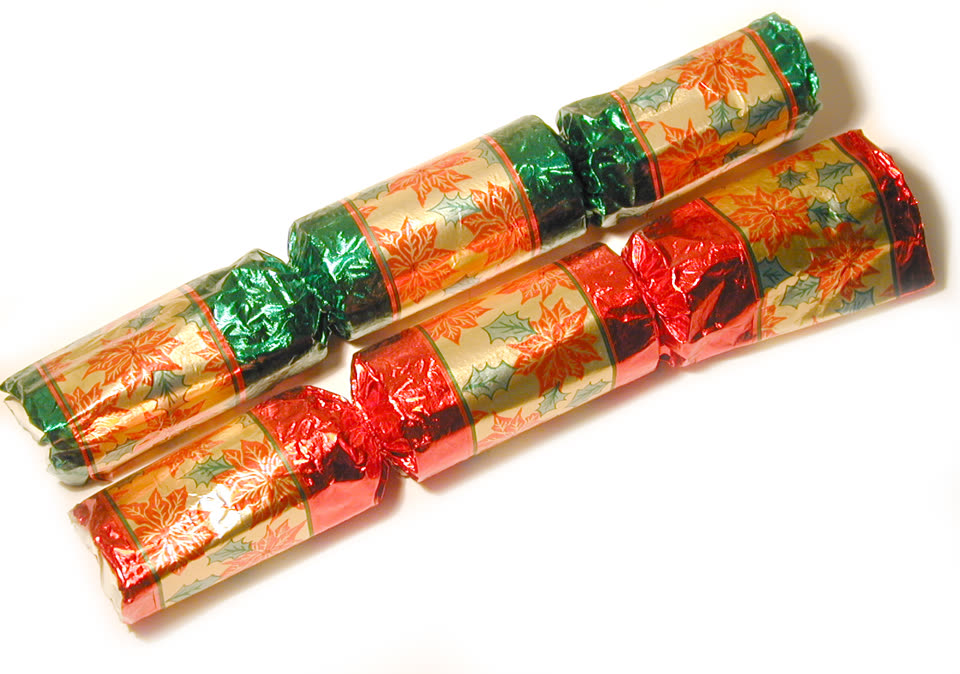
Tom Smith ran a confectionery business in Clerkenwell. In Paris in 1840 he found bon bons — sugared almonds twisted in tissue paper — and sold them well at Christmas; the next year he put a love motto inside the twist and sold more. The bang came later and, the story goes, from throwing a log on his own fire: he wanted that crack inside the novelty, and got it with two chemically treated cardboard strips glued together so that two people pulling the ends set it off. Historic England dates the cracker to 1847. He did not call it a cracker. He called it a Cosaque, after Cossack soldiers and their habit of firing into the air.
Christmas was abolished by ordinance of Parliament, and replaced with the second Tuesday of the month
On 8 June 1647 the Lords and Commons ordained that the Feast of the Nativity of Christ, Easter and Whitsuntide, and all other festival days commonly called holy days, be no longer observed within the Kingdom of England and the Dominion of Wales — notwithstanding any law, statute, custom, constitution or canon to the contrary. It was not a gesture. Earlier measures had been building since 1643, shops were ordered to open on 25 December, and in the City of London soldiers were sent to patrol the streets and seize food being cooked for Christmas. What the ordinance put in the holiday's place is the detail that sticks: scholars, apprentices and servants were to have the second Tuesday of every month for recreation instead — with their master's leave first obtained.
Scotland abolished Yule twice, and what Parliament abolished was the courts’ holiday
The Scottish suppression came in two different kinds of instrument, and only one of them was about worship. In 1575 the General Assembly of the Church of Scotland abolished every day that had been kept holy except the Sabbath, naming Yule day and the saints’ days among them. What Parliament abolished, in 1640 and again in 1690, was narrower and more practical: the Yule Vacance, the holiday the courts kept. The 1640 Act gave its reason as the Kirk being now purged of all superstitious observation of days, and discharged the vacance and all observation of it in time coming. Part of each Act was later repealed, the first in 1686 and the second in 1712, and the Church of Scotland went on discouraging Yule after both.
Schedule 1 of the Banking and Financial Dealings Act 1971 lists the bank holidays for England and Wales, and 25 December is not among them. What is there is the 26th, and the 27th in a year when the 25th or 26th falls on a Sunday. Christmas Day is absent because it never needed adding: it is a common-law public holiday in England, Wales and Northern Ireland, older than the statute and not made by it. Scotland is the other way round: its paragraph of the same schedule names Christmas Day outright.
The wassail goes to the orchard, and it is the trees that are toasted
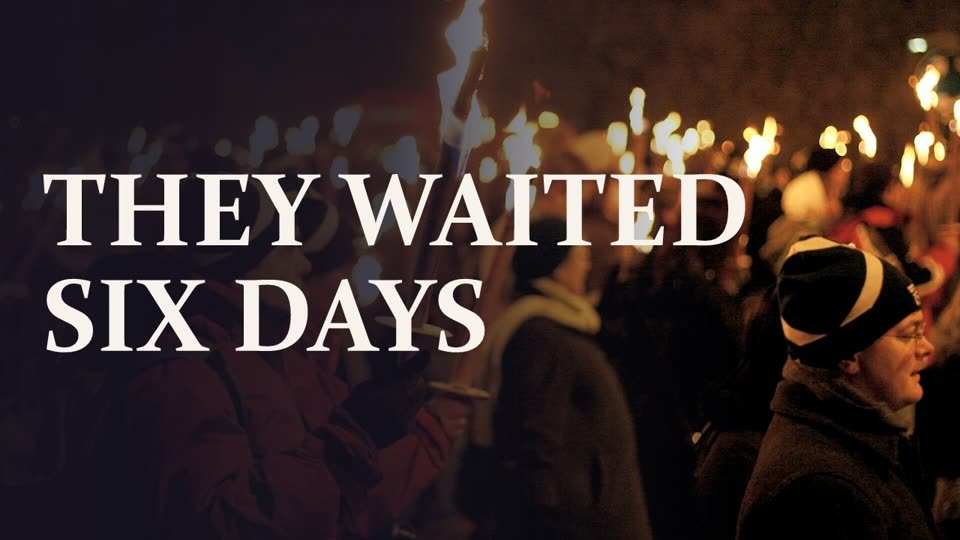
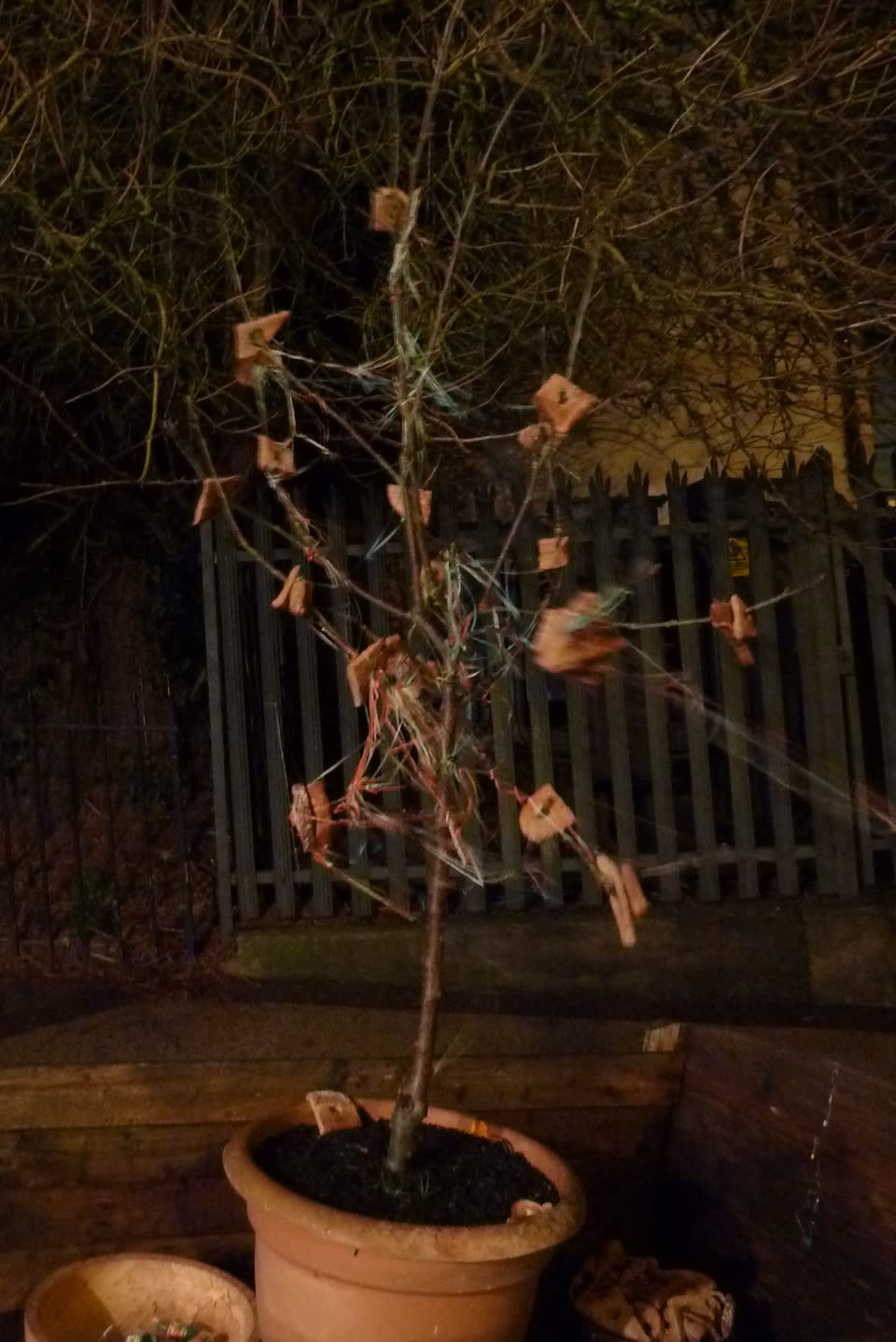
On Twelfth Night the party went out to the apple and pear trees and made a deliberate racket – singing, dancing, and banging pots and pans – to drive the bad spirits out of the orchard and keep the rest of them content, so that the next year's fruit would come. The owner of the orchard paid for it in warm spiced drink from a bowl everyone drank out of, sometimes with roast apple floating in it under the name lamb's wool. A second form of the same custom went house to house rather than tree to tree, drinking the health of whoever lived there, and that is where the word comes from: wassail is the Old English was hál, be hale, good health. It is still done in the parts of Britain that still have orchards.
A horse's skull comes to the door, and you have to sing before it comes in
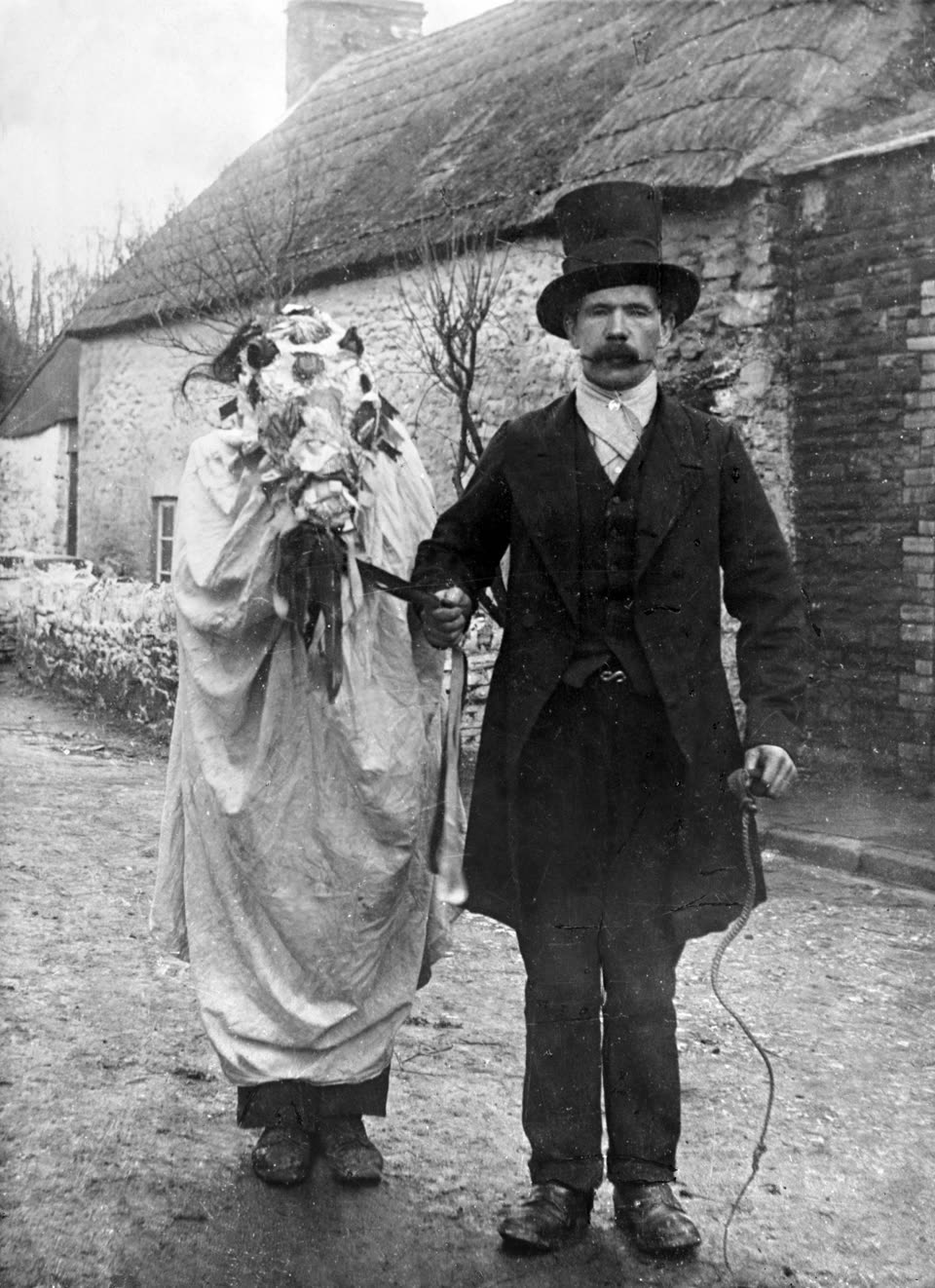
Over the Christmas period in parts of south Wales a horse's skull, dressed and carried, went from house to house, and the way in was singing: the party at the door sang verses to be let in. The national museum of Wales keeps one of them, bought in 1971 and dated to the early twentieth century, from Llangynwyd in the Llynfi valley. It is 107 centimetres tall and it is made of bone, cloth, glass, wood, steel and paper.
People were called before the kirk session and made to repent for keeping Christmas, Aberdeen 1574 and Glasgow 1583
What the Reformed church did about Yule is written down in the minute books of the local kirk sessions, and the national archive quotes two of them. At St Nicholas in Aberdeen, in December 1574, fourteen women were admonished for «plaing, dansink & singin off filthe karrellis on youll day» — playing, dancing and singing filthy carols on Yule day. At Glasgow, on 26 December 1583, five people were ordered to make public repentance for keeping Yule.
The two are not quite the same penalty, and the difference is the texture of the thing: Aberdeen admonished, Glasgow required a public act. Alongside them the sessions were still failing to stamp out playing cards and dice, masked dancing with bells, selling yule loaves, cross-dressing and «extraordinary drinking». The suppression is real, and so is the evidence that it did not take.
The Bank Holidays Act 1871 gave Scotland its own schedule including Christmas Day, where the England and Ireland schedule omits it
The Act that invented the bank holiday has one Schedule and two lists in it, stacked one above the other. England and Ireland get Easter Monday, the Monday in Whitsun week, the first Monday in August, and 26 December if it is a week day. Scotland gets New Year's Day, Christmas Day, Good Friday, the first Monday of May and the first Monday of August — with an indented proviso after the first two: if either of those days falls on a Sunday, the following Monday is the bank holiday.
So Christmas Day is named for Scotland in 1871 and is not named for England, which reads backwards until you see why. England did not need it. The Act's own section 3 measures every new bank holiday against what nobody would be compellable to do «on Christmas Day or Good Friday» — the two days the English common law already kept. A hundred years later the minister taking the replacement Bill through the Lords said it in as many words: before 1871 there were only two days, apart from Sundays, recognised at English common law as days on which the banks did not do business, and they were Good Friday and Christmas Day.
Naming a day in a statute is therefore not evidence that it was observed, and omitting one is not evidence that it was not. Scotland is in the Act because Scotland's law was silent; England is absent from it because England's was not.
In November 1971 the Minister of State at the Treasury told the Commons that a good deal of work goes on on the Christmas Day bank holiday in Scotland
Terence Higgins, moving the second reading of the Banking and Financial Dealings Bill on 12 November 1971, was explaining why the government would legislate for bank holidays rather than public holidays. His reason was that the two are not the same thing in every part of the United Kingdom, and Scotland was his example: «In Scotland, the only bank holiday which is generally observed as a holiday is New Year's Day. I understand that a good deal of work goes on on the Christmas Day bank holiday in Scotland.»
It is worth being exact about what that does and does not show. It is a minister's understanding rather than a count, and it is said a century after the 1871 Act put Christmas Day on the Scottish list. But it is the statement of the man in charge of the Bill, on the floor of the House, and it says that having the day in the statute book had not made it a day off.
In December 1971 Lord Drumalbyn told the Lords that the 1871 bank holidays came to be generally observed in England and Wales though not in Scotland
A month after the Commons debate, Lord Drumalbyn took the same Bill through the Lords and gave its hundred-year history. Sir John Lubbock's Act, he said, had prescribed certain days as close holidays in banks, and then something happened that the Act never provided for: «Although there was nothing in the Bank Holidays Act about this, the days prescribed in that Act gradually came to be fairly generally observed as public holidays in England and Wales, though not in Scotland.»
That is the whole asymmetry in one sentence, from the despatch box. A bank holiday is a rule about banks. South of the border it turned into a public holiday by custom and nobody legislated for it; north of the border it did not.
2 January became a bank holiday in Scotland from 1973 under the Banking and Financial Dealings Act 1971
The 1971 Act made three changes to the bank holidays, and the third applied only to Scotland. Its Schedule 1 adds a Scottish bank holiday on 2 January — or on 3 January when either 2 or 1 January falls on a Sunday — and Clause 1 provides that the first of them falls in 1973.
The reason given was arithmetic rather than sentiment. It brought Scotland to six bank holidays, matching the six bank and common-law holidays England and Wales had, and the minister in the Commons put it as a question of equity: Scottish banks had five against the English six. So the Act that is usually remembered in Scotland for Christmas Day is also the Act that gave the country a second day of Hogmanay, and it did that for a banking reason.
Scottish public holidays were arranged on a local rather than a national basis
Both Houses were told this in 1971, by the two ministers carrying the same Bill, five weeks apart. Higgins in the Commons: «In general, the practice in Scotland is for public holidays to be held on a local rather than a national basis, and in that situation bank holidays have little relevance to the dates and numbers of public holidays.» Drumalbyn in the Lords: «public holidays in Scotland are, for the most part, arranged on a local rather than a national basis and do not, on the whole, coincide with bank holidays.»
That is a fact about the shape of the Scottish holiday year and it is also the thing that makes a single national date for «when Christmas became a holiday in Scotland» hard to state. Trades holidays were fixed town by town. Two ministers said so on the record while legislating around it.
The arithmetic of Scotland's 59th Christmas in 376 years assumes a national date that does not exist
Historic Environment Scotland's timeline says Christmas «was abolished in 1640 by the Parliament of Scotland, and only became a public holiday in 1958», and concludes that 2016 was «Scotland's 59th Christmas holiday in 376 years». The sum is right: 2016 minus 1640 is 376, and 1958 to 2016 inclusive is 59. Both of the numbers it rests on are doing more work than the record supports.
The 1640 end is an Act about the courts. What the Scottish Parliament abolished, in 1640 and again in 1690, was the Yule Vacance — the winter recess of the courts of session — and the church's prohibition on observing the day was earlier and separate. The 1958 end names no instrument at all, which is why the national archive gives a different year, 1971, and points at one.
And underneath both is the assumption that there is a single national date to count from. In 1971 the ministers taking the bank holiday Bill through both Houses told Parliament there was not: Scottish public holidays were arranged locally, town by town, and did not on the whole coincide with the bank holidays. A tidy figure needs a national switch, and the thing nobody has produced is the switch.
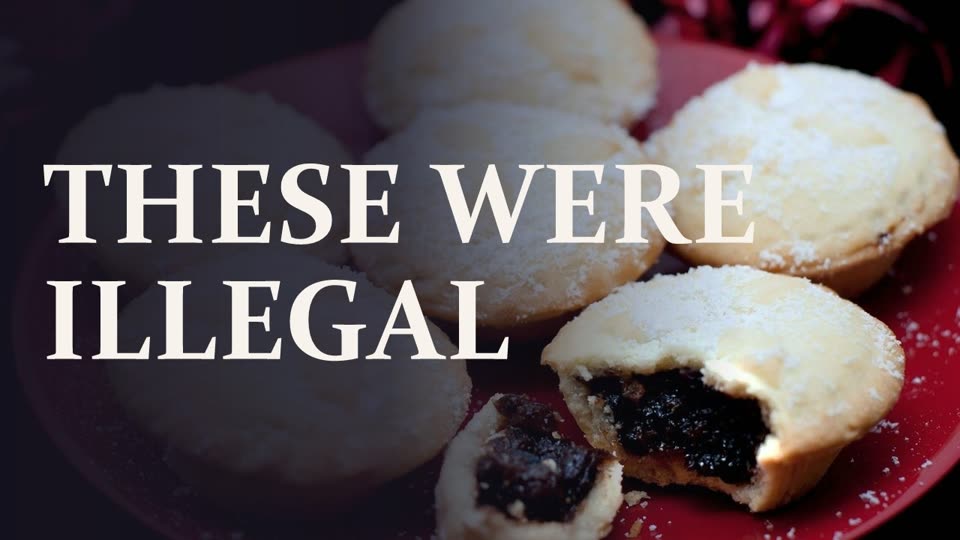
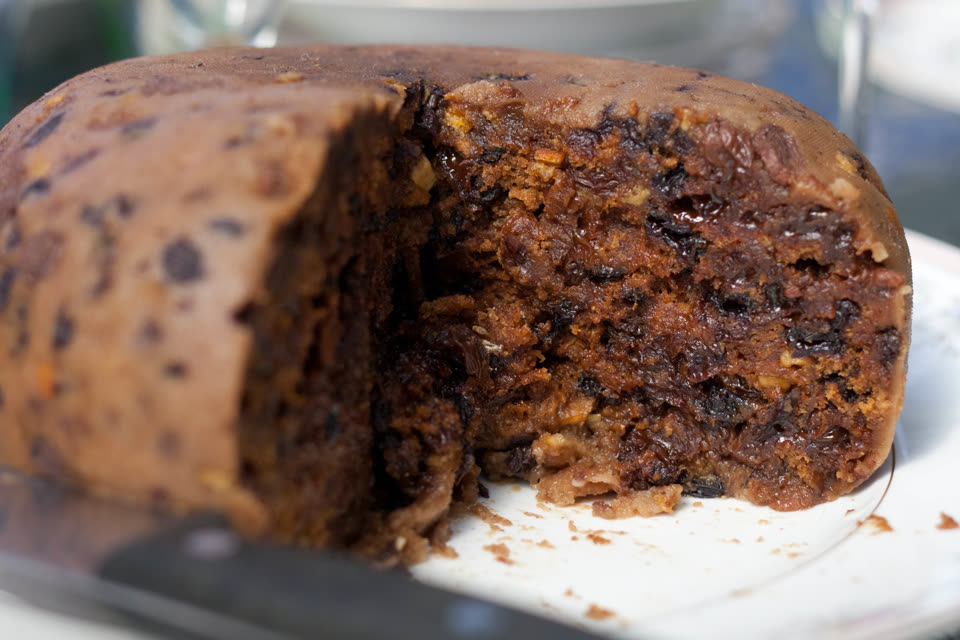
It began as a savoury first course. One of its earliest forms, in the sixteenth century, was a porridge of meat, root vegetables and dried fruit thickened with breadcrumbs, and it was eaten at the start of a meal rather than the end. The meat dropped out and left a suet pudding with plums in it — which were not plums but raisins soaked in wine or brandy. It was shaped into a sphere and boiled in a cloth, and the Navy issued its ships enough cloth for the sailors to boil theirs; steaming it in a basin or a mould came later, and in richer houses. By the Victorian period everyone expected one, and it had charms hidden in it: a silver coin for wealth, a ring for a marriage, a thimble for thrift or spinsterhood, a wishbone for luck, an anchor for safe harbour.
Widely repeated claims about Christmas in the United Kingdom that do not survive
checking. Each one says what is actually the case, because a correction
with nothing in its place leaves you worse off than before.
Oversimplified
Oliver Cromwell banned Christmas.
What is actually the case. Christmas was genuinely abolished in England and Wales, and Cromwell did not do it. The ordinance abolishing the feast was passed by the Lords and Commons on 8 June 1647, and the measures leading to it began in December 1643; Cromwell became Lord Protector in December 1653, six years after the abolition and ten after it started. Historic England, whose listed statue of him prompted the question, puts it that Cromwell did not initiate the banning of Christmas, though his rise to power did result in measures that severely curtailed the celebrations — and from 1656 there was legislation to catch people attending a Christmas church service. So the ban is real, the enforcement under the Protectorate is real, and the man in the story arrives most of a decade late.
What is actually the case. It is a common-law public holiday, which is a different legal animal and an older one. The Banking and Financial Dealings Act 1971 creates the bank holidays, and its list for England and Wales runs Easter Monday, the last Monday in May, the last Monday in August, 26 December and a substitute 27th. Christmas Day is not on it. In Scotland it is: the same schedule names Christmas Day explicitly in its Scottish paragraph. Northern Ireland follows England and Wales on this point.
A bank holiday means you have a legal right to the day off.
What is actually the case. Bank holidays are days on which financial dealings may be suspended. They carry no statutory right to leave. Whether a worker gets the day depends on their contract, and an employer may require attendance on a bank holiday if the contract or industry custom allows it. Most people do get the day; almost none of them get it because the law says so.
Carols from King's, broadcast on television, is the Christmas Eve service from King's College, Cambridge.
What is actually the case. They are two different services. A Festival of Nine Lessons and Carols is sung on Christmas Eve and goes out live on radio. Carols from King's is the televised one, and the college says plainly that it is a different service, recorded by the BBC early in December. The first television recording was a shortened version in 1954 and regular broadcasts began in 1963.
Father Christmas is simply the British name for Santa Claus.
What is actually the case. They are two figures that met and merged, and they were different in kind. Father Christmas was an English allegory of the season — old, bearded, presiding over adult feasting, with no connection to presents and no great dignity: English Heritage quotes the historian Ronald Hutton calling him generally a burlesque figure of fun. Santa Claus arrived from the United States in the nineteenth century, and he was the one who brought the gifts. The two converged, and the English name stayed on a figure whose job description came from somewhere else. The name is interchangeable now. The history is not.
When Parliament abolished Christmas it offered a substitute, and the substitute had a condition on it. Scholars, apprentices and servants were to get the second Tuesday of every month for recreation in place of the old holy days — but only with the leave and approbation of their masters, first had and obtained. If master and servant disagreed about it, the ordinance sent them to the nearest Justice of the Peace.
The first Christmas card was a commercial failure. A thousand were printed in 1843 and offered for sale at a shilling each, which was expensive, and the venture flopped. The artist, John Callcott Horsley, signed his own copy to Cole by drawing a tiny self-portrait in the bottom right corner instead of his name, dated «Xmasse, 1843».
The chemical snap that makes a cracker bang was requisitioned for the Second World War. Tom Smith's company was commissioned by the Ministry of Defence to supply large bundles of snaps, each tied with string, to training camps: pulling the string set off the whole bundle, and it sounded like machine-gun fire. The firm had become official supplier of crackers to the Royal Household in 1910 and still holds that warrant.
The custom is older than its name. The earliest use of «Boxing Day» recorded by the Oxford English Dictionary is from 1830s England, and the day it named was the first weekday after Christmas, kept as a holiday on which postmen, errand boys and servants of various kinds expected to receive a Christmas box.
Three years before the ordinance that abolished Christmas, Parliament had already ordered the day itself kept as a fast. 25 December 1644 fell on the last Wednesday of the month, which was the monthly fast day, and the instrument ordained that it be observed as one. Its own title calls the day the Feast of the Nativity of Christ while ordering it fasted.
When Christmas became a public holiday in Scotland is not settled in the official record. National Records of Scotland gives 1971. Historic Environment Scotland gives 1958. Both are national bodies and both state it flatly, thirteen years apart. What separates them is not confidence but evidence: the archive points to the instrument, the Banking and Financial Dealings Act 1971, whose schedule names Christmas Day in the Scottish paragraph and leaves it out of the one for England and Wales. The other names no instrument at all.
The cracker's famous 1847 is a patent, not a finished product. The museum that holds some of the oldest surviving crackers says Tom Smith patented his first cracker device in that year and did not get the mechanism right until the 1860s – two narrow strips of paper with silver fulminate on one and an abrasive on the other, so that pulling them makes a small explosion by friction. Nearly twenty years between the patent and the bang that works.
The Christmas cracker — Victoria and Albert Museum, London; last updated 17 April 2024
Sources
Every claim carries its own citation. They are collected below, so you
can see what the page rests on and how much of it comes from where.
June 1647: An Ordinance for Abolishing of Festivals — Acts and Ordinances of the Interregnum, 1642–1660, ed. C. H. Firth and R. S. Rait (HMSO, London, 1911), via British History Online. Retrieved 2026-10-18. archived 25 January 2026The primary text, headed «[8 June, 1647.] All Festivals and Holy Days abolished,; Time allotted for Recreation.»«Be it Ordained, by the Lords and Commons in Parliament assembled, That the said Feast of the Nativity of Christ, Easter and Whitsuntide, and all other Festival dayes, commonly called Holy-dayes, be no longer observed as Festivals or Holy-dayes within this Kingdome of England and Dominion of Wales, any Law, Statute, Custome, Constitution, or Cannon to the contrary in any wise notwithstanding»And the replacement, which is the part nobody repeats: «That all Scholars, Apprentices, and other Servants shall, with the leave and approbation of their Masters respectively first had and obtained, have such convenient reasonable Recreation and Relaxation from their constant and ordinary Labours on every second Tuesday in the moneth throughout the year»And is now «ordinance», which is the difference between a statute and what the Lords and Commons could pass without a king to assent to it.
December 1644: An Ordinance for the better observation of the monethly Fast — Acts and Ordinances of the Interregnum, 1642–1660, ed. C. H. Firth and R. S. Rait (HMSO, London, 1911), via British History Online. Retrieved 2026-11-12.The title of the instrument, which is the whole of the fact: «December 1644: An Ordinance for the better observation of the monethly Fast; and more especially the next Wednesday, commonly called The Feast of the Nativity of Christ, Thorowout the Kingdome of England and Dominion of Wales.»
Mari Lwyd, item F71.391 — Amgueddfa Cymru – Museum Wales, Collections Online. Retrieved 2026-11-13.The museum's catalogue record, in full: «Mari Lwyd from Llangynwyd, early 20th century. Over the Christmas period, a horse’s skull such as this would be carried from house to house in parts of south Wales. To gain entry they sang verses.»The same record gives the item number as F71.391, the acquisition as «Purchase, 1971», the height as 107cm against a length of 54 and a width of 28, and the materials as bone, cotton, glass, synthetic fabric, plastic, wood, steel and paper.
The History of Father Christmas — English Heritage (article by Tom Moriarty). Retrieved 2026-10-18. archived 19 August 2026On what he was: «From his earliest days until the 19th century, Father Christmas was a strictly allegorical figure.» and «He was often depicted as a merry old man who presided over festive parties, not a gentle giver of gifts.»On the oldest one: «The earliest evidence for a personified Christmas can be found in a 15th-century carol, in which a character called 'Sir Christëmas' shares the news of Christ's birth.»On the masque of 1616: «the character of 'Christmas' appears in old-fashioned clothes with a long thin beard, calling himself 'old Christmas' and 'old Gregorie Christmas'», arguing that he is «as good a Protestant as any in my parish», and «He brings with him several of his sons and daughters, each personifying a different tradition of the period, with names like ‘Misrule’, ‘Carol’, ‘Mince Pie’, ‘Mumming’ and ‘Wassail’.»On the trials: «the 1645 pamphlet 'The Arraignment, Conviction and Imprisonment of Christmas'», in which «The poor old man...was arraigned, condemned, and after conviction cast into prison amongst the King’s Souldiers; fearing to be hanged.» And «in 1658, a pamphlet entitled 'The Examination and Tryall of Old Father Christmas' depicted him as a man with a white beard and old-fashioned fur-trimmed gown. He's put on trial for his life, but thankfully for us, is acquitted by the jury.»The page prints «the world had to wait for the playwright Ben Johnson» and refers throughout to «Johnson's Christmas, His Masque».
Banking and Financial Dealings Bill, second reading — HL Deb 9 December 1971 vol 326 cc905-12 — Hansard, UK Parliament; Lord Drumalbyn moving the second reading. Retrieved 2026-11-16.At col 906, the common-law position stated by the minister in charge of the Bill: «Before 1871, there were only two days in the year, apart from Sundays, which were recognised under English Common Law as days on which the banks did not do business. They were Good Friday and Christmas Day.» And what happened next: «Although there was nothing in the Bank Holidays Act about this, the days prescribed in that Act gradually came to be fairly generally observed as public holidays in England and Wales, though not in Scotland.»At cc906-7, on the Scottish change: «the bank holidays listed in Schedule 1 of the Bill include an additional bank holiday in Scotland, to be held on January 2, or, when that day or January 1 falls on a Sunday, on January 3. Clause 1 provides that the first of these additional bank holidays in Scotland will be in 1973. This change will bring the number of Scottish bank holidays up to six, the same as the number of bank and Common Law holidays in England and Wales.» And: «public holidays in Scotland are, for the most part, arranged on a local rather than a national basis and do not, on the whole, coincide with bank holidays.»
Banking and Financial Dealings Bill, second reading — HC Deb 12 November 1971 vol 825 cc1453-67 — Hansard, UK Parliament; the Minister of State, Treasury (Mr Terence Higgins) moving the second reading. Retrieved 2026-11-16.At cc1454-5: «In Scotland, the only bank holiday which is generally observed as a holiday is New Year's Day. I understand that a good deal of work goes on on the Christmas Day bank holiday in Scotland.» And, a little later: «In general, the practice in Scotland is for public holidays to be held on a local rather than a national basis, and in that situation bank holidays have little relevance to the dates and numbers of public holidays.» He also gives the count: «at present Scottish banks enjoy only five bank holidays as against six bank and common law holidays in England and Wales.»
How Did Sweets & Fire Lead to the Invention of the Christmas Cracker? — Historic England, the public body for England's historic environment. Retrieved 2026-10-18. archived 27 March 2025«in 1847, almost by accident, Thomas Smith invented the Christmas cracker»On the bon bons and the motto: «Smith travelled widely, and in Paris in 1840 he discovered bon bons, sugared almonds wrapped in twists of tissue paper.» and «the following year Smith placed a small love motto in the tissue paper, increasing sales of the festive treat even more»On the bang: «Legend has it that inspiration for the 'crack' of the cracker came when Smith threw a log on his fire at home.» «Legend has it» is the source's own phrase.On the name: «Christmas crackers - which Smith initially named 'Cosaques' after Cossack soldiers who had a reputation for firing their guns into the air!»
Did Oliver Cromwell Really Ban Christmas? — Historic England, the public body for England's historic environment. Retrieved 2026-10-18. archived 21 September 2026A national heritage body on what surrounded the ordinance, and on how long it held: «From this point until the Restoration in 1660, Christmas was officially illegal.»On the enforcement: «shops and markets were told to stay open on 25 December, and in the City of London soldiers were ordered to patrol the streets, seizing any food they discovered being prepared for Christmas celebrations»On what came first: «In January 1645, Parliament produced a new Directory for Public Worship that made clear that festival days, including Christmas, were not to be celebrated but spent in respectful contemplation.», and before that a 19 December 1643 ordinance on keeping the midwinter period with humiliation rather than «by giving liberty to carnal and sensual delights».Historic England writes that «a 1644 ordinance confirmed the abolition of the feasts of Christmas, Easter and Whitsun». These are not in conflict — the 1640s produced a sequence of measures and the 1647 ordinance is the comprehensive one — but a reader meeting «1644» in one place and «1647» in another deserves to be told that both are real rather than left to assume one of them is a typo.And it did not go quietly: «the Puritans' prohibition of Christmas proved very unpopular, and pro-Christmas riots broke out»
Timeline: Christmas in Scotland — Historic Environment Scotland; article by Wendy Malkin, 20 December 2016. Retrieved 2026-11-16.The sentence the arithmetic comes from: «it was abolished in 1640 by the Parliament of Scotland, and only became a public holiday in 1958. This means that 2016 will only be Scotland’s 59th Christmas holiday in 376 years.»
Bank and public holidays (SN06170) — House of Commons Library, the research service of the UK Parliament. Retrieved 2026-10-18. archived 15 January 2026«In England and Wales, there are eight bank holidays, whilst there are nine in Scotland, and ten in Northern Ireland.»
A History of A Festival of Nine Lessons and Carols — King's College, Cambridge. Retrieved 2026-10-18. archived 12 April 2026«A Festival of Nine Lessons and Carols was first held at King's on Christmas Eve 1918.» and on the man: «It was planned by Eric Milner-White, who at the age of 34 had just been appointed Dean of King’s after experience as an army chaplain which had convinced him that the Church of England needed more imaginative worship.»ON TRURO: «The original service was, in fact, adapted from an Order drawn up by E.W. Benson, later Archbishop of Canterbury, for use in the wooden shed, which then served as his cathedral in Truro, at 10 pm on Christmas Eve 1880.» Benson's son recalled it as «a little service for Christmas Eve – nine carols and nine tiny lessons, which were read by various officers of the Church, beginning with a chorister, and ending, through the different grades, with the Bishop», and the suggestion itself came from a third man: «The suggestion had come from G. H. S. Walpole, later Bishop of Edinburgh.»On the hymn: «from that date the service has always begun with the hymn ‘Once in royal David’s city’»On the broadcasts and the war: «the service was first broadcast in 1928 and, with the exception of 1930, it has been broadcast annually, even during the Second World War, when the ancient glass (and also all heat) had been removed from the Chapel and the name of King’s could not be broadcast for security reasons»
Banking and Financial Dealings Act 1971, Schedule 1 — legislation.gov.uk, The National Archives. Retrieved 2026-10-18. archived 7 August 2026The England and Wales list in full, and the absence is the claim: «The following are to be bank holidays in England and Wales:— Easter Monday. The last Monday in May. The last Monday in August. 26th December, if it be not a Sunday. 27th December in a year in which 25th or 26th December is a Sunday.»And Scotland's paragraph, which does name it: «Christmas Day, if it be not a Sunday or, if it be a Sunday, 26th December.»
Christmas banned in Scotland — National Records of Scotland, the national archive. Retrieved 2026-11-11. archived 28 December 2023On the church prohibition, which came first and was about worship: «In 1575 the General Assembly of the Church of Scotland abolished ‘all days that hereto have been kept holy except the Sabbath day, such as Yule day, saints’ days and such others’.»On what Parliament did, which is narrower than the headline: «Changes in church government meant that in 1640 and again in 1690 Parliament abolished the ‘Yule Vacance’ observed by the courts.»The 1640 Act in the archive’s own modernisation of it: «…the Kirk within this kingdom is now purged of all superstitious observation of days…therefore the said estates have discharged and simply discharge the foresaid Yule vacation and all observation thereof in time coming»On the repeals, and on what they did not end: «While part of each act was repealed in 1686 and 1712 respectively, the Church of Scotland continued to discourage ‘Yule’ celebrations.»The archive credits the act’s text to «Records of the Parliaments of Scotland to 1707 (www.rps.ac.uk)».
Boxing Day’s journey from Pepys to shopping petitions and parliament — Nelson Blackley, Research Associate at the National Retail Research Knowledge Exchange Centre, Nottingham Business School, Nottingham Trent University, in The Conversation. Retrieved 2026-11-11. archived 30 November 2023«The Oxford English Dictionary claims the earliest use of the term “Boxing Day” is from 1830s England. It was “the first weekday after Christmas Day, observed as a holiday on which post-men, errand-boys, and servants of various kinds expect to receive a Christmas box”.»
The proof is in the pudding — Royal Museums Greenwich, Library and Archive. Retrieved 2026-10-18.«One of its earliest forms in the sixteenth century was a porridge made with meat, root vegetables and dried fruit, thickened with bread crumbs. This was usually eaten at the beginning of a meal rather than at the end. Eventually the meat disappeared from the dish and it became a suet pudding with plums» and «These were not actual plums but raisins soaked in wine or brandy.»It is a maritime museum writing about the thing it is the national collection for: «Even the Navy would be sure to supply its ships with enough cloth so the sailors could boil their puddings. This practice eventually gave way to steaming the dessert in a pudding basin or elaborate mould, particularly in wealthier households.»On the charms: «A silver coin which signified wealth A ring to represent a future marriage A thimble meant spinsterhood or thrift A tiny wishbone to bring good luck An anchor to symbolise safe harbour»It says the pudding was «banned in 1647 by Oliver Cromwell».
Wassailing: ritual and revelry — Sally-Anne Huxtable, former head curator, National Trust. Retrieved 2026-11-13.The National Trust's curator on what it is and when: «Wassailing is a Twelfth Night tradition with pagan roots and has been practised in Britain for centuries.» and «The purpose is to encourage the spirits into ensuring a good harvest the following season. It takes place on the twelfth night after Christmas and involves a visit to a nearby orchard for singing, dancing, drinking and general merrymaking.»On the noise and the payment: «Revellers typically visited local orchards and fruit trees, sang songs, made a hullabaloo (often by banging pots and pans) and were rewarded by the orchard’s grateful owner with some form of warm, spiced alcoholic drink from a communal wassail bowl or cup. Sometimes a topping of apple, known as ‘lamb's wool’, would be added.»On the second form, and on the word: «Another form the wassailing tradition took involved groups of revellers going from house to house to drink toasts and wish good health for the year ahead on the dwellers within. Indeed, the word ‘wassail’ is believed to be derived from the Old English ‘was hál’, meaning ‘be hale’ or ‘good health’.»
Bank Holidays Act 1871 (34 & 35 Vict. c. 17), sections 1 and 3 and the Schedule — The National Archives / legislation.gov.uk, Open Government Licence v3.0; King's Printer copy of the Act as enacted, royal assent 25 May 1871. Retrieved 2026-11-16.«Bank Holidays in England and Ireland. Easter Monday. The Monday in Whitsun week. The first Monday in August. The twenty-sixth day of December, if a week day.» Then «Bank Holidays in Scotland. New Year's Day. Christmas Day.» — and an indented proviso before the rest, «If either of the above days falls on a Sunday the next following Monday shall be a bank holiday.» — then «Good Friday. The first Monday of May. The first Monday of August.»The proviso's wording and its position matter: «either of the above days» reaches New Year's Day and Christmas Day and nothing below it. Section 1 requires the schedule days to be kept «as close holidays in all banks in England and Ireland and Scotland respectively». Section 3 sets the benchmark in the Act's own words: nobody is compellable to make a payment or do an act on a bank holiday «which he would not be compellable to do or make on Christmas Day or Good Friday».
The Christmas Broadcast — The Royal Household, royal.uk. Retrieved 2026-10-18. archived 7 October 2026«The original idea for a Christmas speech by the Sovereign was mooted in 1932 by Sir John Reith, the visionary founding father of the BBC, to inaugurate the Empire Service (now the BBC World Service).»On the hour: «The time chosen was 3.00pm - the best time for reaching most of the countries in the Empire by short waves from the transmitters in Britain.»On the plumbing: «Two rooms at Sandringham were converted into temporary broadcasting rooms.» and «the Empire Broadcasting Station at Daventry with its six short-wave transmitters»On Kipling and the length: «The text of the first Christmas speech was written by poet and writer Rudyard Kipling», and «the first Broadcast started at five past three (twenty-five minutes to four according to the King's 'Sandringham Time') and lasted two and a half minutes».The opening line is worth having whole: «I speak now from my home and from my heart to you all; to men and women so cut off by the snows, the desert, or the sea, that only voices out of the air can reach them.»
The first Christmas card — Victoria and Albert Museum, London. Retrieved 2026-10-18. archived 9 October 2026The museum lists the object by its greeting: «'A Merry Christmas' (card with paper lace), unknown, 1860 – 80, England. Museum no. E.1925-1953.»
The Christmas cracker — Victoria and Albert Museum, London; last updated 17 April 2024. Retrieved 2026-11-13.The museum on what it holds: «Our collections contain some of the earliest examples of this popular paper novelty.»And on the two dates: «Smith patented his first cracker device in 1847 and perfected the mechanism in the 1860s. It used two narrow strips of paper layered together, with silver fulminate painted on one side and an abrasive surface on the other – when pulled, friction created a small explosion.»The same article hedges the log-fire story the way Historic England does, in its own word: «The inspiration to add the explosive ‘pop’ was supposedly sparked by the crackling sound of a log fire.»