Christmas Day in Denmark is 25 December. It is a public holiday.
How to say it
Danish
Glædelig jul
Glædelig jul
say it: GLEH-dhuh-lee YOOL
A synthesised voice — not a recording of a person — saying Glædelig jul
in da-DK.
The stød on jul — the catch in the voice that Danish spelling does not mark and that separates hund from hun — is the ˀ in the transcription, and it is the part a foreign speaker loses first.
glædelig; jul — Den Danske Ordbog, Det Danske Sprog- og Litteraturselskab
An old man with a long white beard in a red suit, who brings the presents on Christmas Eve. He is a recent Dane: the country took him from the English-speaking world between the wars and he displaced the nisser, who had the job before him. Even the name is borrowed — julemanden is a translation of the German Weihnachtsmann.
The evening is the 24th, and the 24th is not a holiday
Danish Christmas happens on juleaften, the evening of 24 December: the meal, the tree, the presents, all of it. The two days the state calls holidays are the 25th and the 26th, and the 24th is neither. What closes the shops that day is a different law — the lukkelov, which lists juleaftensdag beside constitution day and New Year's Eve after three in the afternoon. Whether anybody gets the day off is a question for their collective agreement rather than for the calendar.
From 2027 a small enough town may open its shops on Christmas Eve
The closing law changes on 1 January 2027. Shops in the town centres of towns with fewer than 16,850 inhabitants will be allowed to open on the days the lukkelov otherwise closes, Christmas Eve among them. Which towns qualify is not written into the law: the Danish Business Authority publishes the list, and publishes it again every year.
The rice porridge was a starter, and its job was to take the edge off
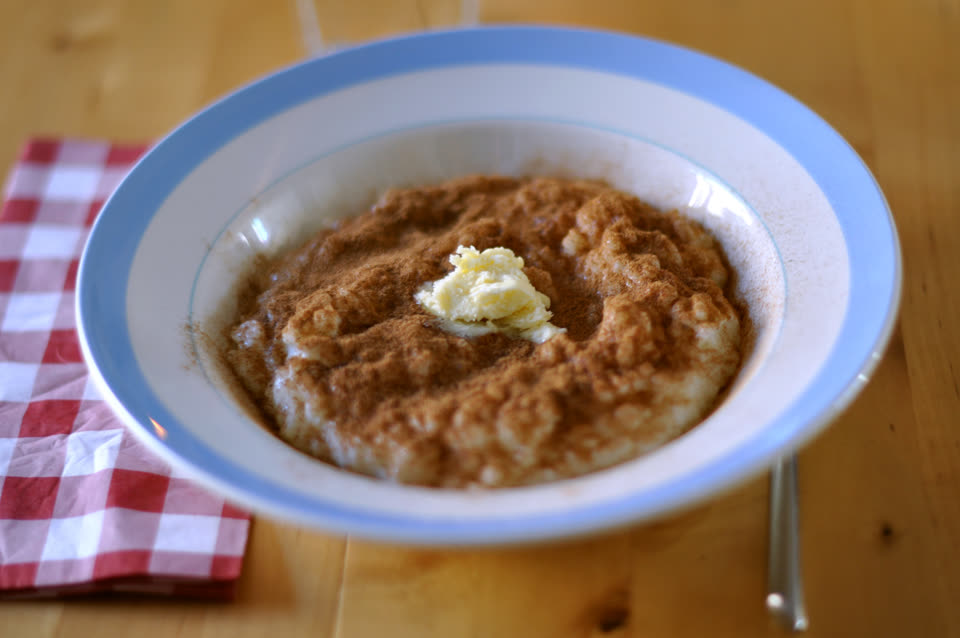
Before it was a dessert the Christmas porridge was a first course, and it came first on purpose: a bowl of rice boiled in milk put a lid on the appetite so that less of the meat went. That was ordinary practice on weekdays as much as at feasts. Industrialisation and money moved it to the end of the meal, where it turned into risalamande.
There is a nut in the porridge, and in the older version the prize was arranged in advance
A whole almond is hidden in the bowl and whoever finds it wins a present. The older country version used a nut rather than an almond and the prize was not a present: it was a kiss, settled beforehand between the girls and the farmhands. In some districts they went further, and said that whoever got the nut would be married before the next Christmas.
The master of the house took three helpings, one for rye, one for barley, one for oats
In the farming household the man of the house served himself first, and when the Christmas porridge came to the table he took from it three times: once for the rye, once for the barley, once for the oats. It was not greed and it was not manners — it was the household securing next year's crop. The woman of the house had already cut a cross into the surface of the porridge and set a knob of butter in it.
Almost everything on the Danish tree was imported, and the record says from where
The tree and the glass ornaments on it came from Germany in the 1800s, and the tree became the centre of the middle-class family Christmas. Between the wars Denmark took the julemand from the English-speaking world, and he gradually pushed the nisser out of the job of giving the presents. After the Second World War the borrowing turned to Sweden: the straw goat, the Lucia procession and gløgg all came from there.
jul — Caroline Nyvang, Jørgen Stenbæk, Iørn Piø and Jørn Lund — Lex (Den Store Danske), Denmark's national encyclopaedia
In the 1920s the labour movement hung red flags on the tree and rewrote the carols
Parts of the Danish labour movement, the Social Democrats and their youth wing among them, set out in the 1920s and 1930s to remake Christmas. They held alternative solstice parties that reached back to pre-Christian midwinter customs in order to pull the feast away from church and bourgeoisie alike. The tree was often decorated with red flags, and the company danced round it singing well-known Christmas hymns to new words written for the occasion, about unemployment, charity and inequality.
jul — Caroline Nyvang, Jørgen Stenbæk, Iørn Piø and Jørn Lund — Lex (Den Store Danske), Denmark's national encyclopaedia
A hundred Father Christmases emptied the Copenhagen shops in 1974, and the state later canonised it
In December 1974 the theatre company Solvognen staged a week of street theatre in central Copenhagen. About a hundred activists dressed as Father Christmas walked in from Christiania to the city's department stores, took goods off the shelves and handed them to passers-by as Christmas presents. The police stopped it quickly. In 2006 the Julemandshær — the Father Christmas army — was entered in Denmark's official Kulturkanon.
jul — Caroline Nyvang, Jørgen Stenbæk, Iørn Piø and Jørn Lund — Lex (Den Store Danske), Denmark's national encyclopaedia
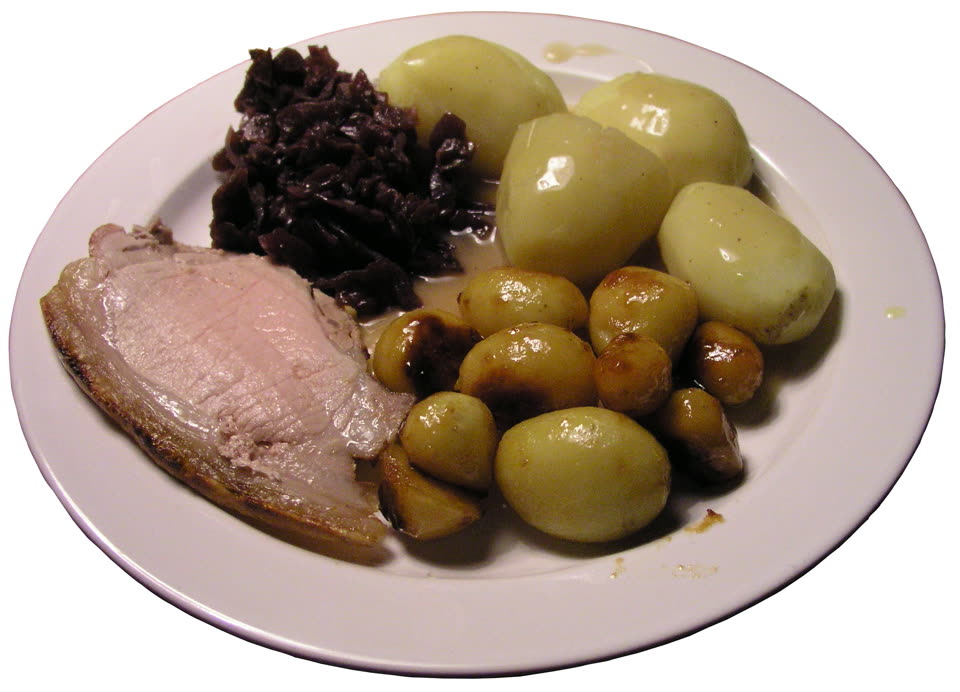
Roast pork with crackling, or a duck or a goose, cooked with apples and prunes and served with gravy, potatoes and red cabbage. This is the menu that took over when Christmas Eve became the main meal in the middle of the 1800s, and it is still the menu.
julemad — Bi Skaarup and Else-Marie Boyhus — Lex (Den Store Danske)
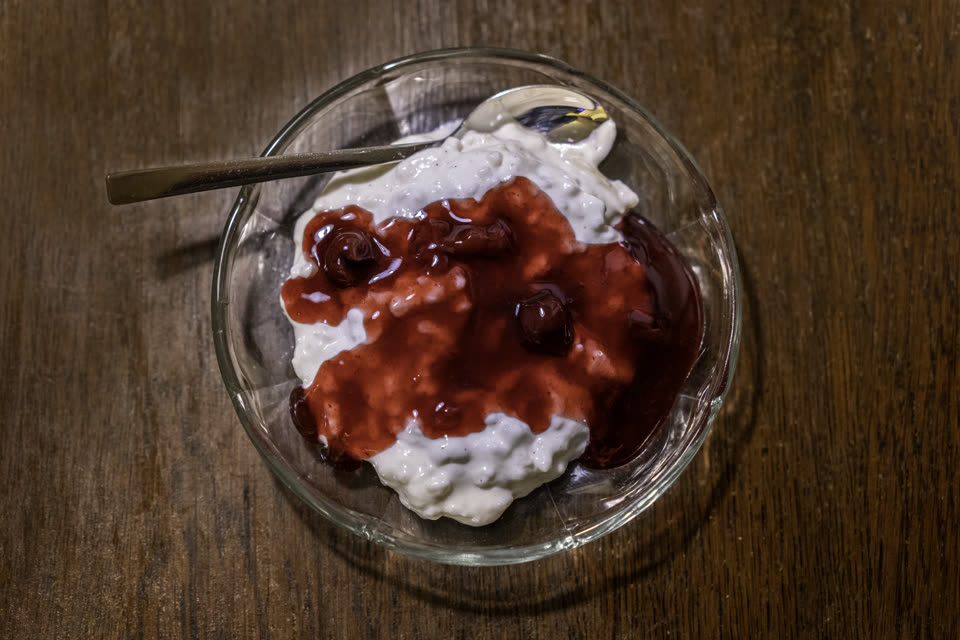
Cold rice porridge folded into whipped cream with vanilla and blanched chopped almonds, served with hot cherry sauce and with one whole almond hidden in it. The name is French — riz à l'amande, rice with almond — and the dish is not.
Salted dried cod, and the oldest thing on this list. It is what Christmas Eve meant in Catholic times, when the evening was still a fast before the feast, and the roast displaced it only in the 1800s. Sweden kept the same pattern and still has it: lutfisk on the Eve, ham on the Day.
julemad — Bi Skaarup and Else-Marie Boyhus — Lex (Den Store Danske)
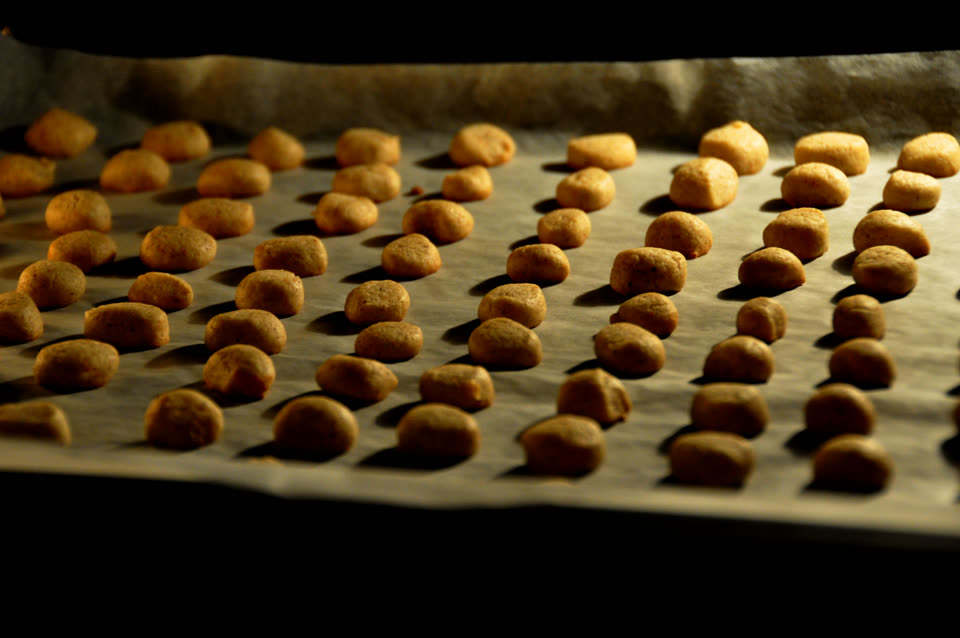
The Christmas baking is what survives of a much larger year of festival baking. Klejner, brown spiced biscuits, pebernødder and honey cakes go back to medieval feast tables; the small biscuits most Danish households now bake — vaniljekranse, finskbrød, jødekager — are nineteenth-century arrivals.
julemad — Bi Skaarup and Else-Marie Boyhus — Lex (Den Store Danske)
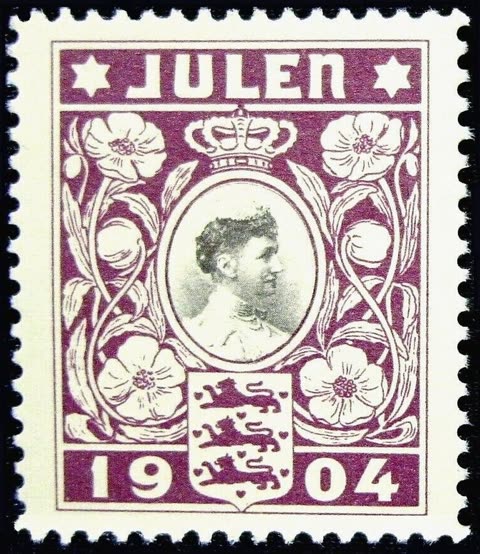
In 1904 a Copenhagen postal clerk named Einar Holbøll put together a committee and issued the world's first julemærke: a stamp with no postal value, stuck on Christmas mail beside the real one, sold for two øre, the proceeds going to sick and undernourished children. The first one carried a portrait of Queen Louise. Denmark has issued one every year since, and the money still runs five Julemærkehjem — at Kollund, Hobro, Ølsted, Roskilde and Skælskør. The 2024 sale brought in about 8.1 million kroner. The idea was copied across most of the world.
julemærker — Peder Kristian Lund — Lex (Den Store Danske)
Risalamande is riz à l'amande with the spaces taken out, and no French household eats it at Christmas. The national encyclopaedia puts it in the etymology box without hedging: despite the French name, risalamande is a Danish phenomenon. It reached print in Danish cookbooks only in the last decades of the 1800s, and then mostly in well-off houses.
Jul is common to the Nordic languages and goes back through Old Norse jól and Gothic jiuleis to proto-Germanic; the very old Germanic loan in Finnish, juhla, simply means «feast». When Denmark was Christianised in the 900s the church tried to put kristmesse in its place and failed. Christmas beat Yule only in the English-speaking world, and not until the 1200s.
jul — Caroline Nyvang, Jørgen Stenbæk, Iørn Piø and Jørn Lund — Lex (Den Store Danske), Denmark's national encyclopaedia
Sources
Every claim carries its own citation. They are collected below, so you
can see what the page rests on and how much of it comes from where.
julemad — Bi Skaarup and Else-Marie Boyhus — Lex (Den Store Danske). Retrieved 2026-11-19.«Først i midten af 1800-tallet, da juleaften blev den vigtigste højtid i Danmark, fortrængtes klipfisken af gåse-, ande- eller flæskesteg med æbler og svesker, sovs, kartofler og rødkål. Denne menu har holdt sig til i dag.»
jul — Caroline Nyvang, Jørgen Stenbæk, Iørn Piø and Jørn Lund — Lex (Den Store Danske), Denmark's national encyclopaedia. Retrieved 2026-11-19.«I 1800-tallet tog danskerne mange juleskikke til sig fra Tyskland. Det gjaldt f.eks. juletræet … og de glasornamenter, vi hængte på det. … Herfra tog danskerne i mellemkrigstiden bl.a. julemanden til sig, og han kom efterhånden til at udkonkurrere nisserne som gavegivere. I tiden efter 2. Verdenskrig kiggede vi især mod Sverige, hvorfra vi lod os inspirere til halmbukke, luciaoptog og gløgg.»
glædelig; jul — Den Danske Ordbog, Det Danske Sprog- og Litteraturselskab. Retrieved 2026-11-19.The dictionary gives glædelig as [ˈglɛːðəli] and lists «glædelig jul» among its examples of use; the separate entry for jul gives [ˈjuˀl], with stød.
Helligdage i Danmark — Info Norden, Nordisk Ministerråd. Retrieved 2026-11-19.The list of Danish helligdage gives «25. december: juledag» and «26. december: anden juledag».
julemanden — Lex (Den Store Danske). Retrieved 2026-11-19.«Det danske navn for julemanden er en oversættelse af det tyske Der Weihnachtsmann, der vandt indpas i de protestantiske dele af Tyskland fra midten af 1800-tallet.» The dating of his arrival in Denmark, «i mellemkrigstiden», and the displacement of the nisser are from the companion article at https://lex.dk/jul.
risalamande — Lex (Den Store Danske). Retrieved 2026-11-19.«Grøden skulle lægge låg på sulten, således at der ikke blev spist så meget af kødserveringerne.»
julemærker — Peder Kristian Lund — Lex (Den Store Danske). Retrieved 2026-11-19.«Einar Holbøll fik opbygget en Julemærkekomité og gennemførte udsendelsen af verdens første Julemærke i 1904; siden da er der hvert år udsendt et dansk Julemærke. Julemærket kostede 2 øre i 1904.» The five homes are named in the article, the 1904 design is captioned «Dronning Louise i ornamental ramme», and «Indtægten for salget af Julemærket var i 2024 ca. 8,1 mio. kr.»