Christmas Elsewhere

A country-by-country atlas of how Christmas is actually kept

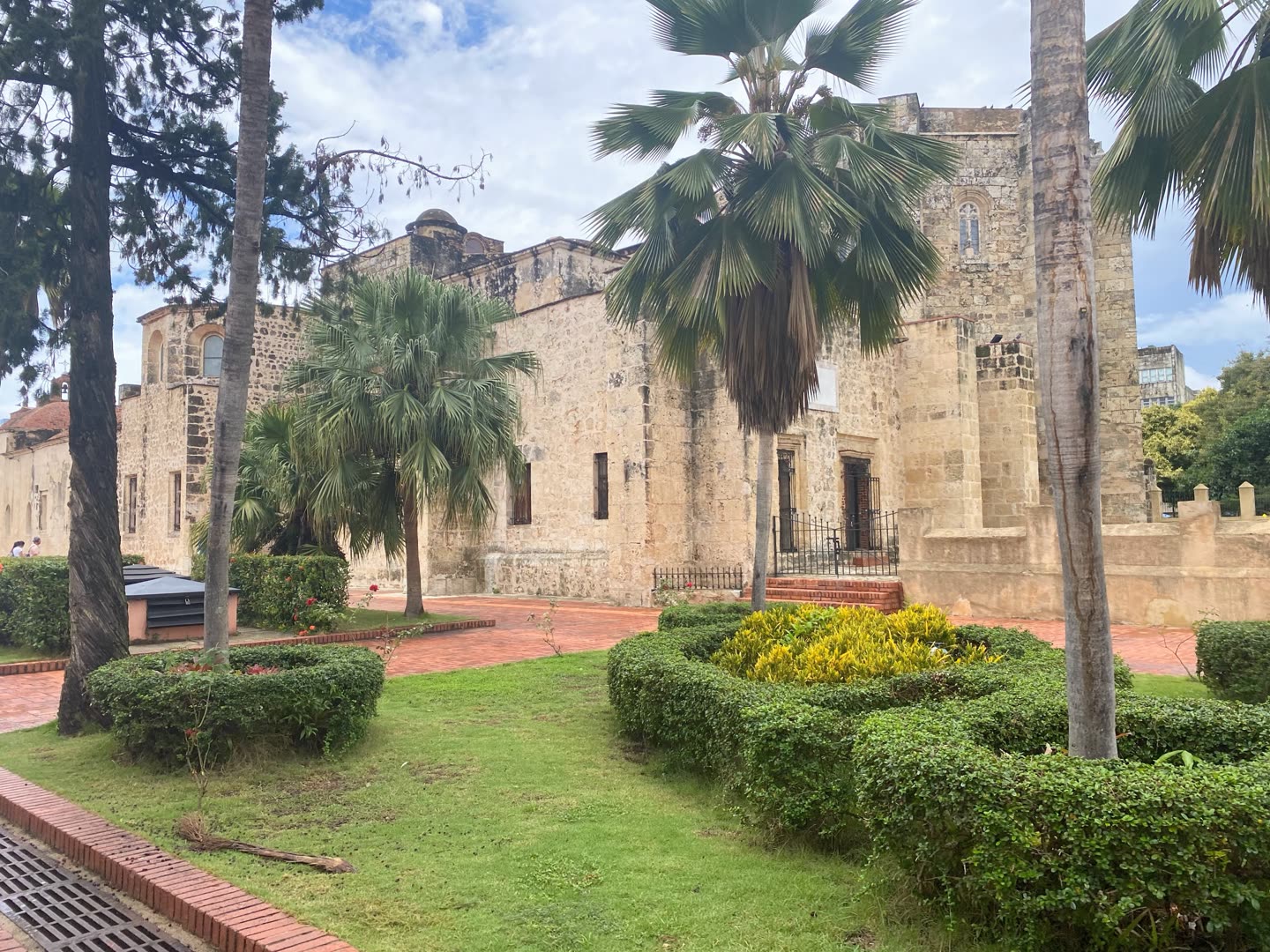
The long side wall of a coral-limestone cathedral seen across its garden: heavy buttresses between tall Gothic windows, an iron gate and brick steps at a side door, and a stone parapet running along the right. Fan palms stand in front of the wall, with clipped box hedges, a bed of yellow-green shrubs and red brick paths in the foreground. Two people sit on a bench at the far left, too distant to make out. Blue sky with broken white cloud.
-wuppertaler · CC BY 4.0

All countries · Caribbean

Christmas in the Dominican Republic

Christmas falls on
25 DecemberGregorian calendar
A public holiday
YesMinisterio de Trabajo informa días feriados correspondientes al año 2026 — Ministerio de Trabajo (Dominican Republic)
Who brings the presents
Los Reyes Magosarrives 6 January
Who brings the presents
La Vieja Belénarrives 13 January
—days
—hrs
—min
—sec

Next: Friday 25 December 2026

When is Christmas in the Dominican Republic?

Christmas Day in the Dominican Republic is 25 December. It is a public holiday.

How to say it

  • Spanish

    ¡Feliz Navidad!

    Feliz Navidad

    A synthesised voice — not a recording of a person — saying ¡Feliz Navidad! in es-DO.

    Ordinary Spanish, as everywhere in the Spanish-speaking Caribbean.

    feliz Navidad — English Wiktionary

Who brings the presents

Los Reyes Magos

The Three Kings bring the children's presents on the night of 5–6 January. In some households children left grass and water at the door or under the bed for the camels, and a note or a small present for the Kings themselves. Since 2012 the holiday has been complicated by the law: Ley 139-97 moves a midweek holiday to the Monday, so 6 January is often a working day with the day off somewhere else, and the Diario Libre reports the question that follows — «¿Regalo el 6 o el feriado?»

Día de Reyes: En RD ya no se celebra el 6 de enero — Diario Libre

La Vieja Belén

The Old Woman of Bethlehem comes after the Kings, for the children the Kings or Santa missed. Her day is not fixed: accounts give the Sunday after Reyes, or 13 January, a week after Epiphany. Where she comes from is unresolved. The late sociologist Teófilo Barreiro traced her to a woman of San Pedro de Macorís who in the 1930s and 1940s collected money to buy toys for poor children; another account puts her down to nineteenth-century Italian immigrants and their Befana. Folklorists have not settled it, and the Diario Libre notes she is invoked less and less.

Conoce la historia de la Vieja Belén — Diario Libre

How Christmas is kept

The season arrives on the roadside, in painted branches

From the beginning of October the charamico sellers set up along the main roads of the capital — Avenida Winston Churchill in the Distrito Nacional, the San Isidro highway in Santo Domingo Este — and stay until 6 January, with the city council's permission. A charamico is a Christmas decoration built out of dry branches, vines and sticks and painted in hard bright colours. The Dominican press dates them to the 1970s. The first ones were trees painted white; the trade now turns out stars, baskets, cones, balls, nativity scenes, angels and little donkeys.

Conoce el origen de los charamicos, los ornamentos navideños que cubren las calles de Santo Domingo — Listín Diario

How a charamico is built, and who builds it

A charamico tree is made by nailing branches into a block of wood, more of them at the bottom than at the top. One seller on the San Isidro road names the main raw material as bejuco jaquimey, with olive branches and bejuco chino; another, on the Churchill, describes a workshop split three ways between the men who build the frames, the ones who wrap the balls and the ones who paint. Reynaldo de Jesús, from La Estancia in Villa Altagracia, has been making and selling them in Santo Domingo for more than forty years; his father, he says, was one of the first to make them at all.

Charamicos, símbolo de la Navidad dominicana y estampa citadina — Diario Libre (Xiara Paulino)

The 24th is the dinner; the 25th is what is left of it

Nochebuena is the meal. Families typically cook far more than one evening needs, and the next day is el recalentao — the reheating — when everyone comes back and eats it again. The Listín describes the same thing happening after both the 24th and the 31st: the family gathers the following day to warm up what was left and share another moment over it.

Tradiciones típicas dominicanas — Listín Diario (separata)

Aguinaldos: the carol round at four in the morning, and what it has become

An aguinaldo — also called an asalto, an assault — is a group of friends going house to house in December singing carols to tambora, güira and accordion, usually in the small hours or very early morning. Neighbours answered the door with ginger tea, hot chocolate, coffee, Christmas biscuits and bread. Dominicans interviewed by the press have been saying the custom is going since at least 2009, when residents of Santiago told El Nacional that the aguinaldos and the mañanitas had been lost. In December 2025 one woman said the opposite about her own neighbourhood: groups organised by her chapel still go from house to house.

La alegría de los Aguinaldos de Navidad cayó en perfil bajo y calladamente ha ido desapareciendo — 7dias.com.do

Mañanitas, and the regional parrandas they belonged to

The mañanitas were December dawn outings: groups with tambora, güira and accordion went through the streets before first light playing Christmas songs and stopping at houses. The folklorist Dagoberto Tejeda Ortiz remembers them in the capital and in nearly every town, with hot ginger drink handed out. He describes the regional versions too, all in the past tense: in Samaná, Sánchez and Sabana de la Mar the parranda de los pollos chose a king and a queen and played guitars and tamboras through the streets until very late; in San Pedro de Macorís the cocolos went out with their own bands of drums, recorders and metal triangles, drinking guavaberry; and in many towns of the south, as night fell, a perico ripiao band went out to play aguinaldos.

La Navidad dominicana — Dagoberto Tejeda Ortiz, in Acento (opinion)

Angelitos: the draw at the office, the school and among friends

The Dominican secret-santa is the angelito. Names go on slips of paper into a container, everyone takes one, and the giver stays secret until the exchange. It runs in companies, schools, institutions and groups of friends, and the Listín quotes the saying that goes with it: sin angelito no hay Navidad — without an angelito there is no Christmas.

La tradición del ‘angelito’ — Listín Diario
What is eaten

Moro de guandules

Rice cooked with pigeon peas, and the dish the Nochebuena table is built around. The Listín's food column offers a reason for the pigeon pea rather than any other bean, and marks it as a guess: the crop is harvested at the end of summer and through the autumn, especially in November and December, which is exactly when it is wanted.

La cena tradicional de Nochebuena — Listín Diario

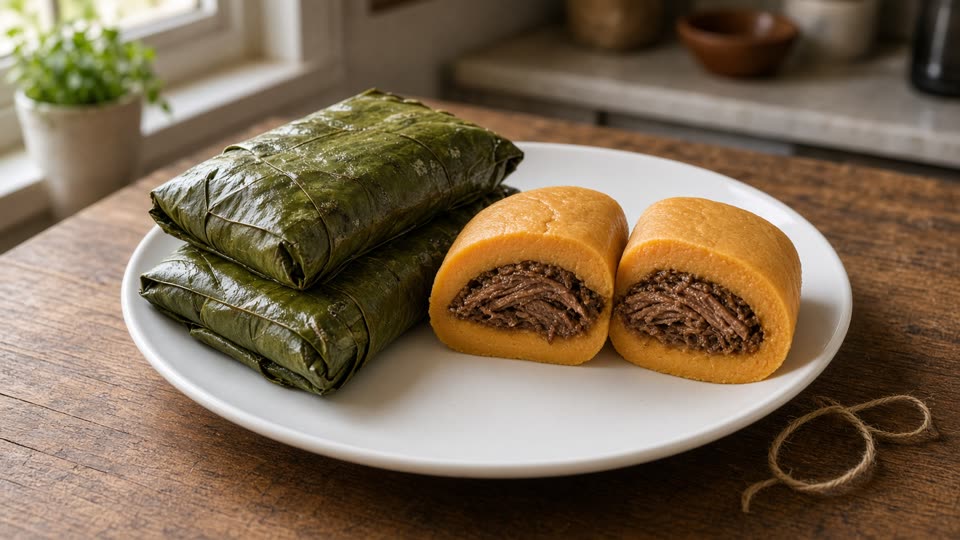
Two parcels wrapped in broad green leaves, folded and creased, lie stacked on a white plate on a wooden table. Beside them two halves of a third stand cut-side to the camera: a thick wall of orange-yellow dough entirely enclosing a core of dark braised shredded beef. A loop of kitchen string lies on the table and a window with a potted plant is out of focus behind.
Illustration, generated with Grok Imagine

Cerdo asado and pasteles en hoja

Roast pork is the centre of the night — marinated criollo style with garlic, oregano and sour orange, either spit-roasted en puya or done as a leg. Beside it go the pasteles en hoja: a dough of plantain and yautía kneaded with annatto and oil, filled with beef or pork and now often chicken, wrapped in leaves and boiled. There is a cassava version too. The same 2007 chef who described the pork noted that turkey was coming in «por la influencia estadounidense».

Varias opciones para el menú de Nochebuena — Listín Diario

Telera

An oversized loaf that turns up on the Nochebuena table, and which the Listín says is only baked at this time of year.

Tradiciones típicas dominicanas — Listín Diario (separata)

Ginger beer in Samaná, guavaberry in San Pedro

Two drinks that belong to two particular places rather than to the country. The Listín names ginger beer as the Christmas drink of the African-American community of Samaná, and guavaberry — made from the arraiján berry that grows wild in the scrub — as the drink of the cocolos of San Pedro de Macorís. Tejeda names the guavaberry with the San Pedro cocolos too. The national drink of the season is ponche.

La cena tradicional de Nochebuena — Listín Diario

What people get wrong

Widely repeated claims about Christmas in the Dominican Republic that do not survive checking. Each one says what is actually the case, because a correction with nothing in its place leaves you worse off than before.

Contradicted

Dominica and the Dominican Republic are the same place, so their Christmas customs can be described together.

What is actually the case. They are two countries with two languages and two histories. The Dominican Republic is Spanish-speaking, shares Hispaniola with Haiti, and has a population of about eleven million; Dominica is a Commonwealth island between Guadeloupe and Martinique where English and Kwéyòl are spoken and fewer than seventy thousand people live. Every custom described here belongs to the Dominican Republic — Santo Domingo, Santiago, San Pedro de Macorís, Samaná — and none of it to Dominica.

Ministerio de Trabajo informa días feriados correspondientes al año 2026 — Ministerio de Trabajo (Dominican Republic)

Unsupported

Pasteles en hoja arrived in 1512 with enslaved Africans.

What is actually the case. The year is printed — Hoy's 2021 food piece says «En 1512 llegan a nuestra isla los pasteles, traídos por los negros esclavos provenientes de Africa» — and the article offers no study or archive for it. No other source supports the year either. The dish is real and old; the date is not shown to be anything.

La cena: Los platos estelares de nochebuena — Hoy

Oversimplified

The Vieja Belén comes on 13 January.

What is actually the case. 13 January is one of the two dates given, and the sources that give it say in the same breath that there is no fixed one. elCaribe's columnist remembers the Sunday after Reyes and says some held it to be the 13th; the Diario Libre's account does not settle it either. Picking the 13th makes a folk figure sound like a scheduled holiday.

La Vieja Belén en la tradición dominicana — César Nicolás Penson Paulus, in elCaribe (opinion)

Contradicted

Christmas Eve is a public holiday in the Dominican Republic.

What is actually the case. It is not on the official calendar. The legal day off is 25 December, which Ley 139-97 also protects from being moved to a Monday — unlike Reyes, which is moved most years.

Al calendario laboral le quedan dos fines de semana largos — Diario Libre

Worth knowing

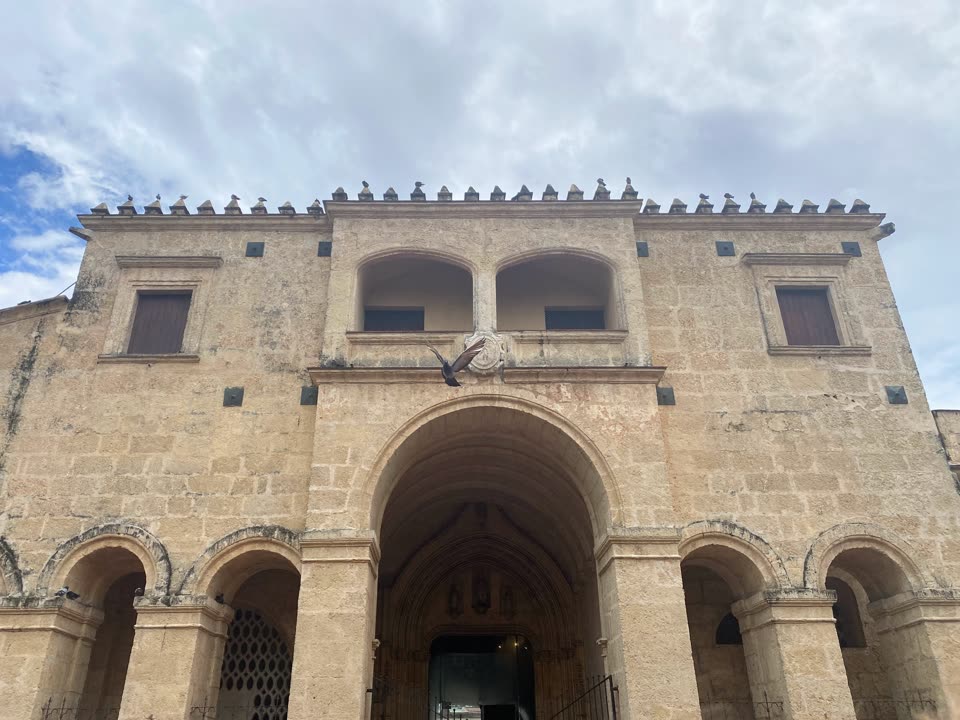
The west front of a coral-limestone cathedral photographed steeply from below. A crenellated parapet runs across the top with a pigeon standing on almost every merlon; beneath it two round-arched openings sit side by side with a carved stone shield between them, and below that a great round-headed portal opens on Gothic vaulting. Shuttered windows left and right, arcaded bays along the bottom, and one pigeon in flight across the centre.
-wuppertaler · CC BY 4.0

Dominican children are not all told the same thing. A columnist writing about the Vieja Belén lists three bringers in one breath, in Dominican street spelling — «ei niño jesú, santicló o lo relle mago»: the Christ child, Santa Claus and the Three Kings. Which of them comes, and on which night, is not something any survey has measured.

La Vieja Belén en la tradición dominicana — César Nicolás Penson Paulus, in elCaribe (opinion)

Christmas Eve is not a public holiday in the Dominican Republic. 24 December 2026 falls on a Thursday and is a normal working day; the day off is Friday the 25th. The big meal happens on a night most people have worked through.

Al calendario laboral le quedan dos fines de semana largos — Diario Libre

Apples, pears and grapes belong to the Dominican Christmas table, alongside the sweets and the coquitos. They are imported fruit in a country of mangoes, and they appear in December.

Tradiciones típicas dominicanas — Listín Diario (separata)

At Christmas, bands of típico or popular musicians play carols in the street for whatever passers-by give them, working the colmados — the corner shops — and the places people go out to.

Tradiciones típicas dominicanas — Listín Diario (separata)

Sources

Every claim carries its own citation. They are collected below, so you can see what the page rests on and how much of it comes from where.

  1. La alegría de los Aguinaldos de Navidad cayó en perfil bajo y calladamente ha ido desapareciendo — 7dias.com.do. Retrieved 2026-11-07. archived 16 October 2024«…consiste en juntarse con los amigos e ir cantando villancicos navideños, se va casa en casa haciendo una especie de sorpresa o “Asalto” en horas de las madrugadas, en la mañana temprana y algunos en la noche. Interpretando a ritmo de tambora, güira y acordeón; las personas que cantaban para estas fechas eran recibidas con júbilo por los vecinos en los sectores que les brindaban té de jengibre, chocolate caliente, café, galletas navideñas, pan, algo que cada vez es menos frecuente en nuestro país.»
  2. La Vieja Belén en la tradición dominicana — César Nicolás Penson Paulus, in elCaribe (opinion). Retrieved 2026-11-07. archived 17 February 2025«Cuando “ei niño jesú, santicló o lo relle mago” no traen regalos, nace la esperanza de que la misteriosa Vieja Belén los supla.»
  3. La Navidad dominicana — Dagoberto Tejeda Ortiz, in Acento (opinion). Retrieved 2026-11-07. archived 14 July 2024«En la ciudad capital y casi todos los pueblos de manera espontaneas en los barrios salían las “mañanitas”, donde se tomaba bebida jengibre caliente.» / «En Samaná, Sánchez y Sabana de la mal, salían las “parranda de los pollos”…» / «En San Pedro de Macorís, “los cocolos” salían por las calles del pueblo con sus orquestas particulares donde sobresalían sus tambores, las flautas dulces y sus triángulos de metal, bebiendo Guababery…» / «En muchos pueblos del Sur, al entrar la noche, con un perico-ripiao se salía a tocar aguinaldos»
  4. Día de Reyes: En RD ya no se celebra el 6 de enero — Diario Libre. Retrieved 2026-11-07. archived 20 April 2026«El 6 de enero es el Día de los Santos Reyes. O así era en República Dominicana hasta el año 2012, cuando se decidió aplicar la ley 139-97 sobre los días feriados del calendario que coincidan con los días martes, miércoles, jueves o viernes.» / «En la actualidad la discusión es una pregunta: “¿Regalo el 6 o el feriado?”» On the camels: «En algunos hogares, en la víspera del Día de Reyes a “los camellos” de los reyes se le dejaba agua y hierba a la entrada de la casa o bajo la cama; a “los Reyes” se les dejaba un regalito, una carta, cualquier detalle.»
  5. Conoce la historia de la Vieja Belén — Diario Libre. Retrieved 2026-11-07. archived 11 January 2024«El fallecido sociólogo Teofilo Barreiro explicó que esta figura hace honor a la solidaridad de una dama de San Pedro de Macorís que entre 1930 y 1940 hacía colectas para comprar juguetes a los niños pobres.» / «Otra teoría atribuye la existencia de la Vieja Belén a inmigrantes italianos que se establecieron en República Dominicana en el siglo XIX, basado en el personaje italiano La Befana.»
  6. Al calendario laboral le quedan dos fines de semana largos — Diario Libre. Retrieved 2026-11-07. archived 1 September 2026«La Nochebuena de 2026 caerá el jueves 24 de diciembre. Sin embargo, esa fecha no figura como feriado nacional en el calendario oficial, por lo que legalmente el día no laborable será el viernes 25, Navidad.» On which holidays never move: «No se trasladan Año Nuevo, el Día de Nuestra Señora de la Altagracia, la Independencia Nacional, Nuestra Señora de las Mercedes y Navidad, entre otras fechas contempladas por la legislación.»
  7. Charamicos, símbolo de la Navidad dominicana y estampa citadina — Diario Libre (Xiara Paulino). Retrieved 2026-11-07. archived 18 October 2025«“La materia prima principal se llama bejuco jaquimey”, dijo Eriberto Modesto, vendedor de charamicos en San Isidro.» / «“Hay un equipo que se encarga de hacer los cuadres (construir la artesanía), hay otro que la forra las bolas y otro que las pinta”, dijo Omar Pujols, otro vendedor de la Churchill.»
  8. feliz Navidad — English Wiktionary. Retrieved 2026-11-09. archived 9 March 2026Given as the ordinary Spanish for «Merry Christmas».
  9. La cena: Los platos estelares de nochebuena — Hoy. Retrieved 2026-11-07.The claim as printed: «En 1512 llegan a nuestra isla los pasteles, traídos por los negros esclavos provenientes de Africa.»
  10. Conoce el origen de los charamicos, los ornamentos navideños que cubren las calles de Santo Domingo — Listín Diario. Retrieved 2026-11-07. archived 8 January 2026On the dating: «Su origen se remonta a los años 70…» On the shapes: «La figura utilizada en un principio eran los árboles de pino pintándolos de blanco, pero el paso del tiempo exigió más formas como las cestas, canastas, estrellas, bolas, cono, nacimiento, ángeles y burritos…» On the season: «…ya desde el 01 de octubre hasta el 06 de enero colocarlos en las calles principales gracias al permiso ofrecido por el ayuntamiento municipal.»
  11. La tradición del ‘angelito’ — Listín Diario. Retrieved 2026-11-07. archived 18 July 2025«…se festeja con entusiasmo los “angelitos”, excitante y divertida tradición, “Sin angelito no hay Navidad”. Este intercambio de regalos realizado por grupos de amigos en empresas, escuelas, instituciones…» / «Para organizar un “angelito” se escriben los nombres de los participantes en papelitos, se introducen en un recipiente del que se toma uno.»
  12. La cena tradicional de Nochebuena — Listín Diario. Retrieved 2026-11-07. archived 2 January 2026«La cena navideña dominicana está integrada por moro, acompañado de ensalada rusa, cerdo asado, pasteles en hoja, yuca sancochada, casabe y jamás puede faltar la telera, que solo se elabora en esta época.» On the pigeon peas: «El moro de la Nochebuena es de guandules y no está de más informarle que es probable que el motivo sea que esta leguminosa se cosecha a finales del verano y durante el otoño, especialmente en noviembre y diciembre, coincidiendo con la temporada navideña…»
  13. Varias opciones para el menú de Nochebuena — Listín Diario. Retrieved 2026-11-07.«…la estrella de la noche es el cerdo asado, adobado al estilo criollo, con ajo, orégano y naranja agria. Ya sea asado en puya como una pierna de cerdo, esta carne roja es la principal protagonista de la cena de Nochebuena De igual modo, comenta, se viene implementando el pavo, “por la influencia estadounidense”.» On the pasteles: «Los primeros son elaborados a partir de plátanos, yautías amasados con bija y aceite, con un relleno, que puede ser de res o cerdo, pero que ya puede ser remplazado por otro tipo de carnes como la de pollo, sin dejar de mencionar el “invento” de los pasteles en hoja de yuca.»
  14. Tradiciones típicas dominicanas — Listín Diario (separata). Retrieved 2026-11-07. archived 12 October 2024«“El recalentao” Después de la cena del 24 y 31 de diciembre la familia se reune al día siguiente para calentar la comida que quedó y compartir otro momento especial.»
  15. Ministerio de Trabajo informa días feriados correspondientes al año 2026 — Ministerio de Trabajo (Dominican Republic). Retrieved 2026-11-07. archived 18 November 2025The labour ministry's own 2026 list marks Christmas as one of the days that does not move: «Viernes 25 de diciembre, día de Navidad o nacimiento de Jesús, no se cambia.»