the Christ Childdas Christkind · arrives 24 December
Who brings the presents
Father Christmasder Weihnachtsmann · arrives 24 December
Who brings the presents
Saint Nicholasder Nikolaus · arrives 6 December
—days
—hrs
—min
—sec
Next: Friday 25 December 2026
When is Christmas in Germany?
Christmas Day in Germany is 25 December. It is a public holiday.
How to say it
German
Fröhliche Weihnachten
Fröhliche Weihnachten
say it: FRUR-li-khuh VY-nakh-ten
A synthesised voice — not a recording of a person — saying Fröhliche Weihnachten
in de-DE.
The adjective is what makes the plural appear at all. Weihnachten is normally used in the singular, and the dictionary of record notes that when the plural does turn up it is mostly with an attributive adjective «wie z. B. fröhliche Weihnachten» — the greeting is one of the few places the plural lives.
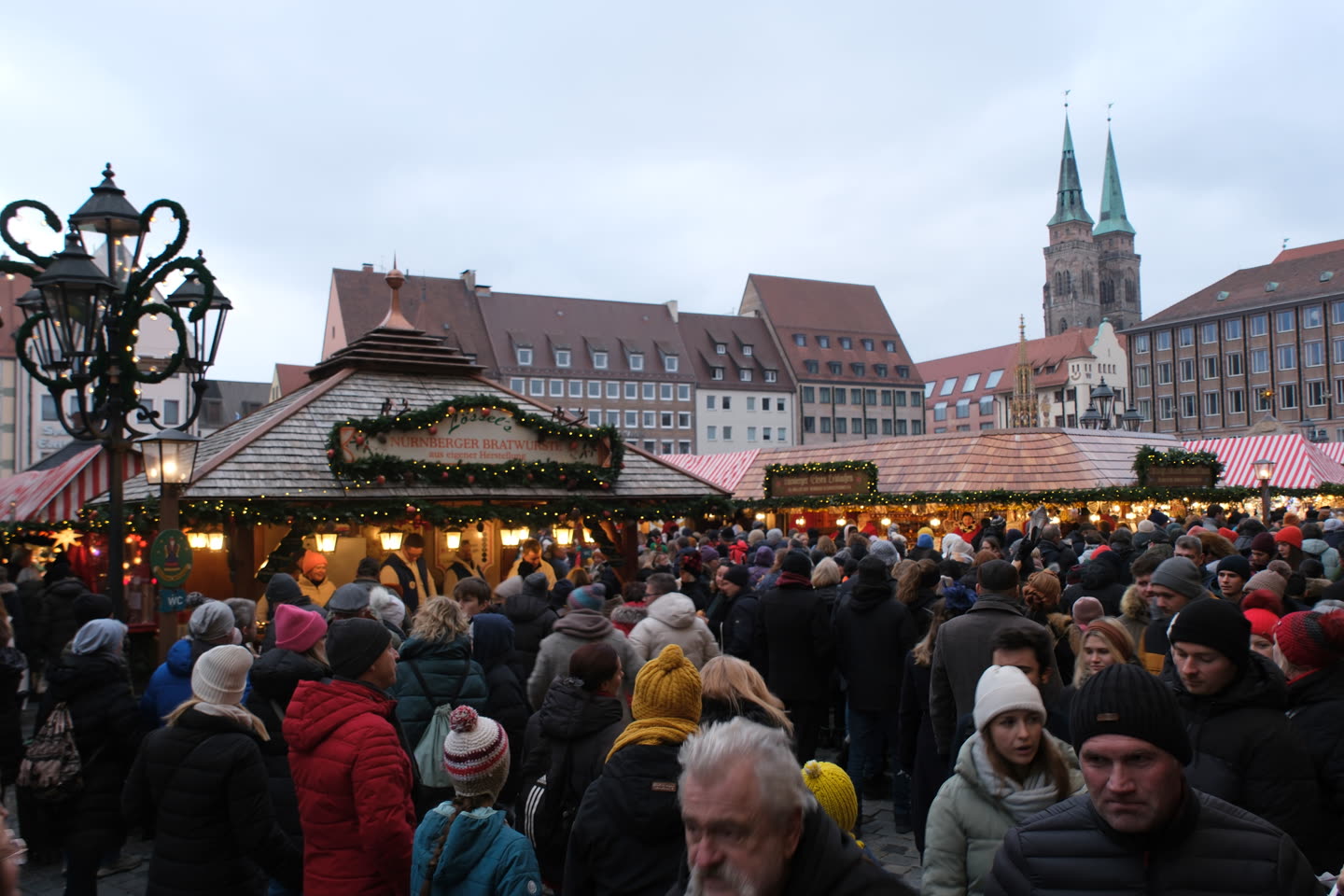
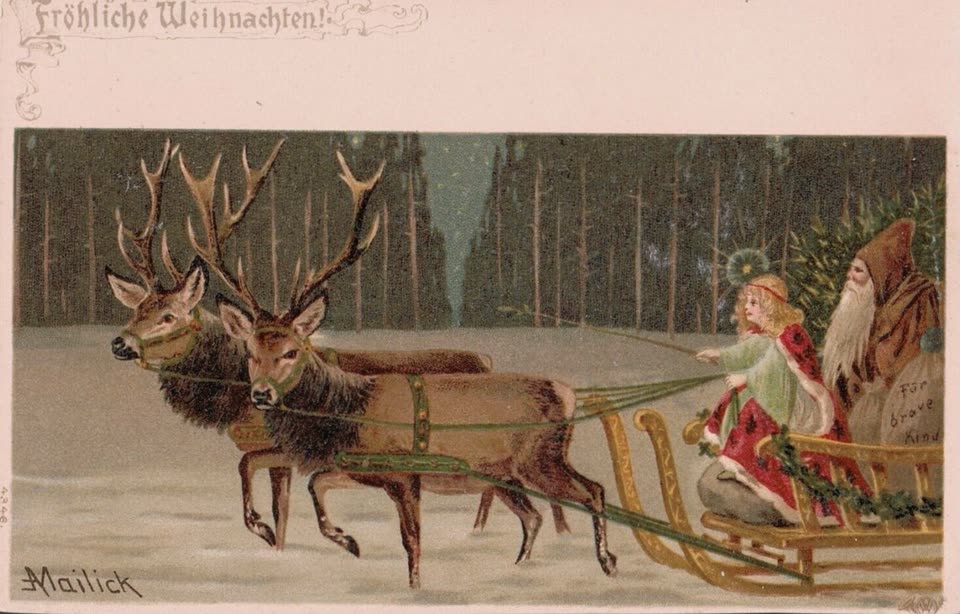
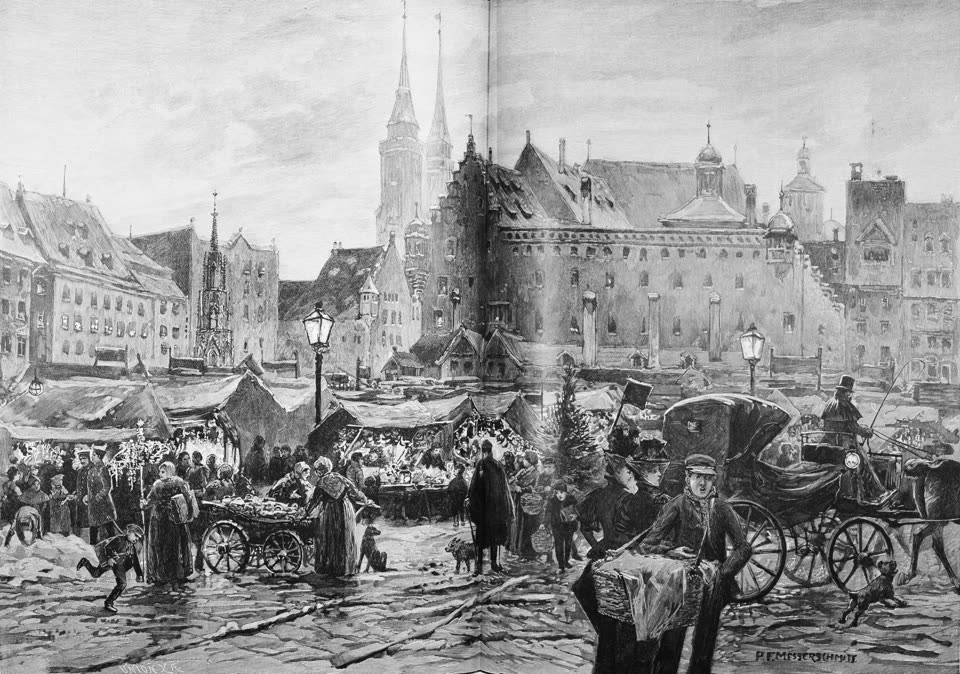
Brings the presents on the evening of 24 December across the south and west, and in Austria and Switzerland. The name is a diminutive in much of that area — Christkindle, Christkindchen, and Christkindli in Switzerland. The figure is the infant Christ; the figure people see, at Nürnberg's market, is a young woman in a gold crown and an angel costume, which is a different thing and is why the two get confused.
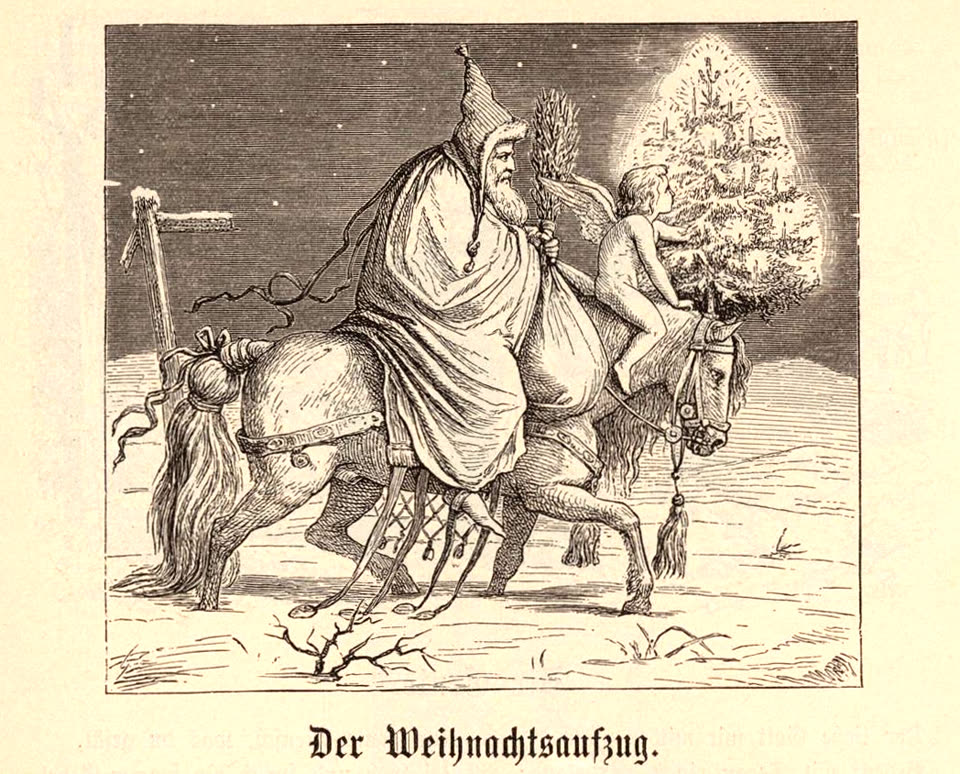
The same evening, in the north and east. He is derived from Saint Nicholas, which is the irony of the German split: the Protestant Reformation's Christ Child ended up in Catholic living rooms, and the figure descended from the Catholic saint took over the Protestant ones.
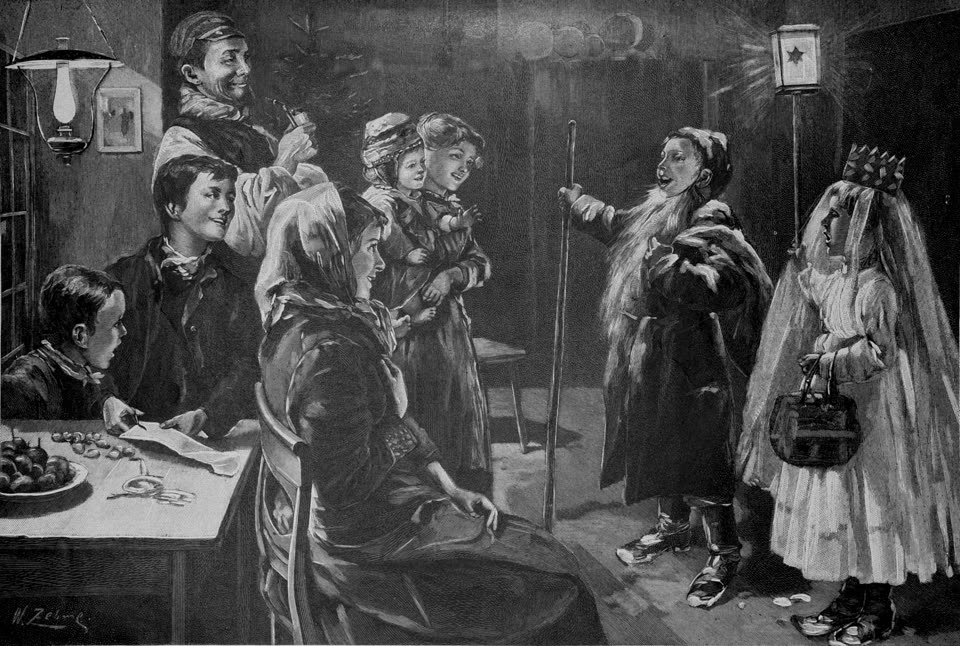
Comes on 6 December, and is the figure the Christmas gift bringers were built out of. He often arrives in person rather than leaving things behind, and he brings a companion — who has more names than he does.
Nikolaus-Begleiter — Bonifatiuswerk der deutschen Katholiken, nikolaus-von-myra.de
How Christmas is kept
The evening is the 24th, and it is a working day
Presents are opened on the evening of 24 December, the Bescherung, not on Christmas morning. The two days after it are the public holidays; the 24th itself is not one anywhere in Germany. Bavaria goes the other way and makes it a stiller Tag, a quiet day, from two in the afternoon: public entertainment that does not suit the seriousness of the day is prohibited until midnight, and sporting events are specifically exempted.
The first Advent wreath was a cartwheel, and it had far more than four candles
In 1839 Johann Hinrich Wichern, who ran a home for poor children in Hamburg, took a wooden cartwheel and fixed to it one candle for every day from the first Sunday of Advent to Christmas Eve. The children had kept asking how long was left. Because the first Sunday of Advent moves, the number moves with it — the wreath lit in the Rauhes Haus today carries up to 28 candles. Fir greenery was not added until around 1860, and the four candles everyone now owns are what is left after the weekday ones fell away.
Two Christmas markets, two founding documents, and both are about meat
Dresden's Striezelmarkt dates from 1434, when Elector Friedrich II and his brother Duke Sigismund granted the city a free market one day a week — and one «am Tage vor dem Heiligen Christabend», the day before Christmas Eve. It was a free meat market: after the pre-Christmas fast days, burghers came to pick out their roast. Nürnberg's Christkindlesmarkt, the other famous one, has no founding charter at all. Its oldest evidence is a painted spruce box in a museum.
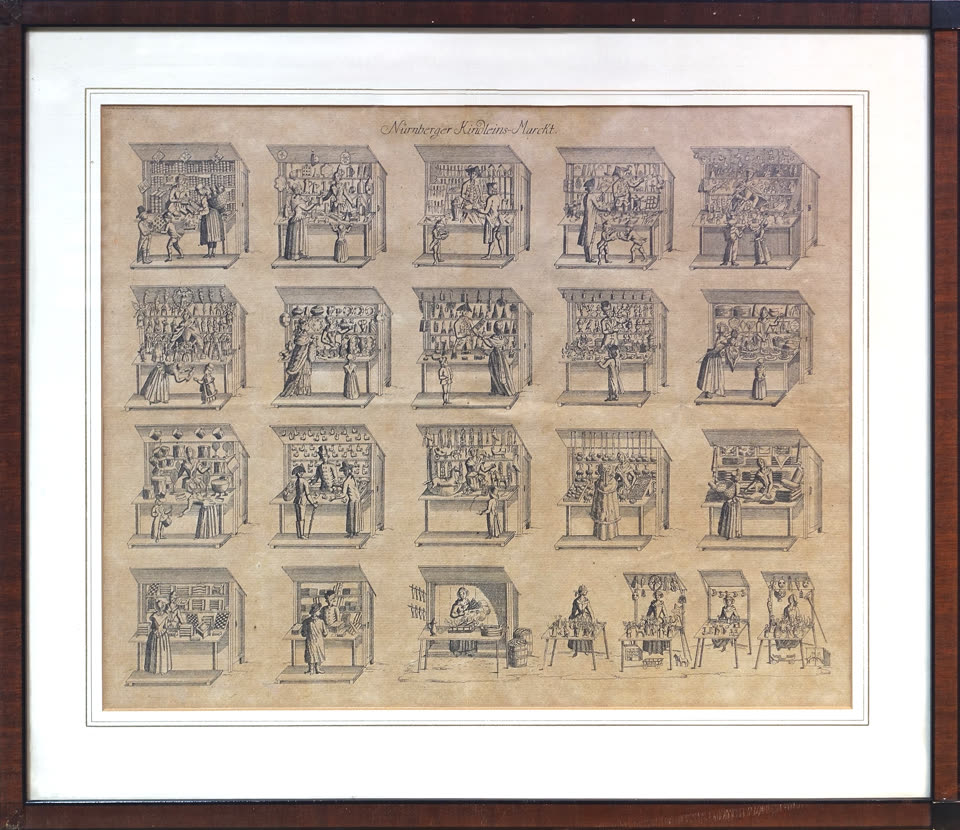
The oldest evidence for Nürnberg's Christkindlesmarkt is a small oval spruce box in the Germanisches Nationalmuseum, nineteen centimetres long, with flowers painted on the lid and twelve strands of raw silk still inside. On the base someone wrote that it was sent to Regina Susanna Harßdörfferin by Jungfrau Susanna Eleonora Elbs «zum Kindles marck» — and then a year whose third digit is smeared and half-covered by a blot of ink. It was read as 1628 for decades. In October 2025 the city archive settled it the long way round, through the women themselves: Harßdörffer lived from 1663 to 1731, and the friend who gave her the box was traced to grave number 54 in St Johannisfriedhof. The year is 1678, and the jubilee the city was preparing for 2028 is a 350th, not a 400th.
The oldest written Christmas tree is in a town account book, and the town says so carefully
On page 239 of Sélestat's municipal accounts for 1521, in Alsace, the town paid four shillings to its foresters to guard the trees from St Thomas's Day, 21 December. It is the oldest known written mention of the Christmas tree anywhere. Sélestat is firm about what that does and does not mean: the town did not invent the tree, it is simply where the custom was first written down — and the reasoning runs the other way round from the usual one. A town only pays to guard its woods if cutting a whole tree, rather than a branch, has already become common. Later entries follow in 1546, 1555 and 1557. Alsace was German-speaking and inside the Holy Roman Empire; the oldest German Christmas tree is in France.
Christkind in the south, Weihnachtsmann in the north, and the two swapped churches
Who brings the presents depends on where in the German-speaking world you are, and the line is sharp: the Weihnachtsmann in the north and east, the Christkind in the south and west and in Austria and Switzerland. The Christkind was the Protestant answer to a Catholic saint — Luther's household moved its gifts to Christmas in the early 1530s, in the name of the Holy Christ — and a folklore survey in 1932 found the figures had changed places. The originally Protestant Christ Child was mostly visiting Catholic living rooms; the Weihnachtsmann, descended from Saint Nicholas, had taken over the Protestant ones.
Klausentreiben: the Allgäu lets the companions out without the saint
On the evenings of 5 and 6 December in Sonthofen, in the Bavarian Allgäu, Rumpelklausen come through the town in heavy furs, hung with antlers, horns and enormous cowbells, carrying switches — and they go for the crowd that has come to watch. The city is unusually honest about where the custom comes from: there are only attempts at an explanation, one of them a story about a Celtic solar year more than two thousand years old. It presents that as one reading among several, not as history.
On the night of 5 to 6 December, Borkum keeps what the island calls its highest holiday. Young islanders dressed as Klaasohms go about the place, and until 2024 part of the custom was that masked men struck women on the buttocks with cow horns if they were out that evening — reported as an old whaling tradition. An NDR Panorama and STRG_F report broadcast on 26 November 2024 showed it; within days the mayor and the Verein Borkumer Jungens announced that the festival would be celebrated without it, starting that same year. The festival itself was not abolished and is still held on 5 December. In 2025 the association put binding rules in place that exclude violence.
The Erzgebirge: a lit arch in the window, and a shift that ends in a hut
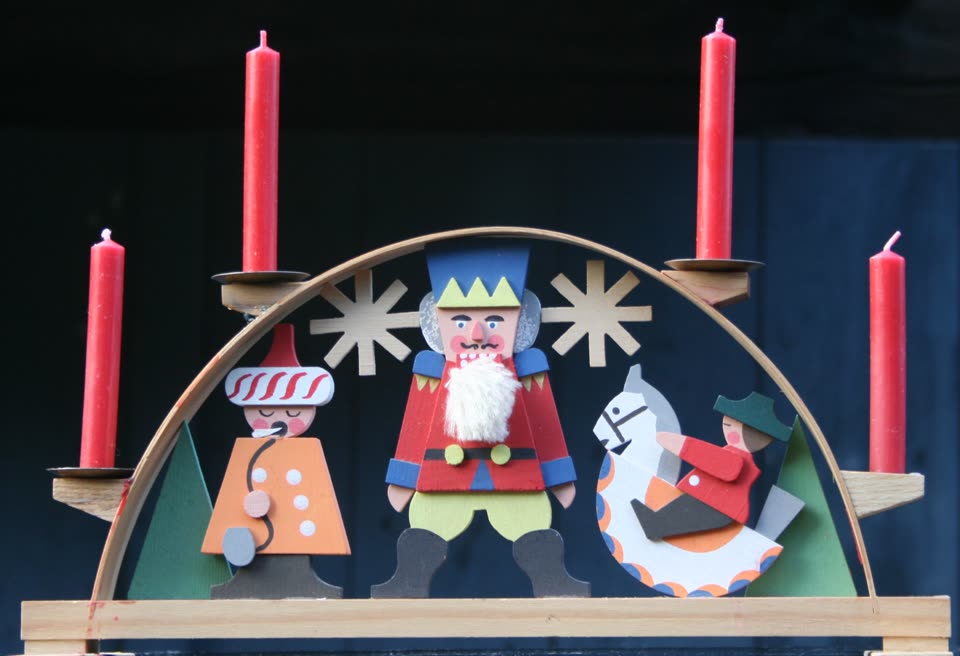
The Schwibbogen, the arch of lights that stands in windows across Saxony and now across Germany, began in the mining towns of the Erzgebirge. The oldest surviving one comes from Johanngeorgenstadt and carries eleven candles, Adam and Eve, angels, and miners with the arms of Saxony. Its date was not known until 2003, when a restorer taking the overpainting of 1829 off a near-identical arch found another layer of paint beneath, partly fire-gilded, with the year 1740 on it — and the oldest Schwibbogen gained about forty years. The miners' own Christmas is the Mettenschicht, the last shift before the holiday, which ended not underground but in the warm hut at the pithead, with prayers, singing and a bottle going round.
Die Bergmetten — Förderverein Pferdegöpel Johanngeorgenstadt e.V., schwibbogen.org
Sternsinger: three kings, chalk on the lintel, and forty-seven million euros
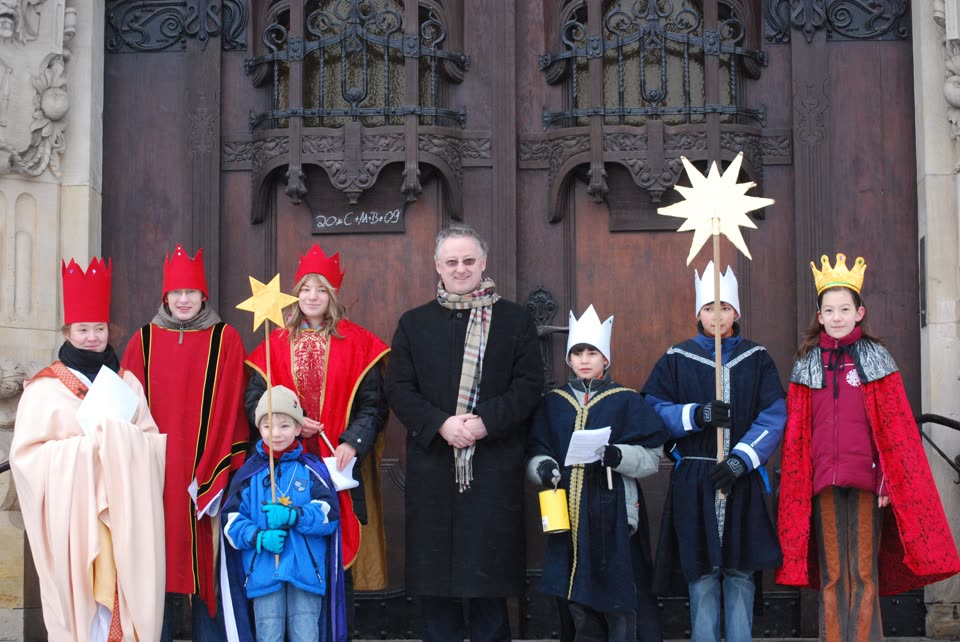
In the first days of January, children dressed as the Three Kings go from house to house, sing, bring a blessing for the year and chalk it over the door. They are collecting, and the scale is the surprise: the 68th Aktion Dreikönigssingen had recorded €47,173,855 by its cut-off of 31 July 2026. Groups came from 7,131 parishes, associations, schools, nurseries and other institutions. Germany put the custom on its national inventory of intangible cultural heritage in December 2015.
Dinner for One, and a myth about its own first broadcast
On New Year's Eve a large part of Germany watches an eighteen-minute English sketch about a woman's ninetieth birthday dinner, performed by Freddie Frinton as a butler getting progressively drunker on behalf of four absent guests. NDR has broadcast it every New Year's Eve since 1972. The date usually given for its first showing, 8 March 1963, is wrong: NDR has confirmed there was no broadcast that day. The recording shown every year was made in 1963 and first aired that June, and Frinton had already performed the sketch on German television by December 1961.
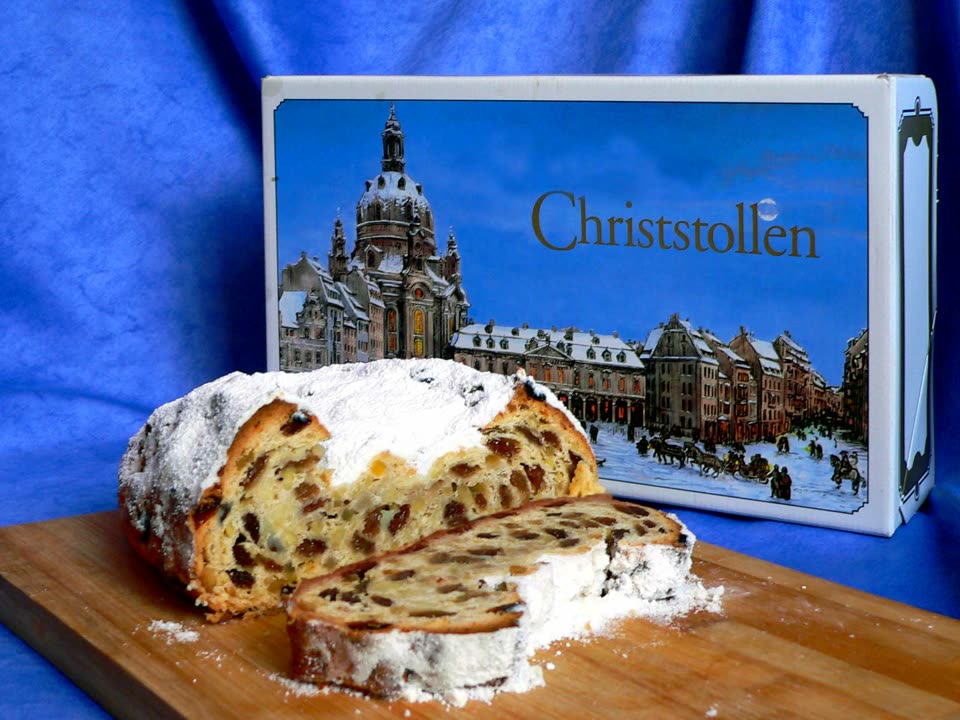
A dense yeast loaf, heavy with dried fruit and butter and buried in icing sugar, shaped — the usual explanation — like the swaddled Christ Child. The Dresden version is protected across the European Union, and the name is older than the cake's Christmas associations: a Naumburg bakers' privilege obliged the city's bakers to deliver «zwey lange weyssene Brothe, die man Stollen nennet» to the bishop every Christmas Eve.
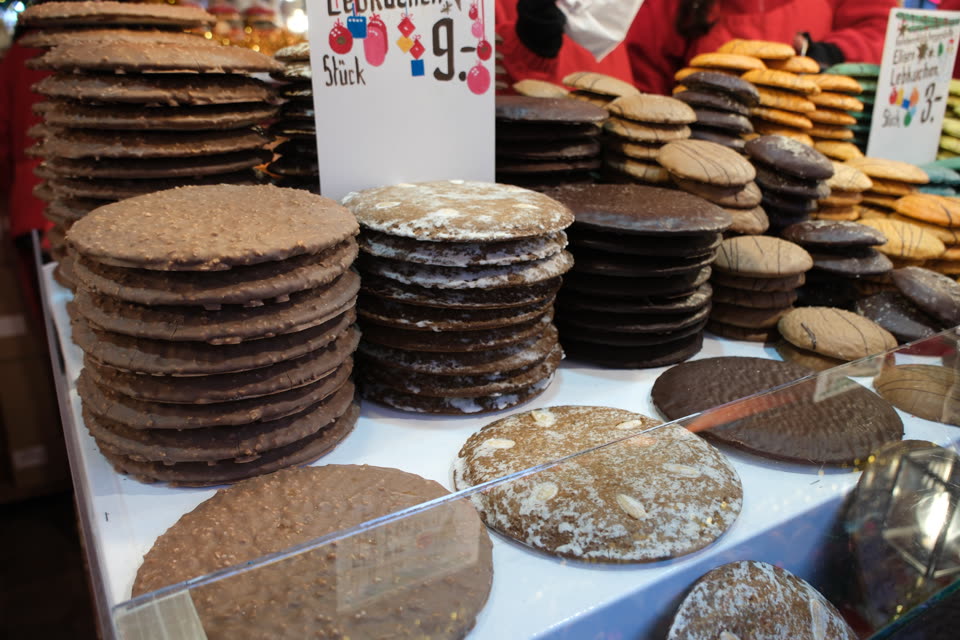
A spiced honey cake, baked in Nuremberg since at least the fourteenth century — bakers of it are documented in the city from 1395, and the city approved a guild of them in 1643. The name is protected across the European Union: it must be baked in Nuremberg itself, though the ingredients may come from anywhere. Germany made a little over 72,800 tonnes of Lebkuchen, Honigkuchen and Printen in 2025, and more than a third of it was baked between July and September.
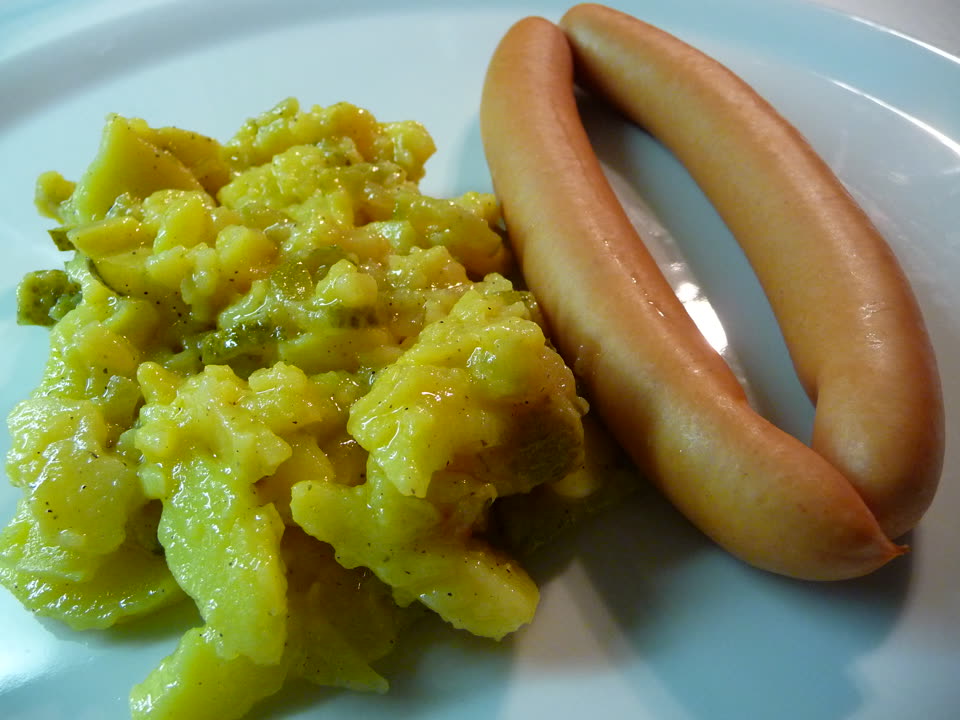
Sausages and potato salad Würstchen mit Kartoffelsalat
The commonest Christmas Eve meal in Germany is sausages with potato salad, and nothing else is close. A quarter of respondents give it as their usual 24 December dinner; meat dishes follow at 14 per cent and roast goose at 9. The old fast-day meal it replaced has almost gone: fish, eaten on Christmas Eve as the last meal before the fast broke, is now the usual choice of 6 per cent. The dish is commonest among the over-55s and markedly commoner in the east than the west.
Widely repeated claims about Christmas in Germany that do not survive
checking. Each one says what is actually the case, because a correction
with nothing in its place leaves you worse off than before.
Unsupported
Martin Luther invented the candle-lit Christmas tree, after walking home under the stars and seeing them through the firs.
What is actually the case. The oldest written trace of the Christmas tree has nothing to do with Luther. It is an entry in Sélestat's municipal accounts for 1521 — four shillings to the foresters, to guard the trees from St Thomas's Day — fifteen years before the date the Luther story is usually given. The story is told as legend even by the publications that repeat it. What Luther did do belongs to the history of gift-giving rather than of trees: his household moved its presents to Christmas, in the Holy Christ's name, in the early 1530s.
What is actually the case. It is an American custom that Germans have mostly never heard of. Asked in 2016, 91 per cent of Germans said they did not know it, and 2 per cent said they practised it. The glass ornaments themselves are genuinely German — Lauscha in Thuringia blew them, and F. W. Woolworth began selling Lauscha glass in the United States around 1880 — but the pickle and its origin stories travelled the other way.
What is actually the case. It became one in 1824, and it did not start as one. August Zarnack, a teacher who ran the Potsdam military orphanage, wrote «O Tannenbaum, o Tannenbaum, wie treu sind deine Blätter» as a man's love-lament and published it in 1820 in a collection of folk songs for schools, to an existing melody. The fir is invoked as the emblem of constancy — the point of the song being the contrast with the unfaithful girl in the second verse. Four years later it was rewritten as a children's Christmas song for a school songbook, keeping the first verse.
O Tannenbaum — Liederlexikon, Zentrum für Populäre Kultur und Musik (Deutsches Volksliedarchiv), Universität Freiburg
Contested
In East Germany, Christmas angels had to be called «Jahresendflügelfiguren» — year-end winged figures.
What is actually the case. Nobody has produced a document. The word is remembered by witnesses, including a former head of the GDR craftsmen's trademark association who said it came from above, and it is attested in print from the mid-1980s — in satire and journalism, not in regulations. The German dictionary's slip index has Jahresendprämie and not the angel word. The story that a 1971 state advertising-agency catalogue imposed it is described as a legend that cannot be traced. What is documented is a smaller and bleaker thing: in 1978 the print-licensing office reprimanded the director of the Dippoldiswalde museum for planning a sheet of angel cut-outs.
Luther invented the Christkind in order to replace Saint Nicholas.
What is actually the case. Both figures already existed, and for a while they appeared together — Luther's own sentence of 1532 has children expecting «das Christkindlin odder Sanct Nicolas». His household was still buying Nicholas presents in the 1530s; a surviving household account records an outlay for Niclasgeschenke. What the Reformation did was reject a saint's gift-giving, which pushed the giving towards Christmas and towards the Holy Christ's name. The folklorist quoted on it is explicit that this was not one man's invention but a cultural process — and the dialect atlas states flatly that it is not true that Luther invented the figure.
The German word for Christmas is a plural, and it started life as a dative singular. Weihnachten is contracted from Middle High German diu wīhe naht — more precisely from the dative ze (der) wīhen naht, in use from the second half of the twelfth century — and means simply the holy night. The singular Weihnacht that looks like the original is the newcomer: it only appears from the eighteenth century. The plural survives in ordinary speech mostly in one place, which is the greeting: fröhliche Weihnachten.
Nine in ten Germans have never heard of the German Christmas pickle. Asked in 2016 about the custom of hiding a glass gherkin in the tree, 91 per cent said they did not know it. Of the 8 per cent who did, most had only heard of it: 5 per cent knew of the vegetable ornament without doing it, and 2 per cent said they kept the tradition.
Germany imports most of its Christmas trees, and nearly all of them come from one country. 1.8 million trees were imported in 2024, and 83 per cent of them came from Denmark; Poland and the Netherlands supplied 7 per cent each. Germany grows trees too — 3,310 farms keep Christmas-tree plantations — but the imported ones are Danish.
The arch of lights in a Saxon window got forty years older because somebody scraped the paint off it. The oldest surviving Schwibbogen comes from the mining town of Johanngeorgenstadt, and until 2003 nobody knew how old it was — a near-identical arch had been overpainted in 1829, and when a restorer removed part of that layer to make a replica for a Dresden museum, he found another painted surface beneath it, partly fire-gilded, carrying the year 1740.
Die Bergmetten — Förderverein Pferdegöpel Johanngeorgenstadt e.V., schwibbogen.org
Germany bakes a third of its Christmas Lebkuchen in high summer. Of the 72,800 tonnes produced in 2025, 36 per cent was made between July and September — the shelves have to be full by the time anyone is thinking about Advent. It was the lowest annual figure in seven years, ten per cent down on 2024.
Every claim carries its own citation. They are collected below, so you
can see what the page rests on and how much of it comes from where.
Christkind (Runde 5, Frage 1b) — Atlas zur deutschen Alltagssprache (AdA), Universität Salzburg and Universität Liège. Retrieved 2026-10-16. archived 13 June 2026A survey atlas rather than an assertion, and it maps the split in its own words: «Für die Bezeichnung der Person, die den Kindern zu Weihnachten die Geschenke bringt, ist eine markante Zweiteilung des deutschsprachigen Raums erkennbar. Während im Norden und Osten Deutschlands an Heiligabend der Weihnachtsmann erscheint, übernimmt im Süden und Westen Deutschlands (inklusive des traditionell katholischen Gebiets im westlichen Niedersachsen) sowie in Österreich und der Schweiz das Christkind diese Aufgabe.»
Gesetzliche Feiertage in Bayern — Bayerisches Staatsministerium des Innern, für Sport und Integration. Retrieved 2026-10-16. archived 7 July 2026The ministry lists 24 December among the stille Tage and gives the hour: «der Schutz der stillen Tage beginnt um 2:00 Uhr, am Karfreitag und am Karsamstag um 0:00 Uhr und am Heiligen Abend um 14:00 Uhr; er endet jeweils um 24:00 Uhr». The exemption is in the same passage: «Sportveranstaltungen sind jedoch erlaubt.»
Nikolaus-Begleiter — Bonifatiuswerk der deutschen Katholiken, nikolaus-von-myra.de. Retrieved 2026-10-16. archived 18 August 2026The companion list is the useful part, and it is long enough to be a map of its own: Knecht Ruprecht across the whole German-speaking area, then Ascheklas, Bullerklas and Klas Bur in Westphalia and the north, Pulterklas in Dithmarschen, Ruklas and Rupsack in Mecklenburg, Hans Muff «(= der muffige Hans)» on the Lower Rhine, Belzebub and Pelzebock in the Eifel and Mosel, Pelzebub in Baden, Pelznickel in the Palatinate and Saarland, Butz in Swabia, Rumpelklas in the Allgäu, Semper and Klaubauf in Bavaria, Schmutzli and Düsseli in Switzerland, Krampus in Austria, Partl and Bartl in Carinthia and Styria, Leutfresser in the eastern Alps.
Nationale Feiertage — Bundesministerium des Innern und für Heimat (BMI). Retrieved 2026-10-17. archived 10 August 2025In the ministry's words: «Die Festlegung von Feiertagen ist in der Bundesrepublik Deutschland grundsätzlich Sache der Länder. Die Ausnahme hierzu ist der Tag der Deutschen Einheit» — setting holidays is a matter for the states, and the 3rd of October is the one exception. «Der einzige bundesrechtlich festgelegte Feiertag ist der Tag der Deutschen Einheit.»What there is instead: «Eine ausdrückliche Kompetenz des Bundes für die gesetzliche Regelung von bundeseinheitlichen Feiertagen besteht nicht. Durch die Sonn- und Feiertagsgesetze der Länder sind jedoch neun Feiertage bundeseinheitlich gesetzlich geschützt» — nine days protected across the whole country by sixteen separate state laws agreeing. The list ends «erster Weihnachtstag, zweiter Weihnachtstag».This source replaced A REGIONAL ONE on 17 October 2026, because «a day off work: yes» had been cited to Bavaria's holiday list alone, which reads as though the claim were Bavarian.Bavaria's list gives «6. Januar – Heilige Drei Könige (Epiphanias)» and Baden-Württemberg's interior ministry gives it as «Erscheinungsfest»; both were read.
Adventskranz: Geschichte & Herkunft — Das Rauhe Haus, Hamburg. Retrieved 2026-10-16. archived 10 April 2026The institution's own account: «Und so bastelte er 1839 aus einem Wagenrad und Kerzen den ersten Adventskranz der Welt.» It quotes Wichern's diary on what the thing was for — «Das Ganze diente ebenso wie zur Erbauung als Stärkung und Freude im Herrn» — and cites Thomas Ehlert, Der Adventskranz und seine Geschichte (Agentur des Rauhen Hauses, 2006).
Geschichte und Tradition — Kleine Marktchronik — Dresdner Striezelmarkt, Landeshauptstadt Dresden. Retrieved 2026-10-16. archived 6 July 2026The privilege is quoted as a market «am Tage vor dem Heiligen Christabend» — the day before Christmas Eve — not on Christmas Eve itself, and the words quoted from the charter are «umb gemeines nutzens und unserer Stadt Dresden besten willen».The chronicle is also explicit about what kind of market it was: «Dieses befristete Privileg bezog sich zunächst auf einen freien Fleischmarkt. Nach den vorweihnachtlichen Fastentagen wählten hier die Bürger ihren Festbraten aus.»The Striezel entry is dated 1471, not 1474; hospital accounts of 1471 record «Eyn Weißbrot den armen Leuten auf Weihnachten», «den Kranken ein Christbrot», «ein Christstrüzel», «jeder Schwester einen Stroczel».
Protestantischer Gegenentwurf: Martin Luthers Christkind verdrängte den Nikolaus — evangelisch.de, Gemeinschaftswerk der Evangelischen Publizistik. Retrieved 2026-10-16. archived 14 March 2026«Eine volkskundliche Umfrage von 1932 ergab, dass das ursprünglich evangelische Christkind als Geschenkebringer vorwiegend in katholische Wohnzimmer einkehrte, während der vom ursprünglich katholischen Nikolaus abgeleitete Weihnachtsmann diese Aufgabe in den evangelischen Regionen Deutschlands übernahm.»
Die Bergmetten — Förderverein Pferdegöpel Johanngeorgenstadt e.V., schwibbogen.org. Retrieved 2026-10-16. archived 9 June 2026«Als im Jahre 2003 eine Replik dieses Bogens für das Museum für Volkskunde in Dresden hergestellt werden sollte, entfernte der Lößnitzer Restaurator Helmut Georgi Teile der Übermalung von 1829. Darunter kamen eine weitere Farbschicht mit teilweiser Feuervergoldung und der Jahreszahl 1740 zum Vorschein. Deshalb musste die Datierung dieses ältesten Schwibbogens um etwa 40 Jahre vorverlegt werden.»
Schachtel "Christkindlesmarkt", Inv. HG1531 — Germanisches Nationalmuseum, Nürnberg — Objektkatalog. Retrieved 2026-10-16.The museum record now gives «Herstellungsdatum 1678» and the measurements that fix the size: «H. 3,5 cm; L. 19,0 cm; B. 3,8 cm», spruce, lid painted, base inscribed. The catalogue transcribes the base as «Regina Susanna Harßdörfferin von der / Jungfrau Susanna Eleonora Erbsin [oder Elbsin] zum / Kindles marck überschickt 1678», describes the lid — a yellow tulip, a red fantasy flower «(Granatapfel?)», pansies and lilies of the valley — and lists the contents as «12 Stränge Naturseide von verschiedener Dicke». The city press release calls it «knapp 20 Zentimeter»; the catalogue's 19.0 cm is the measured figure and is the one used.
Mehr als 47 Millionen Euro werden bei der Aktion Dreikönigssingen 2026 gesammelt — Kindermissionswerk „Die Sternsinger" e.V., Aachen. Retrieved 2026-10-16.The organiser's figures, dated 5 August 2026: «Bis zum Stichtag am 31. Juli wurden bei der 68. Aktion Dreikönigssingen 47.173.855 Euro erfasst», and «Sternsingergruppen aus 7.131 Pfarrgemeinden, Verbänden, Schulen, Kindergärten und weiteren Einrichtungen waren in den ersten Januartagen … unterwegs».
O Tannenbaum — Liederlexikon, Zentrum für Populäre Kultur und Musik (Deutsches Volksliedarchiv), Universität Freiburg. Retrieved 2026-10-16. archived 31 January 2026«Das Liebeslied "O Tannenbaum, o Tannenbaum, wie treu sind deine Blätter" wurde von August Zarnack (1777–1827), Lehrer und Direktor des Potsdamer Militärwaisenhauses, auf eine schon vorhandene Melodie geschrieben und erschien 1820 in seiner Sammlung "Deutsche Volkslieder mit Volksweisen für Volksschulen"», and «Zu Beginn des als Liebesklage eines Mannes angelegten Liedes wird der Tannenbaum als Sinnbild der Treue beschworen, die im Kontrast steht zur Untreue des in der zweiten Strophe angesprochenen Mädchens».On the Christmas version: «Erstmals veröffentlicht worden ist es 1824 in einem Schulliederbuch als Umdichtung eines wenige Jahre zuvor entstandenen Liebeslieds, dessen erste Strophe beibehalten wurde.»
Weihnachten ohne Christkind und Engel — MDR, Mitteldeutscher Rundfunk. Retrieved 2026-10-16. archived 5 October 2026The verdict is «contested» because the sources disagree about the same question rather than about different ones: there are named witnesses and no archival trace.
Adventskranz wurde in Hamburg erfunden und hatte 24 Kerzen — NDR, Norddeutscher Rundfunk. Retrieved 2026-10-16. archived 7 April 2026The text reads «Noch heute wird im Hamburger Rauhen Haus der traditionelle Wichern-Kranz mit — je nach Jahr — bis zu 28 Kerzen entzündet», and explains that Wichern fixed on as many candles «wie es Tage vom ersten Advent bis zum Heiligen Abend waren», unlike a modern Advent calendar which always shows 24.The fir and the Catholic adoption are here too: «Erst um 1860 wurde der Kranz auch mit Tannengrün geschmückt», and «1925 soll auch erstmals ein Kranz in einer katholischen Kirche in Köln gehangen haben» — soll, reportedly, which is the broadcaster's own hedge.
"Klaasohm" auf Borkum: Wie das Fest ab heute gefeiert werden soll — NDR, Norddeutscher Rundfunk. Retrieved 2026-10-16. archived 4 September 2025NDR, 5 December 2024, on the night itself: the island's «höchsten Feiertag», «die Nacht vor dem Nikolaustag, also vom 5. auf den 6. Dezember», and the practice — «Dabei wurde Frauen von maskierten Männern mit Kuhhörnern auf das Gesäß geschlagen, wenn sie an diesem Abend nicht zu Hause blieben.» The whaling attribution is the broadcaster's: «Alte Walfänger-Tradition». The mayor is named as Jürgen Akkermann (independent), and the change took effect «ab kommender Nacht schon».
Klaasohm 2025 — Stadt Borkum. Retrieved 2026-10-16. archived 21 April 2026The town's own page a year on, which is what establishes that the festival continues and what changed: the association «formulierte bereits im Dezember 2024 eine klare Null-Toleranz-Linie gegen jegliche Form von Gewalt und bat öffentlich um Entschuldigung», and «im Jahr 2025 wurde dieser Wandel verstetigt: Der VBJ hat verbindliche Regeln eingeführt, die Gewalt ausdrücklich ausschließen», quoting Oldermann Maximilian Rau, chairman since 2024.
Neue wissenschaftliche Erkenntnisse zur Geschichte des Nürnberger Christkindlesmarkts (Nachrichten aus dem Rathaus Nr. 1168) — Stadt Nürnberg. Retrieved 2026-10-16. archived 15 December 2025The city's own announcement, and the reference it carries is «Nachrichten aus dem Rathaus Nr. 1168 / 23.10.2025», printed at the top of it.The word for the blot is Tintenkleks: «Die dritte Ziffer der Jahreszahl ist leicht verschmiert und teilweise durch einen Tintenkleks verdeckt und deshalb nahezu unleserlich.» Photographic analysis settled nothing — «Weder Quellen im Germanischen Nationalmuseum noch fototechnische Untersuchungen führten zu einem eindeutigen Ergebnis» — which is why the proof is genealogical.The spelling of the giver's surname is uncertain and is left so: the museum catalogue prints «Erbsin [oder Elbsin]» and the city prints «Elbsin».
Klausentreiben — Stadt Sonthofen. Retrieved 2026-10-16. archived 12 June 2026«Vermummt mit dicken Pelzen, geschmückt mit Geweihen, Hörnern und riesigen Kuhschellen und bewaffnet mit Ruten laufen sie in Gruppen umher und schlagen nach den Schaulustigen.»The sentence worth having is the next one: «Auch für diese Überlieferung gibt es bis heute nur Deutungsversuche» — to this day there are only attempts at interpretation. Age claims attached to this custom elsewhere, including «about 1,000 years old» from the Klausenverein's chairman, rest on nothing documentary and are not printed.
10 % weniger Lebkuchen im Jahr 2025 produziert (Zahl der Woche Nr. 42) — Statistisches Bundesamt (Destatis). Retrieved 2026-10-16. archived 13 October 2026Dated 13 October 2026: «Im Jahr 2025 wurden in Deutschland gut 72 800 Tonnen des Weihnachtsgebäcks produziert … Das war der niedrigste Wert der vergangenen sieben Jahre und entspricht einem Rückgang von 10 % gegenüber dem Vorjahr.» 2024 was «gut 81 000 Tonnen». The seasonal shift is in the same release: «So entfiel 2025 mehr als ein Drittel (36 %) der Produktion auf die Monate Juli bis September.»
Fakten zum Advent — Statistisches Bundesamt (Destatis). Retrieved 2026-10-16. archived 16 December 2025«Im Jahr 2024 wurden 1,8 Millionen Weihnachtsbäume nach Deutschland importiert. Der größte Teil der nach Deutschland eingeführten Weihnachtsbäume stammt üblicherweise aus Dänemark: Im letzten Jahr kamen 83 % der importierten Weihnachtsbäume aus unserem nördlichen Nachbarland. Weitere 7 % der Bäume wurden 2024 jeweils aus Polen und den Niederlanden importiert.»
Etappe 1: Ausstellung „1521: Die Tradition des Weihnachtsbaums“ — Ville de Sélestat. Retrieved 2026-10-16.The town's German page, which carries the page number — «findet sich auf Seite 239 ein handschriftlicher Vermerk» — the date, the four shillings, the claim «Es handelt sich hierbei um die weltweit älteste bisher bekannte schriftliche Erwähnung des Weihnachtsbaums», and the inference about guarding the wood.The German page does not give it; it gives a translation, and the translation garbles the key word — «... ebenso 4 Schilling an die Förster für die Bewachung der Maisfelder ab dem Thomas-Tag». Maisfelder is maize fields, which cannot be what a 1521 Alsatian account book means in late December.
Kartoffelsalat und Würstchen sind beliebtestes Heiligabend-Essen — YouGov Deutschland. Retrieved 2026-10-16. archived 16 March 2026Published 8 December 2015: «bei jedem vierten Befragten (26 Prozent) Würstchen und Kartoffelsalat — mit Abstand die beliebteste Mahlzeit am 24. Dezember. Auf Platz zwei folgen Fleischgerichte (z. B. Steak oder Schnitzel, 14 Prozent), Gänsebraten (9 Prozent).» On fish: «Heute geben nur noch 6 Prozent der Deutschen an, dass es am 24. bei ihnen für gewöhnlich Fisch gibt.» And the age and east–west splits: 31 per cent of the over-55s against 23 per cent of those under 55, and «Im Osten ist die Tradition wesentlich verbreiteter als im Westen.»
Brauchtum: Weihnachtsgurke in Deutschland weitgehend unbekannt — YouGov Deutschland. Retrieved 2026-10-16. archived 18 April 2026«Der Brauch der Weihnachtsgurke ist in Deutschland fast gänzlich unbekannt. 91 Prozent der Befragten sagen sie kennen ihn nicht. Nur 8 Prozent der Deutschen kennen den Brauch der Weihnachtsgurke. Davon sagen 5 Prozent, sie haben schon einmal von dem Gemüse-Weihnachtsbaumschmuck gehört, zelebrieren ihn aber nicht. Und nur 2 Prozent sagen sie praktizieren die Tradition, die in den USA in den letzten dreißig Jahren beliebt» — the sentence runs on past what was captured, so the American half of it is summarised and not quoted.