Gwiazdor — the Star ManGwiazdor · arrives 24 December
Who brings the presents
Święty MikołajŚwięty Mikołaj · arrives 6 December
Who brings the presents
Dzieciątko — the Christ ChildDzieciątko · arrives 24 December
Who brings the presents
Dziadek MrózDziadek Mróz · arrives 31 December
—days
—hrs
—min
—sec
Next: Friday 25 December 2026
How to say it
Wesołych Świąt
Wesołych Świąt
say it: veh-SAW-wykh SHFYONT
A Polish speaker recording for Lingua Libre, contributing as «Poemat», saying Wesołych Świąt Bożego Narodzenia — the longer form, which contains the greeting.
Wikimedia Commons — Lingua Libre, CC0.
Literally «happy holidays», and the dictionary glosses it as BOTH «Merry Christmas» and «happy Easter» — it is the general festival greeting and not a Christmas one. For Christmas specifically Poles extend it: «Wesołych Świąt Bożego Narodzenia». A record that printed «Wesołych Świąt» as the Polish for Merry Christmas and stopped would be right about the words and wrong about what they mean, which is the failure this project keeps meeting in other fields.
In Pomerania and Wielkopolska — «na terenach dawnego zaboru pruskiego», in the lands of the former PRUSSIAN PARTITION, which is how the museum puts it — the main figure of the carol group was and is Gwiazdor. Usually one, sometimes played by two young men. He examined the children on their prayers, handed out sweets, apples, gingerbread or nuts, and punished the disobedient with a straw korbacz, a birch switch or a rope. His name is given two etymologies by the same ethnographer: from «gwiazda», the star the carol group carries, or from «gwizdanie», whistling — the «Gwiżdże» were the members who went ahead and announced the group's arrival to the village days in advance by whistling loudly on a pipe.
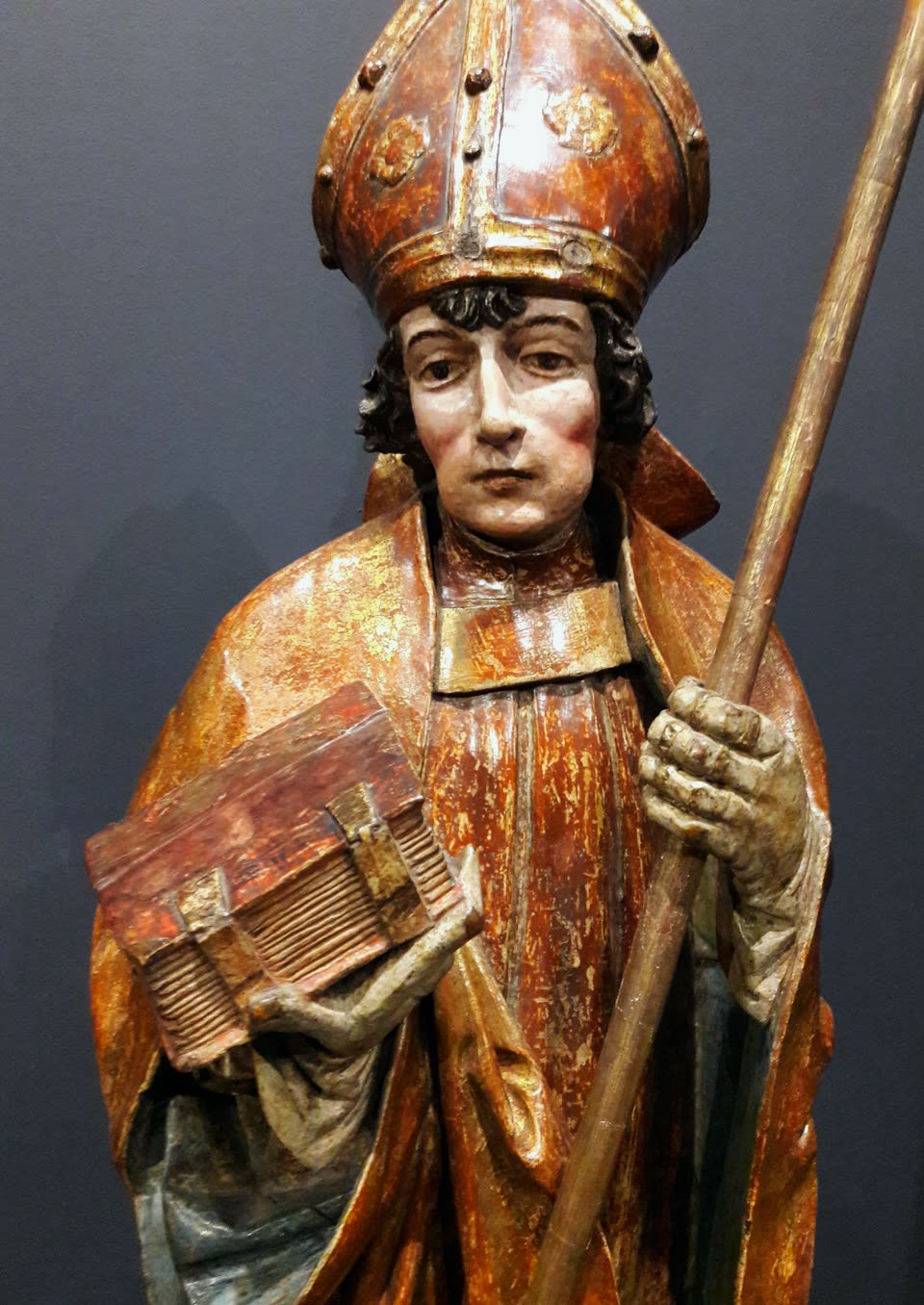
St Nicholas, nationally, and on two different days depending on what is meant. On 6 December he leaves small presents for children — Mikołajki — which is a separate occasion from Christmas. He has also become the Christmas Eve gift bringer across most of the country, displacing the regional figures: Polish Wikipedia's own account of Gwiazdor ends by saying that migration, mass media, shopping centres and above all popular culture have moved part of Wielkopolska and Kaszuby onto Święty Mikołaj, while noting he is still much less popular there than Gwiazdor.
In Upper Silesia the presents come from the Christ Child rather than from a man with a sack. It is the same figure as the German and Austrian Christkind, which Luther propagated around 1535 as a Protestant alternative to St Nicholas and which then became a mainly Catholic custom — and the German account of its range names Upper Silesia in present-day Poland explicitly, alongside southern and western Germany, Alsace, Luxembourg and Austria. So the gift bringer here is a direct survival of the German-speaking world's, in the part of Poland that was in it.
Grandfather Frost, the East Slavic New Year figure, promoted in Poland during the Stalinist years as a secular replacement for the Christmas gift bringers. He never displaced them and did not survive the period as a majority custom. The Russian-language account of the Polish Christmas adds that he comes «к православным полякам», to Orthodox Poles — a group of roughly 600,000, about one Pole in sixty — so he may be a small living custom in the east as well as a dead political imposition in the past. No Polish source consulted mentions him at all, and the record claims neither reading as settled.
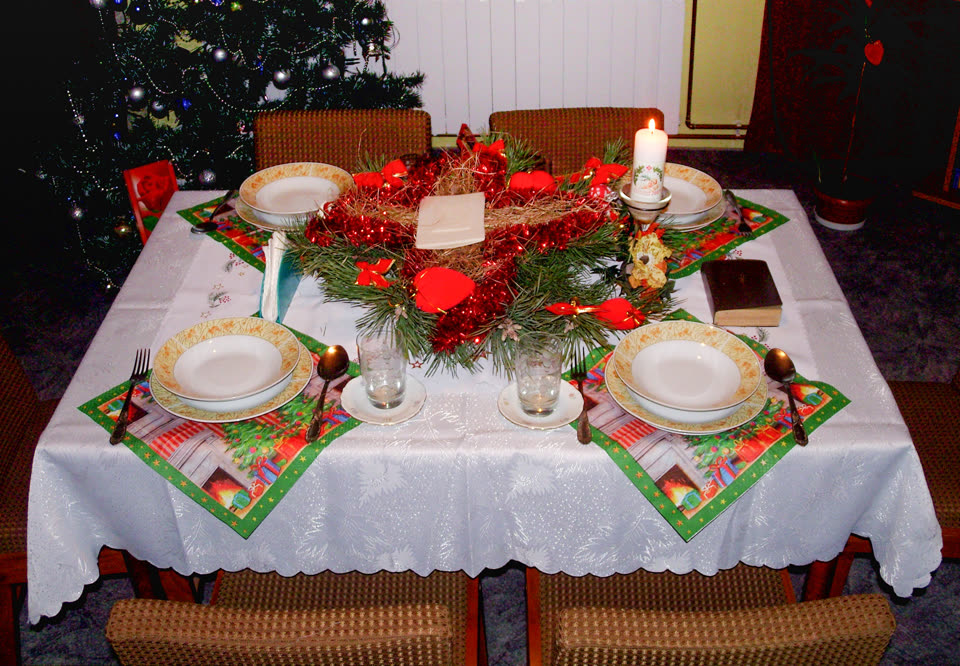
Wigilia begins when the first star appears, and the meal before it is a fast
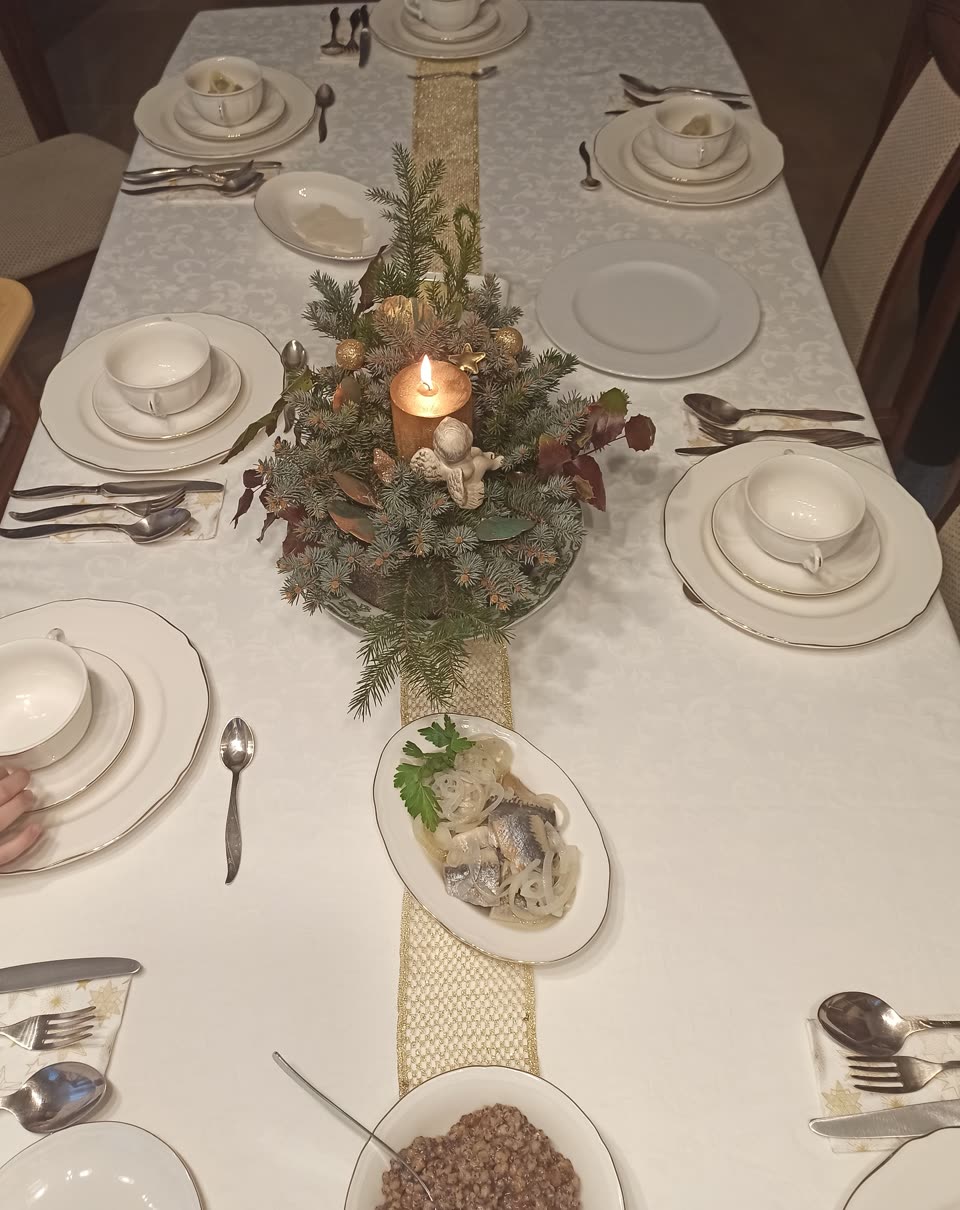
Christmas Eve is the centre of the Polish Christmas, and the supper does not begin at a time — it begins when the first star is seen. «Do wieczerzy siadano, gdy zaświeciła pierwsza gwiazdka.» The day itself was kept as a fast, in places with no food at all until the supper, and the dishes are postne: made from what the field, forest, orchard and water give — fruit, grain, poppy seed, nuts and fish. The star is why the Polish word for Christmas Eve supper and the word for a little star are so close, and why German accounts of the Polish custom borrow «Gwiazdka» untranslated.
The number of dishes was odd — and twelve is the exception that became the rule
Every foreign account of a Polish Christmas gives twelve dishes, for the twelve apostles. The ethnographic record says something else: «Na ogół liczba potraw była nieparzysta: trzy, pięć, siedem lub dziewięć» — as a rule the number was ODD, three, five, seven or nine. Twelve was regional, recorded for instance around Morawica in Dębska Wola, and explained there as the twelve apostles at the Last Supper. What had to be even was the number of PEOPLE: an odd number at the table meant somebody in the house would die within the year, and if the count came out odd a lone neighbour was invited to even it.
Zwyczaje wigilijne na dawnej wsi — dzieje.pl — Polska Agencja Prasowa, with Muzeum Historii Polski; quoting Janina Skotnicka, Muzeum Narodowe w Kielcach
A thin unleavened wafer, stamped with a Nativity scene, is broken and shared by everyone at the table with a wish for each person, before anybody eats. It is the most recognisable Polish Christmas custom and it is younger than it looks: the opłatek appeared in Poland in the seventeenth and eighteenth centuries, and at the start of the twentieth there were still country districts where it was unknown and people shared BREAD instead. The sharing is the custom; the wafer is the latest thing to be shared. On the Wigilia table the centre was a loaf of bread with the opłatek laid on top of it, which is the two of them in one object.
Zwyczaje wigilijne na dawnej wsi — dzieje.pl — Polska Agencja Prasowa, with Muzeum Historii Polski; quoting Janina Skotnicka, Muzeum Narodowe w Kielcach
Hay under the tablecloth, and the stalk you pull out of it
Straw or hay is spread under the Wigilia tablecloth. The reason given in the countryside was not the manger but the harvest — it was to guarantee a good crop in the coming year. It also carried a fortune: you pulled a stalk out from under the cloth, and a long one meant a good year and a long life while a short or blackened one did not. Unmarried women drew from the hay to learn what their husband would be like. In the Kielce region the men went further after supper and lay down on straw spread on the floor, throwing handfuls at the ceiling; the ones that stuck up there promised a good crop.
The empty place is for the dead, and the stranger is how they arrive
A place is laid that nobody will sit in. Modern and foreign accounts explain it as hospitality — a setting kept for an unexpected guest, for a traveller caught out by winter. The older explanation is different and the two are the same belief at different ages: the Wigilia supper descends from the feast for the dead, the turn of the year was when the dead came back to the earth, and the empty setting was for the souls of ancestors. The bridge between the two readings is explicit in the ethnography — it was believed that an ancestor's soul might arrive IN THE FORM of a wanderer, so you laid a place for the wanderer. Leftovers were left out for the dead as well.
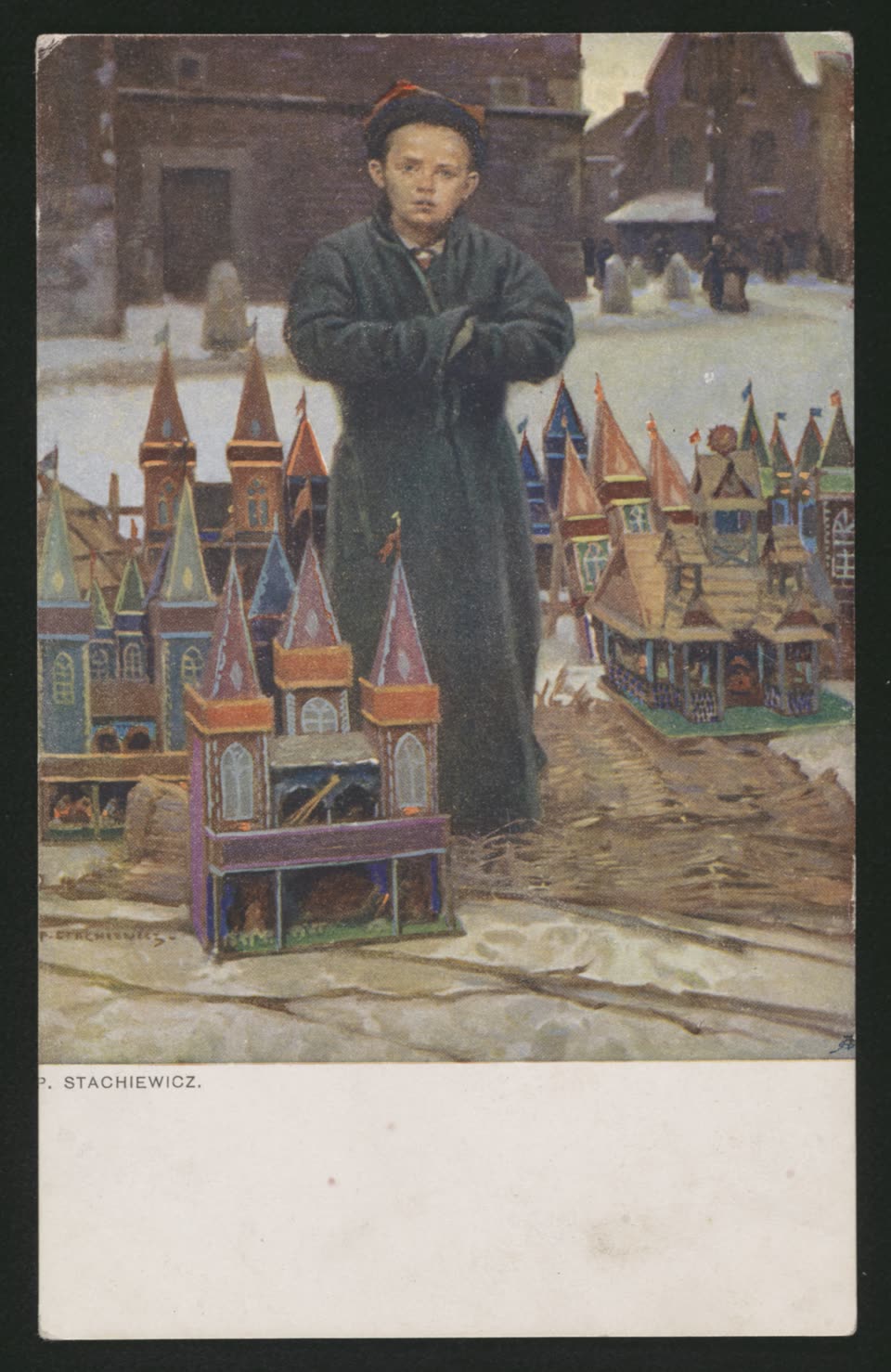
Szopka krakowska — a nativity scene built out of Kraków itself
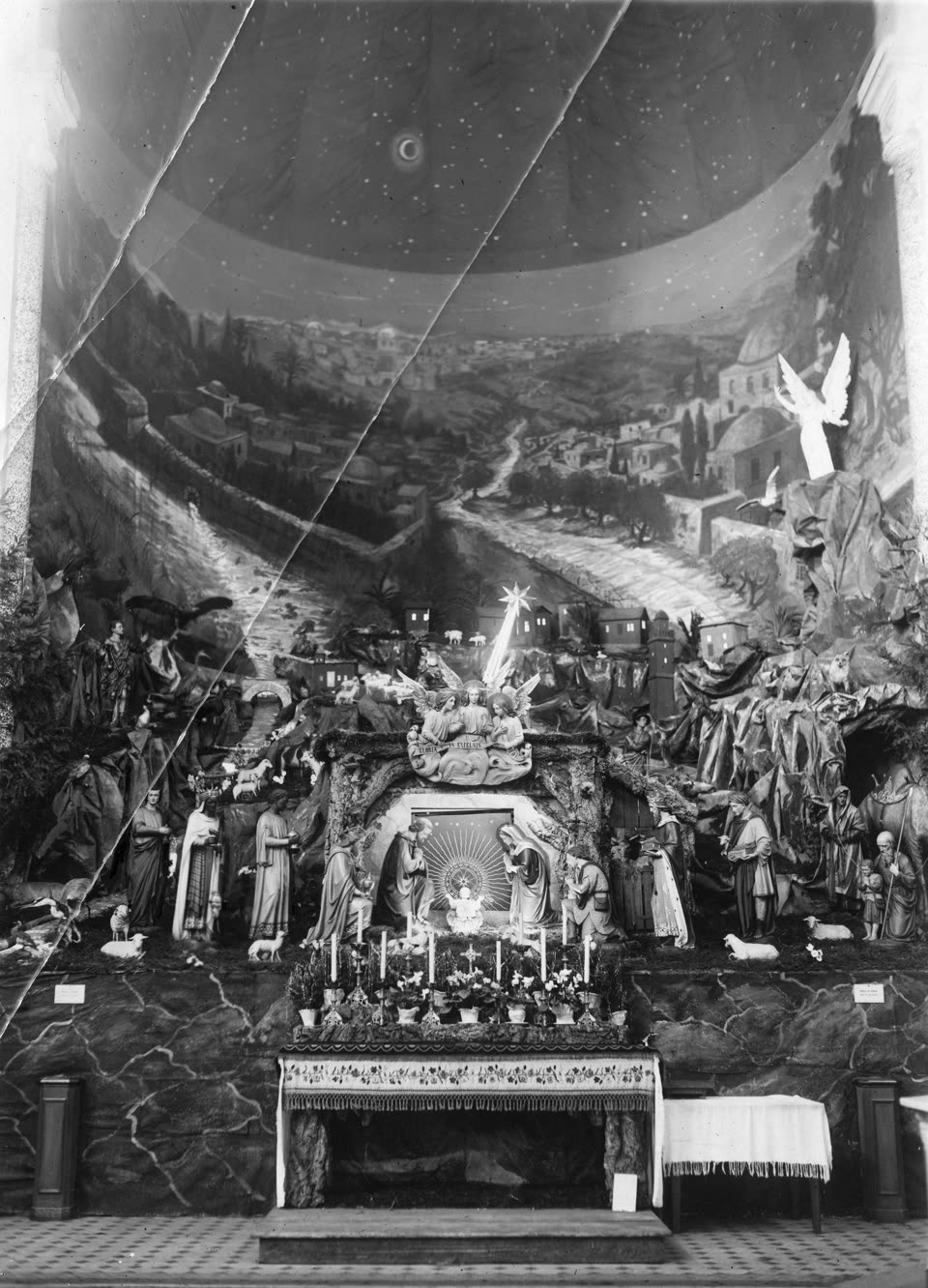
The Kraków szopka is not a stable. It is a tall, light, brilliantly coloured construction in which the Nativity is set inside miniature versions of the city's own buildings — the towers of St Mary's, the Wawel, the Sukiennice — made of cardboard and tinfoil. UNESCO describes it as «a social practice originating from Christmas celebration customs, centred around constructing cribs», born in the nineteenth century and «indissolubly connected to the City of Krakow». It was inscribed on the Representative List of the Intangible Cultural Heritage of Humanity in 2018, the first Polish entry.
Kolędnicy — the carol round is a house visit, not a parade
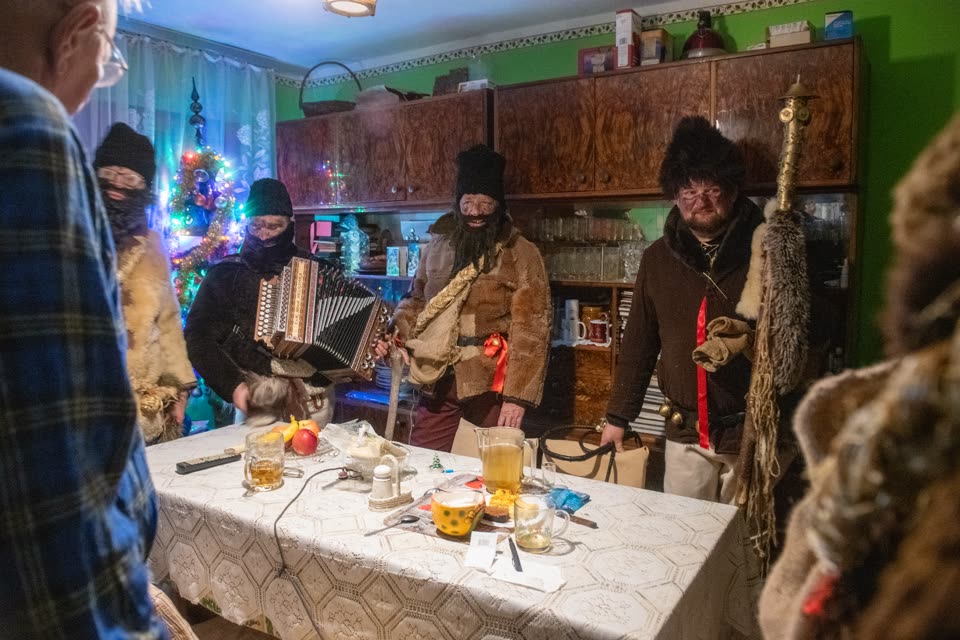
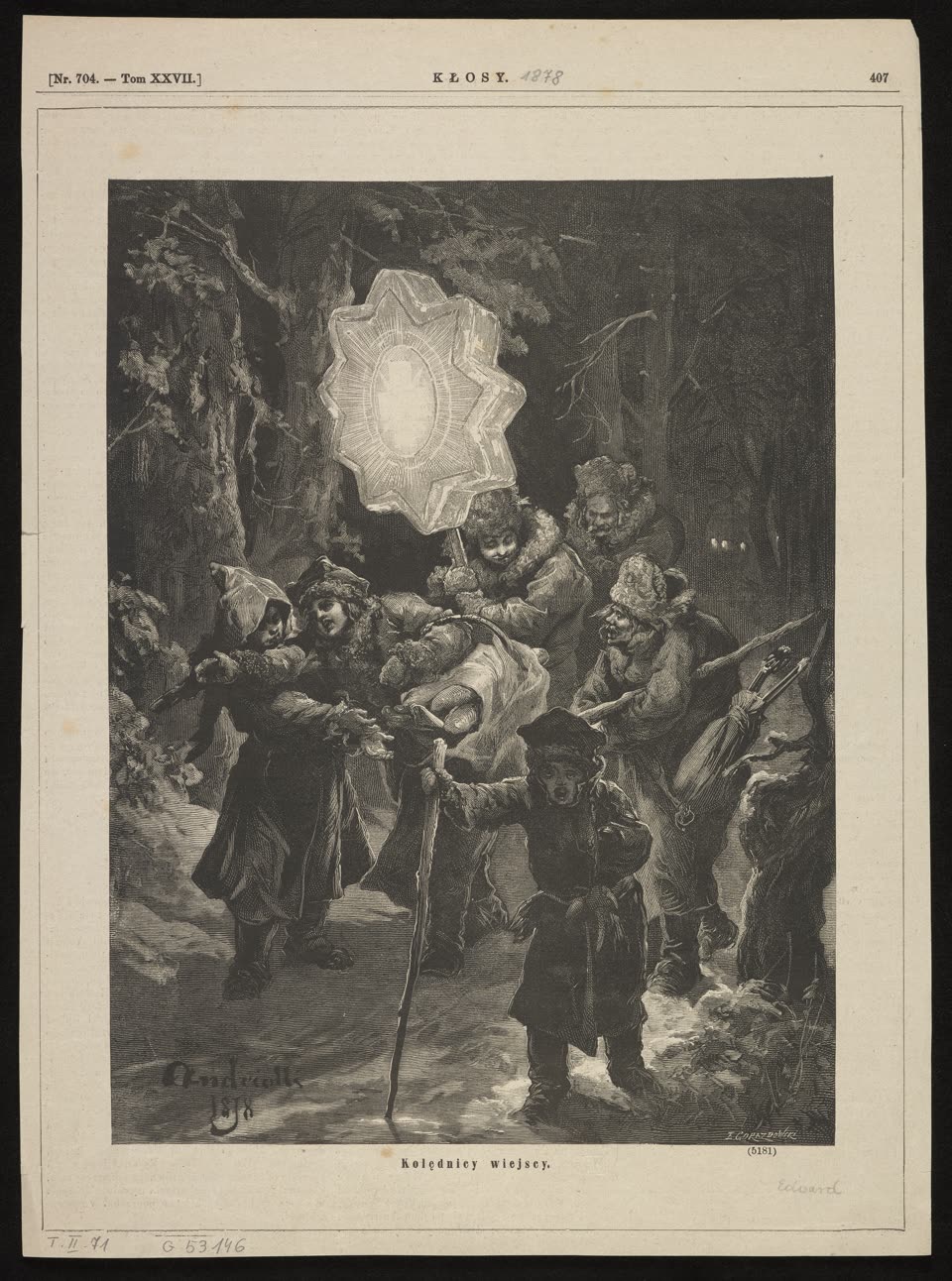
From the second day of Christmas, St Stephen's, costumed groups walk from house to house: with a star on a pole, with a crib, with a turoń — a snapping horned beast under a cloth — and with the Herod play. They are let in, they perform in the kitchen, and they are fed and paid. The Katowice regional culture institute has been photographing the surviving rounds in the Beskids: Szczyrk on 28 December, Leśna on 31 December, Radziechowy at Epiphany, which is three dates and three different rounds filed under the one word.
Mikołaje z Łąki — a village where St Nicholas arrives three at a time, with Death
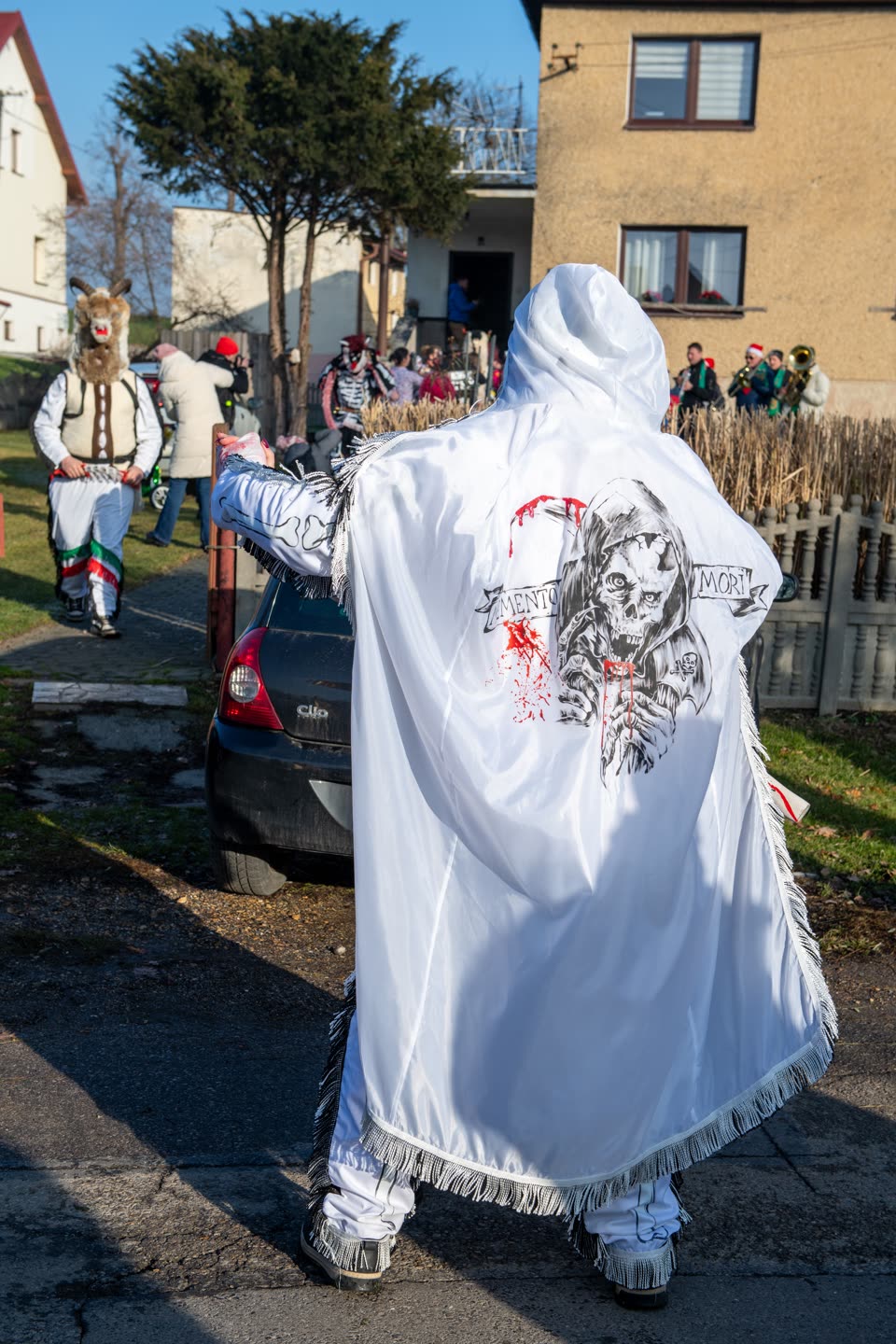
In Łąka, near Pszczyna in Upper Silesia, on the Sunday nearest 6 December, bands of costumed figures come out of the church of St Nicholas after Mass and go through the village visiting houses. They are called «bandy mikołajowe». There are three Mikołaje at once, in full bishop's vestments with mitres and croziers — and dark sunglasses — and they walk with a brass band, a bear, a devil, sheep-headed figures, a chimney sweep, and Death in a white hooded cape with a skull and MEMENTO MORI printed across the back.
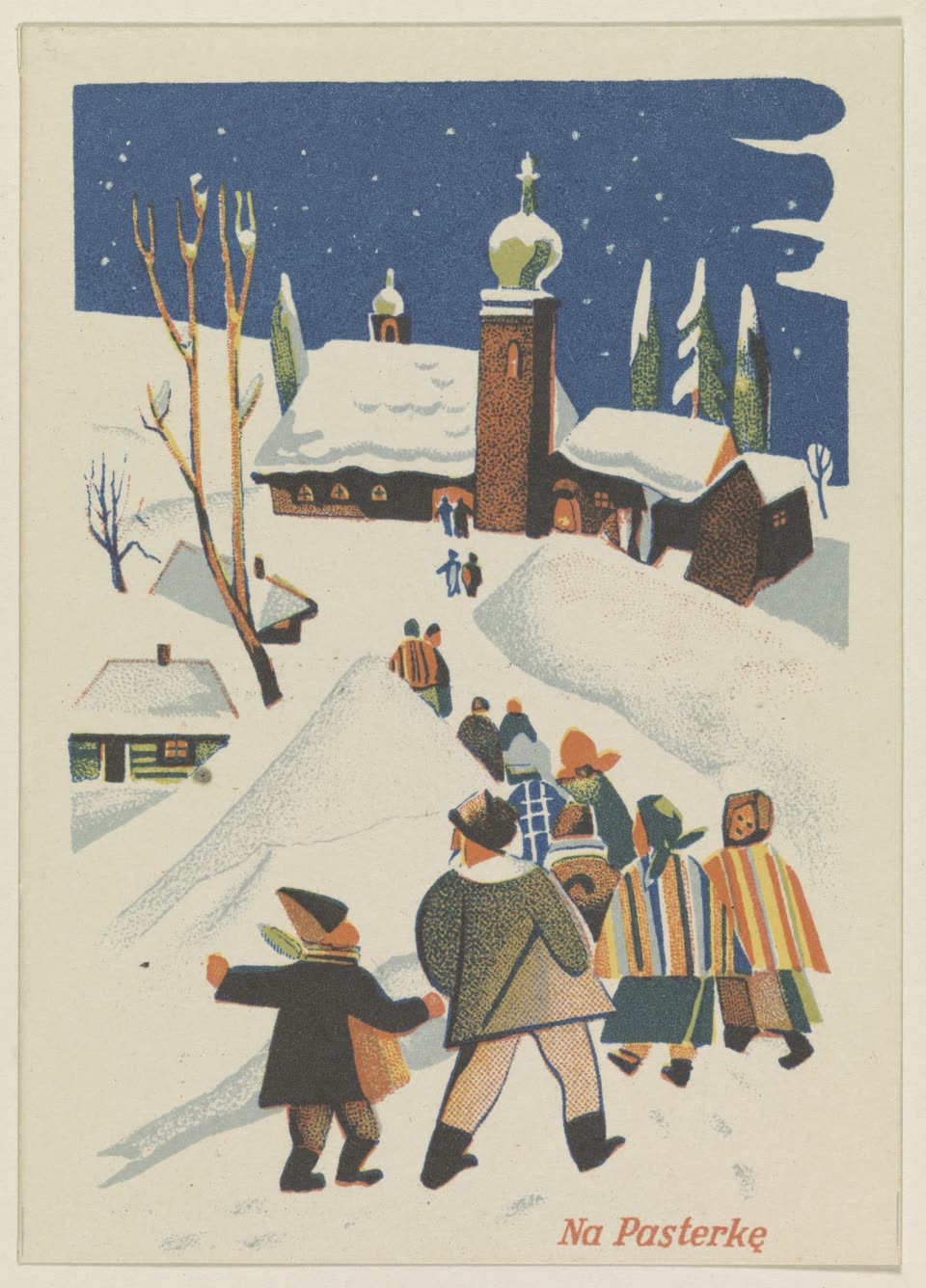
Midnight mass on Christmas Eve, named for the shepherds who were first at the manger. It closes the Wigilia and it is the night's second gathering: the supper is the family, the Pasterka is the parish. It is the most-attended mass of the Polish year and in the countryside people walked to it in the dark, which is the scene the greetings-card printers chose again and again — «Na pasterkę» is a whole genre of Polish Christmas card.
A small Orthodox minority keeps Christmas on 7 January
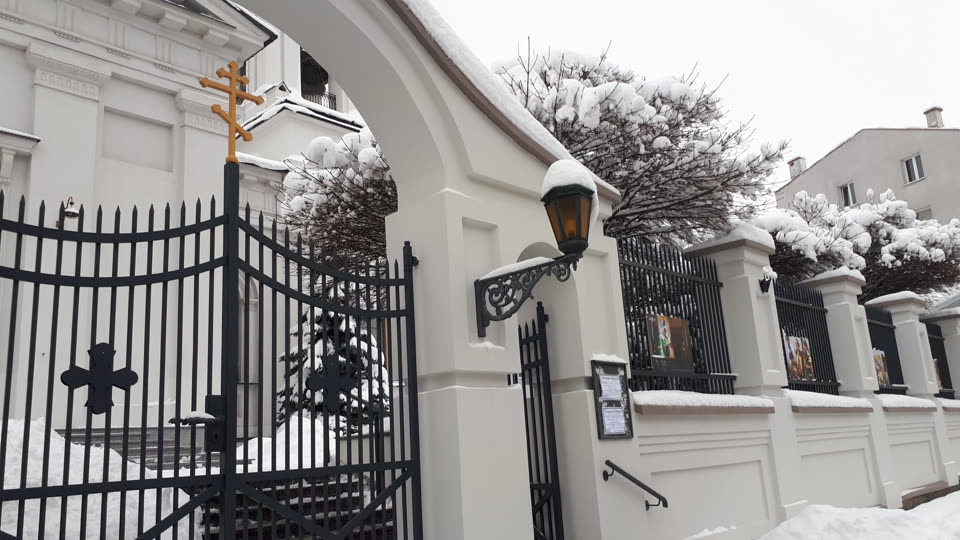
Poland's Christmas is a Catholic one, and overwhelmingly so. The exception is small and worth knowing: the Polish Autocephalous Orthodox Church has roughly 600,000 faithful — about one Pole in sixty, in a country of 36.6 million — in 250 parishes, and close to 70 per cent of them live around Białystok in the east. They keep the old calendar, so their Wigilia falls on 6 January and Christmas on 7 January, thirteen days after everyone else's.
Their eve is called sooczelnik, from socziwo, cooked grain with something sweet in it, which is the same dish and the same word as kutia. They break prosfora rather than opłatek — and that sharing is recent, adopted from the Catholic majority around them. A cup of grain with a wax candle in it stands on the embroidered white cloth. On Podlasie the carol round begins on the first day of Christmas, and in the towns the carollers carry a star up to two metres across and sing beneath the apartment blocks.
The eastern table is now in the far west, because the people who ate it were moved
Ziemia Lubuska, on the German border, is called a melting pot of cultures, and the reason is 1945: post-war migration replaced its inhabitants with newcomers from across Poland, from the eastern borderlands of the Second Republic, and from Romanian Bukovina. The only native ethnographic group with unbroken pre-war continuity is in western Wielkopolska. So the Christmases kept in Lubuskie today are the Christmases of places several hundred kilometres east: the Bukovina highlanders gather up to forty people under one roof in a different house each year, and their most important dish is kutia of wheat and poppy seed, with lenten pea soup, Ukrainian borscht, stuffed vine leaves and płacinty — yeast buns filled with poppy and plum jam, which unmarried women would put outside, the one the dog ate first telling whose wedding came first.
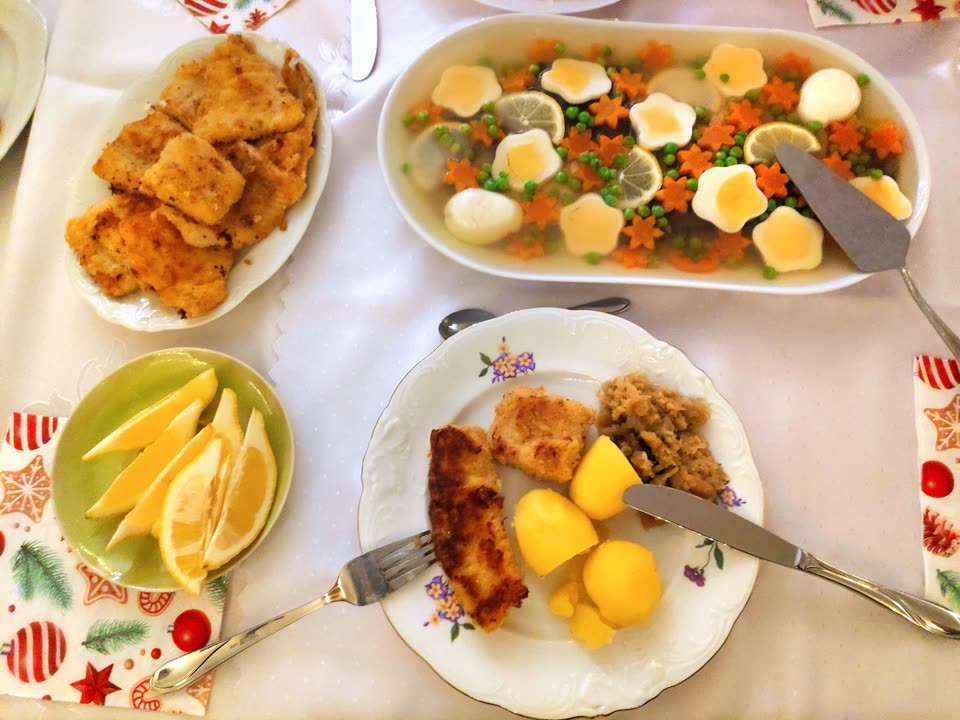
The fish on the Wigilia table, fried or in jelly, and for much of the twentieth century bought alive and kept in the bath until Christmas Eve. It is the dish foreigners know about Poland and the one Poles argue about: it is widely said to have been imposed by the communist state in the 1940s, and that is a half-truth worth untangling rather than repeating. See misattributions.
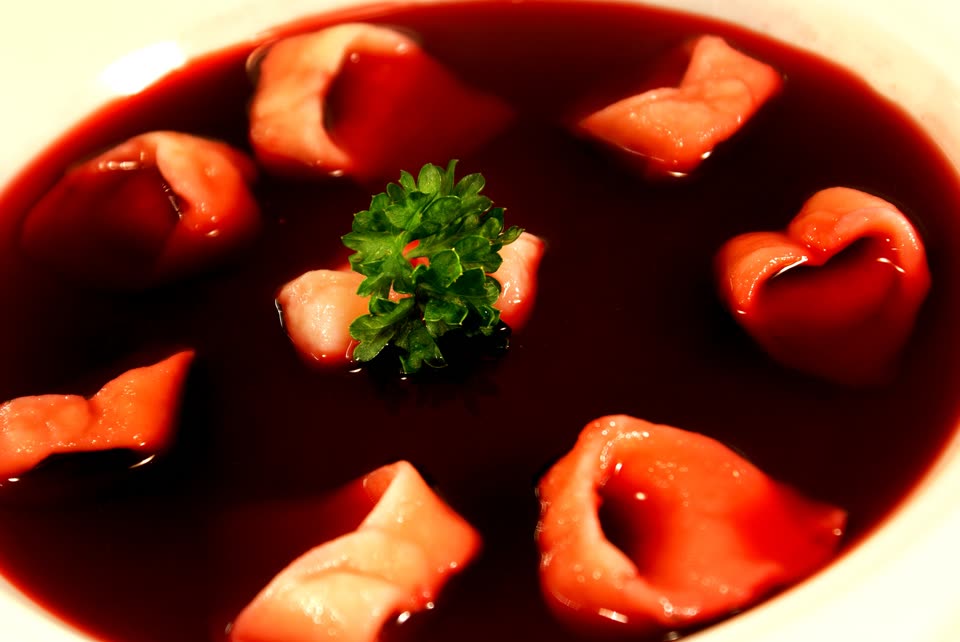
A clear, sour beetroot broth with «little ears» — small pasta dumplings filled with dried wild mushroom — floating in it. It is the first course of the Wigilia supper over most of Poland, and it is a fasting dish by construction: no meat in the stock, no meat in the filling. In the Kielce region the same slot was filled by mushroom soup, or barszcz made with mushrooms rather than beetroot, which is the same idea with whatever the forest gave.
Zwyczaje wigilijne na dawnej wsi — dzieje.pl — Polska Agencja Prasowa, with Muzeum Historii Polski; quoting Janina Skotnicka, Muzeum Narodowe w Kielcach
Kluski z makiem, and the poppy seed on the table kluski z makiem
Noodles or small dumplings with sweetened ground poppy seed. Poppy seed runs through the whole Polish Christmas table — in kluski, in makowiec, in kutia further east — and the ethnographic reason is older than the sweetness: the Wigilia supper descends from the feast for the dead, and its ingredients are the feast-for-the-dead ingredients. Poppy seed, nuts, grains, pulses, apples and mushrooms are the list, and poppy in particular is the seed of sleep and of the dead across Slavic practice.
Salted herring, soaked and served in oil with onion, or in soured cream. It belongs on this list because it is what the record actually shows on the poorer Wigilia table: in the Kielce countryside herring was the fish of Christmas Eve «bo były najtańsze» — because they were cheapest. Any account that puts carp on every historical Polish table has replaced the fish people could afford with the fish they are sold now.
Zwyczaje wigilijne na dawnej wsi — dzieje.pl — Polska Agencja Prasowa, with Muzeum Historii Polski; quoting Janina Skotnicka, Muzeum Narodowe w Kielcach
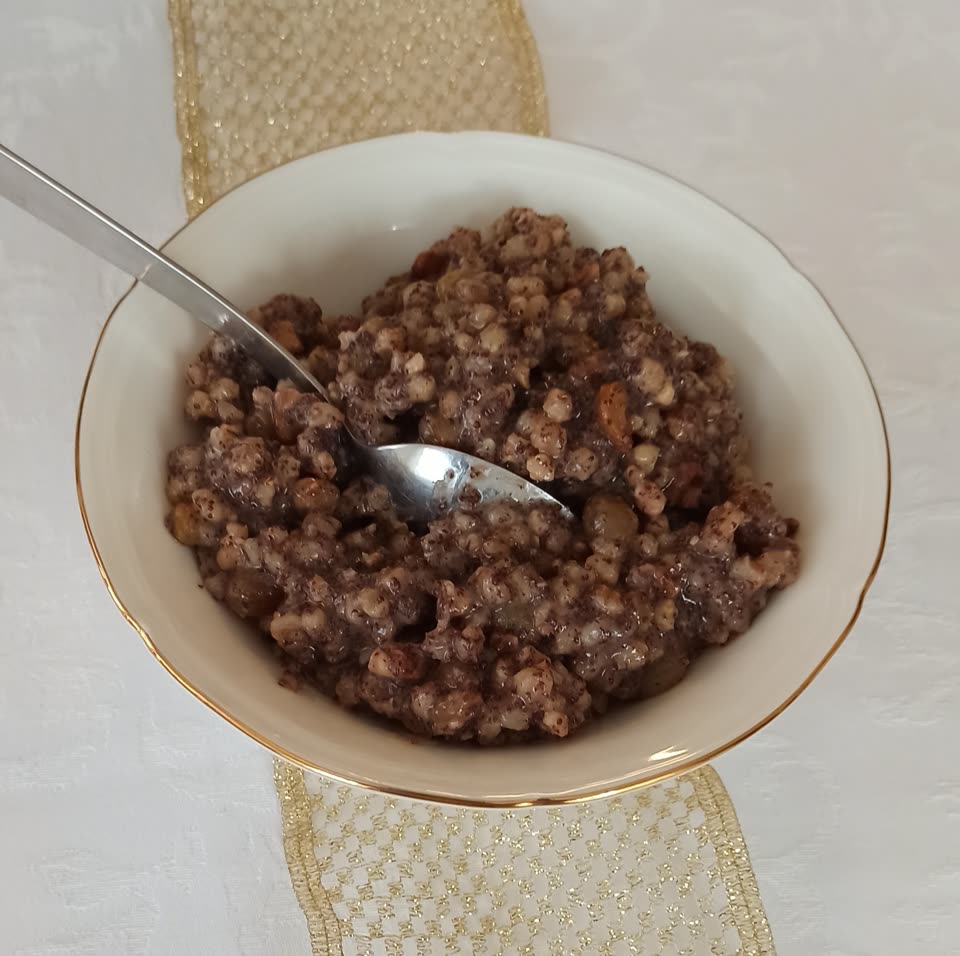
Whole wheat or barley grains boiled and dressed with honey, poppy seed, nuts and dried fruit. It is the eastern Polish Christmas dish — Podlasie, Lublin, the lands the borderland populations came from — and in the east the Wigilia supper was named after it. What it is NOT is a pudding: across the Slavic world kutia is the dish of funerals, memorial meals and the Saturdays of the dead, and both East and West Slavs put it on the table on Christmas Eve. That is the Polish ethnographers' account of the whole Wigilia supper — that it descends from the feast for the dead — arriving independently from the other side of the border, in the form of a specific dish that is still eaten at both.
Poland has three statutory Christmas days, and the third one is four months old. Christmas Eve became a non-working day by the act of 6 December 2024, in force 1 February 2025 — so the first Wigilia that was legally a day off was 24 December 2025. The drafters had used up the alphabet: 24 December is inserted into the list of holidays as item «ka)», wedged between k) Independence Day and l) Christmas Day.
Epiphany was taken off Poland's holiday list by one sentence in 1960 and put back by one sentence in 2011. The 1960 act reads, in full: «w art. 1 pkt 1 skreśla się lit. b) i i)» — in article 1 point 1, delete letters b) and i). Letter b) was 6 January, Epiphany; letter i) was 15 August, the Assumption. The communist state removed two Marian and Christological feasts from the working calendar in nineteen words. The restoration, fifty-one years later, is one line of an employment-law amendment: «w art. 1 w pkt 1 lit. b otrzymuje brzmienie: „b) 6 stycznia - Święto Trzech Króli”».
One Polish institution has released more free photographs of the living Christmas than this project has found for any other country. The Regionalny Instytut Kultury w Katowicach, photographing through its Mobile Digitization Centre, has put 4,431 files of Silesian custom on Wikimedia Commons under CC BY 4.0, typically at 8256×5504. Four hundred and nine of them are the Christmas cycle: 153 of the New Year «dziady», 136 of Epiphany processions, 67 of the Łąka St Nicholas bands and 53 of carol rounds.
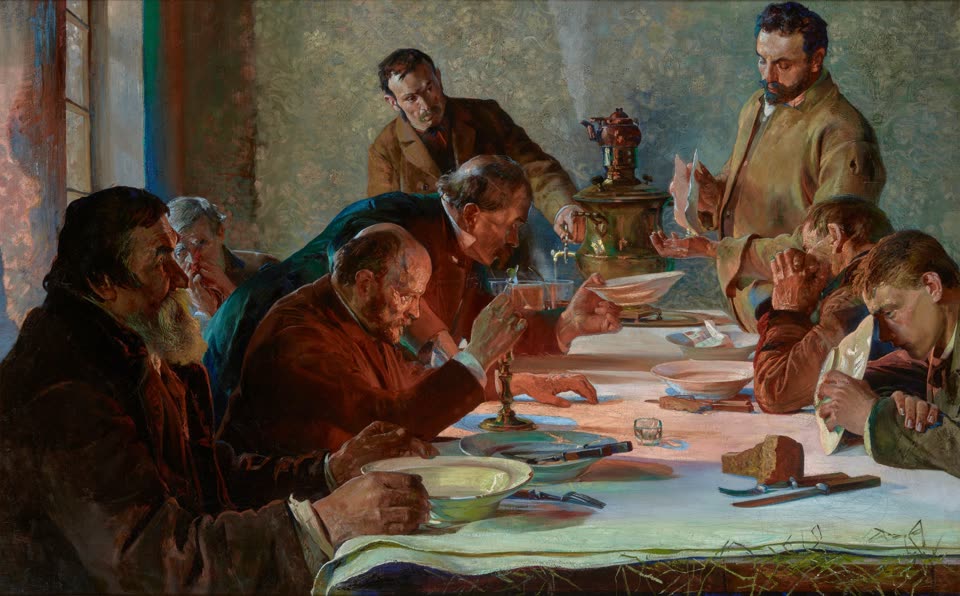
The Polish Christmas Eve table is most often photographed and painted somewhere other than Poland. The best-known painting of it is Jacek Malczewski's «Wigilia na Syberii» of 1892 — ten exiles round a white cloth in a bare room, a samovar, one piece of black bread, hay visible under the tablecloth, and a man at the head holding up the opłatek to break. The Polish National Digital Archive's Christmas holdings repeat the shape fifty years later: a Wigilia in a Polish Army unit in Britain, Polish refugees at a Wigilia table, and a Christmas party for Polish children in London.
Widely repeated claims about Christmas in Poland that do not survive
checking. Each one says what is actually the case, because a correction
with nothing in its place leaves you worse off than before.
Oversimplified
Carp on the Polish Christmas table was invented by the communists — specifically by Hilary Minc, the Stalinist industry minister, whose slogan was «a carp on every Wigilia table in Poland».
What is actually the case. Carp was on Polish Christmas tables centuries before the People's Republic. The oldest Polish cookbook — Stanisław Czerniecki's «Compendium Ferculorum albo Zebranie Potraw» of 1682, written by the cook to Prince Lubomirski — already contains a recipe for Wigilia carp, and Zygmunt III Waza and Jan III Sobieski were both enthusiastic eaters of it. What the post-war decades plausibly did was make carp the ONLY fish: prof. Janusz Dumanowski puts it that sturgeon, perch, Vistula salmon, eel, pike and many other fish disappeared from Wigilia tables in that period, «hence perhaps the impression that the now-solitary carp was comrade Minc's gift». The slogan itself is attributed rather than sourced — Polish Wikipedia's own wording is «przypisuje mu się», it is attributed to him — and no decree answering to the description has been found in Dziennik Ustaw, Monitor Polski or the ISAP system.
A Polish Wigilia has twelve dishes, one for each apostle.
What is actually the case. Twelve is now the common practice and it is not the old rule. The ethnographic record has the number of dishes as ODD — «na ogół liczba potraw była nieparzysta: trzy, pięć, siedem lub dziewięć» — with twelve recorded as a regional variant, for instance around Morawica in Dębska Wola, and explained there by the apostles. What had to be EVEN was the number of people at the table: an odd number of diners was believed to mean a death in the house within the year, and a lone neighbour would be invited in to make the count even. So the number that carried the superstition was the one counting the people, not the one counting the plates — and the famous twelve is the regional exception that travelled.
Zwyczaje wigilijne na dawnej wsi — dzieje.pl — Polska Agencja Prasowa, with Muzeum Historii Polski; quoting Janina Skotnicka, Dział Sztuki Ludowej, Muzeum Narodowe w Kielcach
Sources
Every claim on this page carries its own citation. They are collected
here so you can see what this page is built on, and how much of it comes from where.
Ekspert o kaszubskich zwyczajach: Gwiazdor pytał dzieci o znajomość pacierza, dawał im cukierki i orzechy — dzieje.pl — Polska Agencja Prasowa, with Muzeum Historii Polski; quoting Bartosz Stachowiak of the Muzeum — Kaszubski Park Etnograficzny im. Teodory i Izydora Gulgowskich we Wdzydzach. Retrieved 2026-10-09.Published 25 December 2023. «Na Pomorzu i w Wielkopolsce – czyli na terenach dawnego zaboru pruskiego – główną postacią zespołu kolędniczego był i jest Gwiazdor» and «karcił słomianym korbaczem, rózgą lub powrozem». Verbatim. This replaces a Wikipedia-only citation; a museum ethnographer at the Kashubian open-air museum is the right kind of authority for a Kashubian custom.
Lubuskie zwyczaje wigilijne – bogate tradycje o różnorodnych korzeniach — dzieje.pl — Polska Agencja Prasowa, with Muzeum Historii Polski; quoting Damian Danak, ethnographer, Muzeum Etnograficzne w Zielonej Górze. Retrieved 2026-10-10.Published 23 December 2018. «Powojenne migracje zastąpiły dotychczasowych mieszkańców przybyszami z różnych stron Polski, Kresów Wschodnich II Rzeczypospolitej oraz Bukowiny Rumuńskiej. Jedyną autochtoniczną grupą etnograficzną o przedwojennej ciągłości są mieszkańcy zachodniej Wielkopolski» and «Najważniejszą potrawą jest tu kutia z pszenicy i maku». Verbatim.
Zwyczaje wigilijne na dawnej wsi (Christmas Eve customs in the old countryside) — dzieje.pl — Polska Agencja Prasowa, with Muzeum Historii Polski; quoting Janina Skotnicka, Dział Sztuki Ludowej, Muzeum Narodowe w Kielcach. Retrieved 2026-10-09.Published 24 December 2009, updated 13 July 2016. The quoted sentences are verbatim from the fetched page.
Boże Narodzenie u wyznawców prawosławia (Christmas among the Orthodox) — eKAI — Katolicka Agencja Informacyjna, the Catholic Information Agency of the Polish Bishops' Conference. Retrieved 2026-10-10.«Hierarchowie Polskiego Autokefalicznego Kościoła Prawosławnego szacują liczbę wiernych na ok. 600 tys. Są skupieni w 250 parafiach, posiadają ponad 400 świątyń… blisko 70 proc. wszystkich wyznawców prawosławia w Polsce mieszka na Białostocczyźnie» and «Dla blisko 600-tysięcznej społeczności prawosławnej w Polsce dniem wigilijnym rozpoczynającym Święta Bożego Narodzenia, jest 6 stycznia». Verbatim. A CONFESSIONAL source, and a Catholic one writing about the Orthodox — read for its figures and its description, and noted as what it is. The membership figure is the hierarchy's own estimate and other estimates run lower, around 450–500 thousand.
Christkind — German Wikipedia. Retrieved 2026-10-09.«Die Idee des Christkinds ist jedoch heutzutage überwiegend in katholischen Gegenden verbreitet, vor allem in Süd- und Westdeutschland, im Elsass, in Luxemburg, Österreich und Oberschlesien im heutigen Polen…» and «Martin Luther propagierte um 1535 den „Heiligen Christ” als Alternative zur bisherigen Geschenksitte am Nikolaustag.» Verbatim. Cited in German because that is the language in which this figure's range is documented.
Etnograf: Wigilia to kwintesencja polskości (Ethnographer: Wigilia is the quintessence of Polishness) — Nauka w Polsce — Polska Agencja Prasowa; quoting Małgorzata Imiołek, ethnographer, Muzeum Wsi Kieleckiej. Retrieved 2026-10-09.«Wyciągano źdźbło siana spod obrusa; jeśli było długie, wróżyło dobry rok i długie życie. Krótkie czy czarne źdźbło oznaczało złą wróżbę.» The harvest reason is from the dzieje.pl piece: «Pod obrus rozścielano słomę albo siano — miało to zagwarantować urodzaj w roku przyszłym.»
Gwiazdor — Polish Wikipedia. Retrieved 2026-10-09.«Współcześnie na skutek migracji oraz wpływu mass-mediów, działalności centrów handlowych, a przede wszystkim, popkultury, część mieszkańców Wielkopolski i Kaszub porzuciło tradycję Gwiazdora na rzecz św. Mikołaja, nadal jednak w tych regionach znacznie popularniejszy jest Gwiazdor.» Verbatim.
Dziadek Mróz — Polish Wikipedia. Retrieved 2026-10-09.«pierwotnie postać ze wschodniosłowiańskiego folkloru, w okresie istnienia Związku Radzieckiego spopularyzowana tamże jako świecki odpowiednik Świętego Mikołaja… Dziadek Mróz pojawia się na Nowy Rok, żeby wręczać dzieciom prezenty.» Verbatim. WEAK CITATION, and the weakest in the record: the article does not source the Polish imposition specifically, which is the part this entry is about. Listed in state._whatIsLeft.
Kolędnicy — pochód grupy kolędniczej (Carollers — a carol group's round), photographed at Szczyrk, Leśna and Radziechowy, 2024–2025 — Robert Garstka for the Regionalny Instytut Kultury w Katowicach (Wojciech Korfanty Regional Institute of Culture), released CC BY 4.0 via Wikimedia Commons. Retrieved 2026-10-09.The institute's own caption: «Począwszy od drugiego dnia świąt Bożego Narodzenia – od Szczepana — chodziły po wsiach i miastach różne grupy kolędnicze, np. z gwiazdą, szopką, żłóbkiem oraz herody.» 53 photographs; the dates in this entry are each file's own DateTimeOriginal.
Mikołaje — procesja — pochód z okazji dnia św. Mikołaja, Łąka, 8 December 2024 — Robert Garstka for the Regionalny Instytut Kultury w Katowicach, released CC BY 4.0 via Wikimedia Commons. Retrieved 2026-10-09.The institute's caption: «Mikołaje z Łąki to unikalna tradycja, która jest kultywowana w Łące koło Pszczyny. W każdą niedzielę, która jest najbliżej 6 grudnia… po mszy w kościele pw. świętego Mikołaja, na ulice miejscowości wychodzą barwne grupy przebierańców, zwane „bandami mikołajowymi”.» 67 photographs, all CC BY 4.0. The figures listed in this entry were read off the photographs, not off the caption.
Nativity scene (szopka) tradition in Krakow — UNESCO Intangible Cultural Heritage — Representative List. Retrieved 2026-10-09.«Inscribed in 2018 (13.COM) on the Representative List of the Intangible Cultural Heritage of Humanity.» Decision reference 13.COM 10.b.29; nomination inventory in English and Polish; element photographs credited to the Historical Museum of the City of Krakow.
Wigilia na Syberii (Jacek Malczewski, 1892); and the Christmas holdings of Narodowe Archiwum Cyfrowe — Wikimedia Commons; Narodowe Archiwum Cyfrowe. Retrieved 2026-10-09.The painting is public domain at 4000×2486 and the details in this entry were read off the image. The NAC items are «Wigilia w jednostce Wojska Polskiego w Wielkiej Brytanii» (21-119), «Uchodźcy polscy w Wielkiej Brytanii podczas Wigilii» (21-120) and «Gwiazdka dla polskich dzieci w Londynie» (21-239), all public domain. This is an observation about what survives in archives, not a claim about how Poles kept Christmas.
Wesołych Świąt — Polish entry — Wiktionary. Retrieved 2026-10-09.Gives IPA /vɛˈsɔ.wɘx ˈɕfjɔnt/, syllabification We‧so‧łych Świąt, and both glosses — «Merry Christmas» and «happy Easter» — each marked idiomatic. Further reading cites Wielki słownik języka polskiego, Instytut Języka Polskiego PAN.

.jpg)


.jpg)


.jpg)


.jpg)
