Christmas Elsewhere

A country-by-country atlas of how Christmas is actually kept
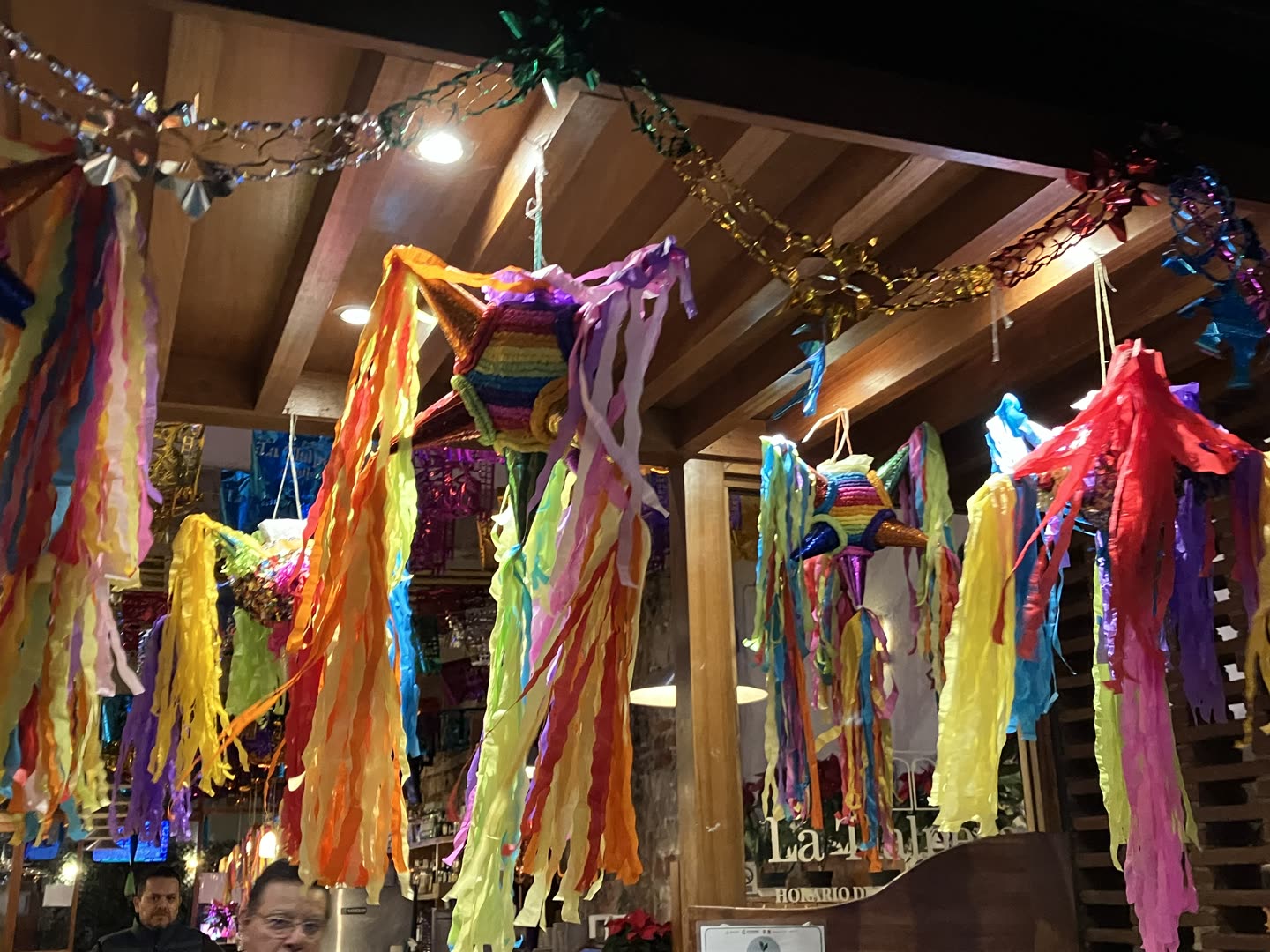
Half a dozen traditional star piñatas hanging close together from the beamed wooden ceiling of an indoor market hall, photographed looking up. Each is a ball of coloured tissue with seven cones radiating from it, and from the tip of every cone falls a long bunch of crepe paper streamers in pink, yellow, orange, lime, purple and blue, so that the whole ceiling is curtained in paper. The nearest piñata is banded in rainbow stripes with a gold cone pointing at the camera; others in red, white and blue hang behind it. Foil garlands in silver and gold are strung between the beams, and papel picado in blue and purple shows through the gaps beyond. Warm downlights are set into the ceiling. Two men stand at the bottom left of the frame, well below the piñatas and partly cut off by the edge.
Paricutina · CC BY 4.0

All countdowns · North America

Christmas in Mexico

Christmas falls on
25 DecemberGregorian calendar
How it is kept
A public holiday
A day off work
YesLey Federal del Trabajo, artículo 74, fracción VIII — Cámara de Diputados del H. Congreso de la Unión — copy hosted by gob.mx
Who brings the presents
Los Reyes Magosarrives 6 January
Who brings the presents
Santa Clausarrives 24 December
—days
—hrs
—min
—sec

Next: Friday 25 December 2026

How to say it

  • Feliz Navidad

    say it: feh-LEESS nah-vee-DAHD

    A synthesised voice — not a recording of a person — saying Feliz Navidad in es-MX.

    Universal and unceremonious, and familiar to a great many people who speak no Spanish at all — which is worth saying on a site about how Christmas is actually kept, because the familiarity comes from a 1970 Puerto Rican song rather than from Mexico. The respelling is for a Latin-American mouth: the final -d is barely voiced, closer to «nah-vee-DAH» in ordinary speech than the full stop an English reader would give it.

    feliz Navidad — Wikcionario (Spanish Wiktionary)

Who brings the presents

How Christmas is kept

Fifty-three days — it opens with Guadalupe and closes with a debt

The Mexican Christmas is not a day with a run-up. It is a season with a beginning, a middle and an ending that are separately observed, and it lasts from 12 December to 2 February. It opens on the feast of the Virgen de Guadalupe, the country's patron, when the sanctuary is sung Las Mañanitas at midnight. From the 16th come the nine nights of Las Posadas. The 24th is Nochebuena, with a mass and a party. The 6th of January brings the Reyes Magos and the rosca. And on 2 February, the Candelaria — the feast that formally ends the Christmas period of the Catholic liturgical year — whoever found the figure in the rosca a month earlier must produce tamales and atole for everyone who was at the table. So the season does not end on a date. It ends when a debt contracted by eating a slice of cake has been paid.

Navidad en México — Wikipedia (Spanish)

Las Posadas — nine nights of being turned away at the door

From 16 to 24 December, nine processions on nine nights, one for each month Mary carried the child. The company walks to a house carrying candles and images of Mary and Joseph, and splits in two: half stay outside and sing a request for shelter, half answer from inside refusing it. The exchange is sung back and forth until the door opens and everyone goes in. In some places the procession is turned away at two houses before the third admits it. Then the party. The hosts hand out ponche, sugar cane, oranges or tangerines, and a little bag of sweets and peanuts called a colación; the children break a piñata; and the whole thing moves to a different house the following night, or round a street or a block so that each household takes one of the nine.

Las Posadas — Wikipedia (Spanish)
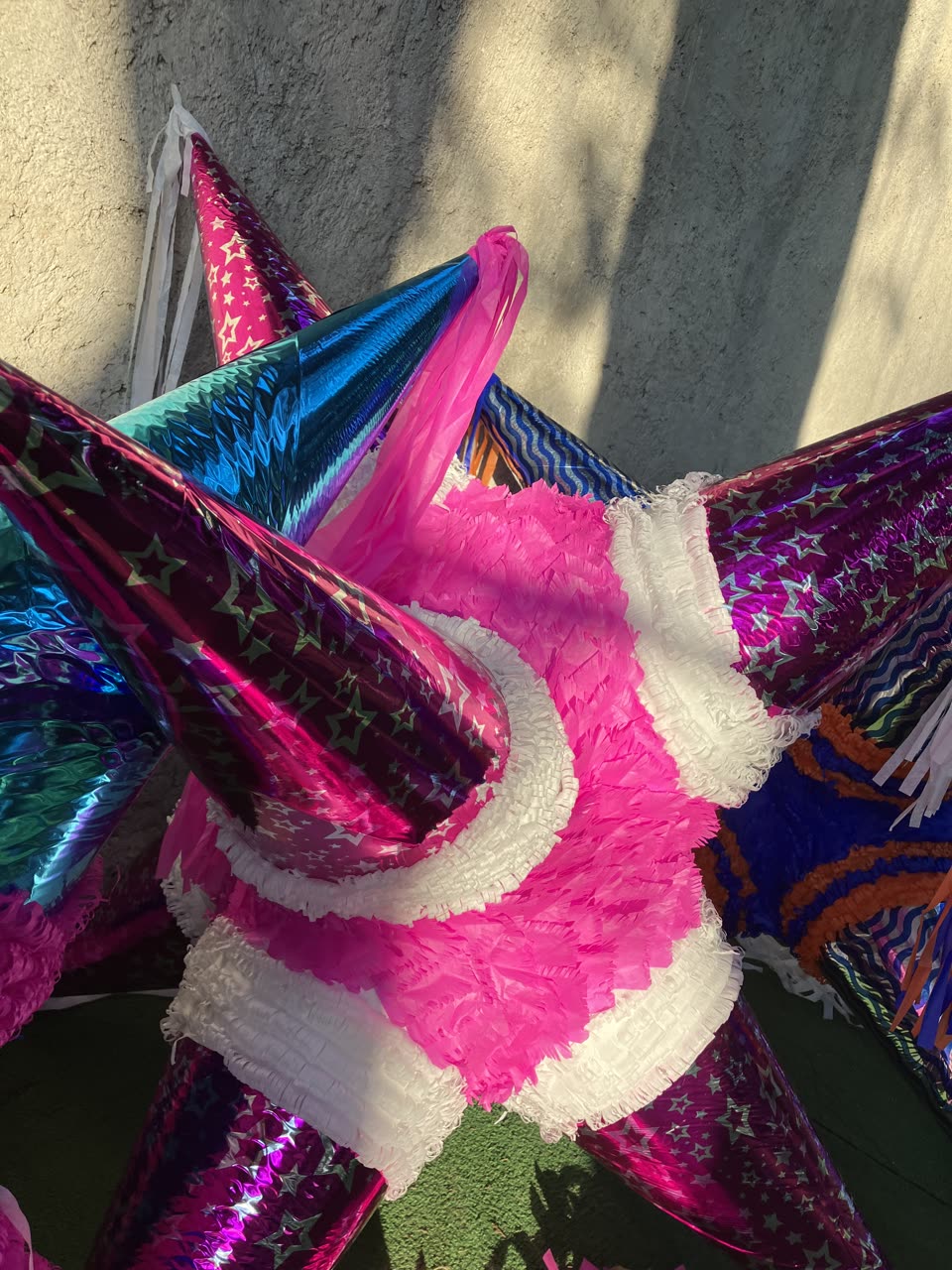
A close view of a single star piñata standing against a rough grey stucco wall in hard sunlight, filling the frame. Its cones are wrapped in metallic foil printed with stars — magenta, hot pink, electric blue and teal — and each cone is finished at the base with a fringed collar of crepe paper in bright pink and white. A second piñata in blue and orange stands behind it at the right, and a third shows at the left edge. The fringing is cut into fine strips and ruffled in overlapping rings, and loose white paper tails hang from two of the points. The ground beneath is green artificial turf and the shadow of foliage falls across the wall. No people are in the picture.
Paricutina · CC BY 4.0

The piñata was a teaching aid, and the shape was the lesson

The piñata belongs to the Posadas rather than to birthdays, and the traditional one is not a donkey or a cartoon character. It is a star with seven points, and every part of it was meant to mean something. As the friars used it: the pot is Satan, holding everything good in the world inside itself and decorated in bright colours to attract people; the seven points are the seven deadly sins; the stick is the Christian faith, and the blindfolded swing is blind faith striking at evil; the sweets and fruit that fall out are the riches of heaven, which is why everybody scrambles for them at once. It is a catechism you can hit with a stick, and it is still the shape children break in December.

Navidad en México — Wikipedia (Spanish)

The Night of the Radishes, in Oaxaca, on 23 December

On the evening of 23 December the city of Oaxaca fills with carved radishes. Competitors cut whole scenes out of the roots — nativities, saints, village life, buildings — and the carvings are judged in categories before thousands of spectators. It began as salesmanship rather than art. Radishes reached Mexico from China by way of Spanish friars and became a garnish; farmers at the Oaxaca Christmas market carved figures out of them to pull buyers to their stalls, and the clergy — the friars especially — encouraged the religious subjects. People started buying them as table centrepieces rather than as vegetables. It was made a formal competition in 1897 and has run since.

Noche de Rábanos — Wikipedia (Spanish)
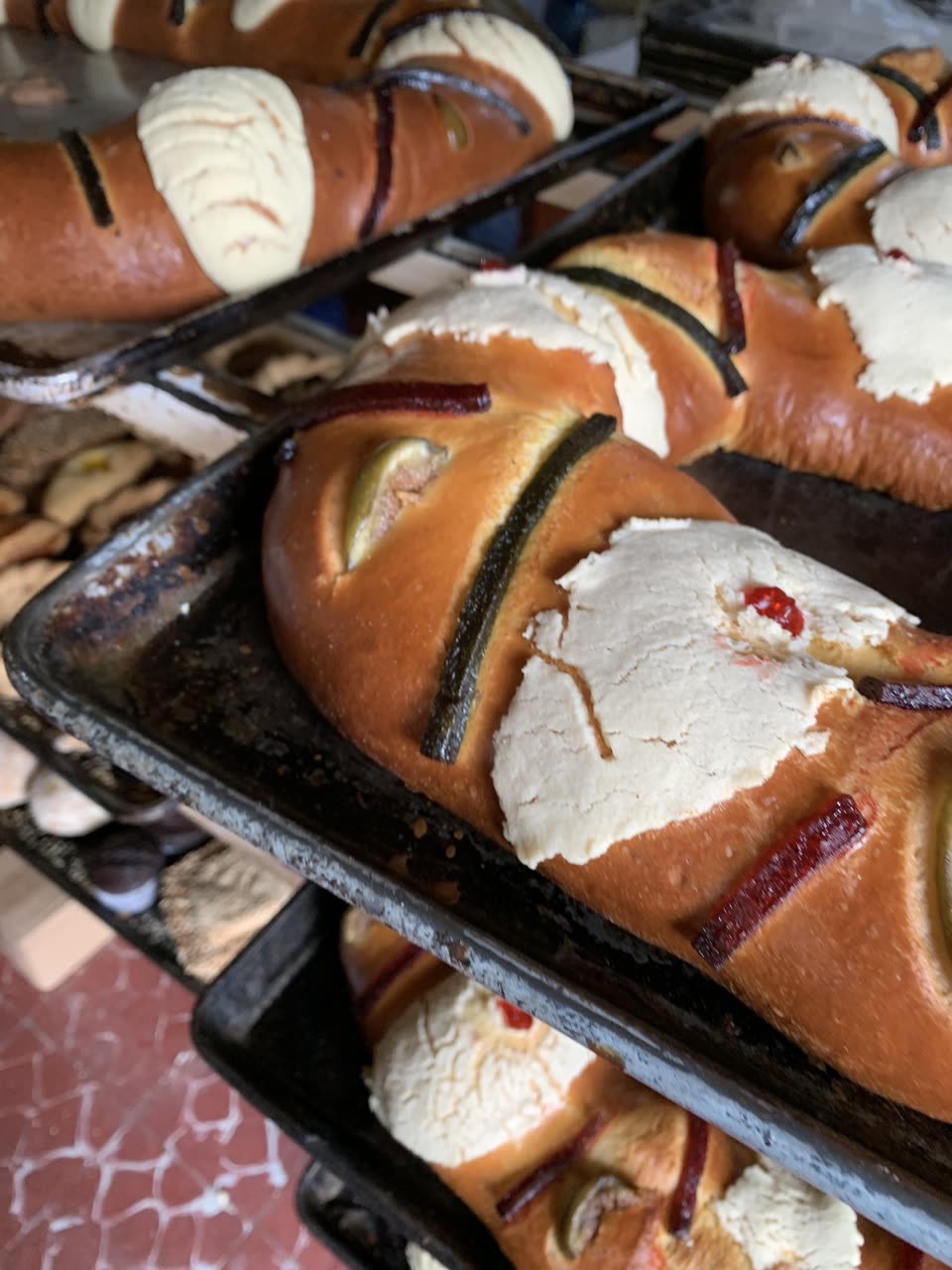
Several roscas de reyes stacked on blackened steel baking trays on a bakery rack, photographed close and from slightly above. Each is a wide oval ring of glossy golden-brown enriched bread, scored and risen, decorated along the top with broad ovals of pale cream sugar paste and with strips of candied fruit in dark green and deep red laid between them; one strip carries a single bright red glacé cherry. The trays are old and scorched around the edges. More roscas are visible on the tray above and the tray below, and a patterned tiled floor shows at the bottom left. Nothing is cut, so none of the hidden figures can be seen. No people are in the picture.
Koffermejia · CC0

The rosca, the hidden child, and who pays

On the night of 5 January or on the 6th, a ring-shaped sweet bread studded with candied fruit is cut and eaten with chocolate, coffee or atole. Hidden inside it are one or more small figures of the infant Christ, and the cutting is a lottery: the figure is baked in so that the child is concealed, as he was concealed from Herod's massacre. Whoever finds one in their slice is not congratulated so much as appointed. They owe the company tamales on 2 February, the Candelaria, which is why the Mexican Christmas does not end on Epiphany like everybody else's.

Roscón de Reyes — Wikipedia (Spanish)

Candelaria — tamales for the Christ child, where tamales once went to the rain gods

On 2 February the debt falls due and the season closes. The person who found the figure gives a party built on tamales and atole, both made of maize, and the Christmas period of the Catholic liturgical year formally ends. The older layer is still visible underneath and the sources name it. The pre-Hispanic practice was to carry tamales when making offerings to Tláloc, to Chalchiuhtlicue and to the tlaloques — the gods and helpers of water, who sent the rain that made the harvest. In many towns people still take maize cobs to the church on 2 February to be blessed before the agricultural cycle begins, and the date falls on the eleventh day of the first month of the Mexica calendar. So the same food, made of the same grain, carried to the same church on the same day, for a different reason that is also the same reason.

Fiesta de la Candelaria — Wikipedia (Spanish)

What is eaten

Tamales tamalli

Maize dough, seasoned, wrapped in a maize husk or a banana leaf, and steamed. They are older than the feast they close by a very long way — Mesoamerican and pre-Columbian, and the word is Nahuatl. They appear right through the Mexican calendar, at baptisms and weddings and on the Day of the Dead, but their Christmas station is fixed: they are what the finder of the rosca figure owes everybody on 2 February, eaten with atole, and they are what ends the season.

Tamal — Wikipedia (Spanish)

Romeritos

A Christmas dish with almost nothing European in it. Romerito is a quelite — a wild edible green, Suaeda, that grows in the milpa among the maize — and it looks like rosemary without being related to it. The leaves are bathed in mole, usually mole poblano, made with powdered dried shrimp. It is eaten at Mexican Christmas and again in Lent, and the Spanish source describes it plainly as having a strong indigenous component. Of everything on the Christmas table here it is the dish that would have been recognisable before 1519.

Romeritos con mole — Wikipedia (Spanish)

Ponche navideño

The drink handed out at every posada, hot, from a pot. It is made with tejocote — the Mexican hawthorn, which has no English name worth using — along with guava, plum, tangerine, orange and prunes, sweetened with piloncillo, which is unrefined cane sugar in a cone, and spiced with cinnamon or vanilla. Sugar cane is cut into lengths and put in the cup, to be chewed when the liquid is gone. For the adults, rum or tequila goes in. The recipes vary enormously from house to house and from state to state, which is the point of it.

Navidad en México — Wikipedia (Spanish)

What people get wrong

Widely repeated claims about Christmas in Mexico that do not survive checking. Each one says what is actually the case, because a correction with nothing in its place leaves you worse off than before.

Oversimplified

Las Posadas are a Spanish custom that the colonists brought over with them.

What is actually the case. They were built in Mexico, on purpose, on top of something that was already there. Before the conquest, the Mexica kept Panquetzaliztli — the festival of the coming of Huitzilopochtli, god of war — from 6 to 26 December. The dates overlapped the European Christmas, and the Spanish evangelisation reshaped the existing celebration rather than replacing it: the image of Huitzilopochtli was substituted with those of Mary and Joseph. The Catholic form was given to it by the first evangelisers, and specifically by the Augustinian friar Diego Soria, who obtained from Pope Sixtus V indulgences for nine misas de aguinaldo in the days before Christmas. Then it left the church. In the eighteenth century the celebration moved out into the neighbourhoods and the houses, and the religious music was replaced by popular song — which is how a liturgical novena became nine parties with a piñata. So: a Spanish liturgical instrument, deliberately laid over an Aztec winter festival, which the Mexican street then took away from the clergy. Calling it an import describes a third of that.

Las Posadas — Wikipedia (Spanish)

Contradicted

The poinsettia is an American Christmas plant, named after the man who discovered it.

What is actually the case. It is Mexican, it was named in Nahuatl long before it was named in English, and Poinsett did not discover it — he exported it. Euphorbia pulcherrima is native to Mexico and Central America and grows wild in Guerrero, Oaxaca, Michoacán and Chiapas. The Mexica called it cuetlaxóchitl, the flower that withers. It was already being used to decorate churches at Christmas under the viceroyalty of New Spain, and it reached Europe in 1678 — nearly a century and a half before Joel Roberts Poinsett, the first United States ambassador to Mexico, took it home in 1825 and gave English the word poinsettia. Mexico does not call it that. It is the flor de Nochebuena.

Euphorbia pulcherrima — Wikipedia (Spanish)

Worth knowing

The plant on every Christmas table in the northern hemisphere is Mexican, and its first name is not Christmas. Euphorbia pulcherrima is native to Mexico and Central America; the Mexica called it cuetlaxóchitl in Nahuatl, which means the flower that withers. It was used to decorate churches at Christmas in New Spain, reached Europe in 1678, and arrived in the United States in 1825 with Joel Roberts Poinsett, the first American ambassador to Mexico, whose name it now carries in English. Mexico calls it the flor de Nochebuena — the Christmas Eve flower — and grows more than a hundred cultivated varieties of it.

Euphorbia pulcherrima — Wikipedia (Spanish)

An ingredient was taken out of the Christmas cake to save a cactus. The rosca de reyes was traditionally studded with acitrón, candied biznaga — a barrel cactus that grows slowly and has been declared an endangered species in Mexico. Bakers have moved to substitutes: nopal, jícama, beetroot, and increasingly ate, a firm fruit paste. The cake is one of the few foods anywhere whose recipe has been rewritten by a conservation listing.

Roscón de Reyes — Wikipedia (Spanish)

The radishes of the Oaxaca contest are not a Mexican vegetable. They came from China, and they were brought to Mexico by Spanish friars — so the Night of the Radishes is a Chinese root, introduced by Spaniards, carved into nativity scenes by Zapotec and mestizo farmers, judged as an art form since 1897. Three continents in one vegetable, and the only one it is native to is the one that does not carve it.

Noche de Rábanos — Wikipedia (Spanish)

The Mexican state is reported to publish postal addresses for both gift bringers. Letters to the Reyes Magos are said to be addressed to Calle Estrella de Belén No 6, Colonia Sorpresa, CP 00542, Alcaldía de los Deseos, Cd. Oriente; letters to Santa Claus to Calle Regalo núm. 5, Colonia Nieve, CP 00695, Alcaldía Polo Norte, Cd. Laponia. Two fictional addresses, in the format of a real Mexican one, down to the postcode and the borough.

Reyes Magos — Wikipedia (Spanish)

Sources

Every claim on this page carries its own citation. They are collected here so you can see what this page is built on, and how much of it comes from where.

  1. Ley Federal del Trabajo, artículo 74, fracción VIII — Cámara de Diputados del H. Congreso de la Unión — copy hosted by gob.mx. Retrieved 2026-10-11.Mexico does not legislate its holidays in a dedicated statute the way Brazil does. They are in the labour code, as días de descanso obligatorio — days on which rest is compulsory rather than days that are merely marked. «Artículo 74. Son días de descanso obligatorio: I. El 1o. de enero; … VIII. El 25 de diciembre, y IX. El que determinen las leyes federales y locales electorales…» Nine fractions, and Christmas is the eighth. Note what else is in the list: the first Monday in February, the third Monday in March, the third Monday in November — Mexico moves three of its civic holidays to Mondays and does NOT move Christmas. VERSION READ. This is the consolidated text at «Última reforma publicada DOF 12-06-2015», hosted by gob.mx, of a law first published in the Diario Oficial de la Federación on 1 April 1970. It is an official copy and it is not the current one. The Chamber of Deputies publishes the current consolidation and its site could not be reached from here, so a later amendment is unlikely rather than ruled out — and unlikely is not the same as checked.
  2. feliz Navidad — Wikcionario (Spanish Wiktionary). Retrieved 2026-10-11.«Interjección. Frase usada como felicitación con motivo de la Navidad.» Short, and it is the whole entry.
  3. Reyes Magos — Wikipedia (Spanish). Retrieved 2026-10-11.«En varios países de Hispanoamérica existe la costumbre adoptada de los españoles de que los niños reciban regalos de los Reyes Magos, bien en la víspera, es decir, a la medianoche del 5 de enero, o en la mañana del 6 de enero (Argentina, Bolivia, Colombia, Ecuador, México…)» and «los niños pueden escribir una carta a los reyes… En esta carta, los niños enumeran sus deseos y aducen los méritos que han hecho a lo largo del año para ser merecedores de tales anhelos.»
  4. Papá Noel — Wikipedia (Spanish). Retrieved 2026-10-11.«Papá Noel (del francés Noël, Navidad), conocido también como Santa Claus… es un personaje legendario originario del cristianismo occidental, conocido por repartir regalos a niños durante las noches de Nochebuena.» In Mexico the usual name is Santa Claus rather than Papá Noel, which is the commoner form elsewhere in Spanish America.
  5. Navidad en México — Wikipedia (Spanish). Retrieved 2026-10-11.«La Navidad en México se celebra desde el 12 de diciembre hasta al 6 de enero, con una celebración adicional el día 2 de febrero… Esta temporada empieza con celebraciones en honor a la Virgen de Guadalupe, la Patrona de México, seguido de otras costumbres como por ejemplo: Las Posadas, Pastorelas y otras costumbres regionales. En Nochebuena, se realiza una misa y una fiesta.» The liturgical closing is from es:Tamal: «El día de la candelaria termina el periodo de Navidad del año litúrgico católico y se celebra en la parte secular con el consumo de tamales y atole.»
  6. Las Posadas — Wikipedia (Spanish). Retrieved 2026-10-11.«durante los nueve días antes de la Navidad, es decir, del 16 al 24 de diciembre… Se puede celebrar cada día en una casa diferente, o bien, se tiene la costumbre de organizar a los vecinos por calles o cuadras y de este modo a cada cuadra le va tocando la realización de cada una de las 9 posadas… Los caseros ofrecen ponche, cañas, naranjas o mandarinas y una bolsita con dulces y cacahuates llamada «colación».» The sung exchange and the two-houses-refuse variant are from es:Navidad en México: «La mitad se queda afuera y cantando una canción tradicional para pedir refugio. El otro canta en respuesta desde adentro… en la procesión vayan cantando en tres casas, dos de las cuales «rechazan» la fiesta hasta que la tercera casa acepta.»
  7. Noche de Rábanos — Wikipedia (Spanish). Retrieved 2026-10-11.«La Noche de los Rábanos… es un concurso oaxaqueño anual que se lleva a cabo el día del Mercado Navideño (23 de diciembre) en la ciudad de Oaxaca… El evento surge durante la época colonial, como un método de venta utilizado por los granjeros para atraer compradores, pero fue hasta 1897 cuando fue declarado formalmente como un concurso… Provenientes de China, los rábanos fueron introducidos a México a través de los frailes españoles… Originalmente las figuras talladas en rábano eran utilizadas por granjeros para atraer la atención de los comerciantes… Usualmente estas figuras tenían temas religiosos relacionados con la Natividad (debido a la época) y eran alentados por el clérigo, especialmente los frailes.»
  8. Roscón de Reyes — Wikipedia (Spanish). Retrieved 2026-10-11.«En México y Guatemala, la representación de la Natividad se incorpora a la «rosca de reyes», y se incrustan en el pan uno o más muñequitos alusivos a Jesucristo, lo que simboliza que el niño tuvo que ser escondido y protegido de la matanza de Herodes.» And: «Su consumo se maximiza el 6 de enero y antecede a la festividad de la Candelaria, fecha en que se ofrecen tamales a los compañeros de rosca, el anfitrión es señalado por encontrar la figura del niño al degustar la rosca por el día de reyes.» The chocolate, coffee or atole, and the cutting on the night of the 5th, are from es:Reyes Magos: «En México, el día 5 de enero por la noche se parte una Rosca de reyes que es tomada con chocolate, café o atole.»
  9. Fiesta de la Candelaria — Wikipedia (Spanish). Retrieved 2026-10-11.«En México y Guatemala, el Día de la Candelaria se acostumbra que, quien obtuvo el niño oculto en la rosca de reyes, haga una fiesta (tradicionalmente basada en tamales y atole, ambos productos de maíz). Esta tradición tiene raíces prehispánicas; en muchos pueblos los habitantes llevan a la iglesia mazorcas para que sean bendecidas a fin de sembrar sus granos en el ciclo agrícola que inicia, pues el 2 de febrero coincide con el undécimo día del primer mes del calendario mexica… La tradición prehispánica establecía que se debía llevar tamales cuando se rendía culto a Tláloc, a Chalchiuhtlicue (dioses del agua) y a los tlaloques (ayudantes del primero), quienes derramaban su lluvia sobre la tierra asegurando así buenas cosechas.» The article calls the result «el sincretismo de dos culturas y religiones» in those words, which is the source making the argument rather than this page making it for it.
  10. Tamal — Wikipedia (Spanish). Retrieved 2026-10-11.«El tamal (del náhuatl tamalli) es un alimento de origen mesoamericano del periodo precolombino, elaborado a partir de una masa de harina de maíz sazonada y envuelta en hojas de plátano o de la mazorca del maíz, y cocida al vapor o en el horno.» And: «los tamales son parte importante de la gastronomía contemporánea de los mexicanos en las fiestas y celebraciones… en las posadas y fiestas navideñas… y en las del Día de la Candelaria, celebrada el 2 de febrero.»
  11. Romeritos con mole — Wikipedia (Spanish). Retrieved 2026-10-11.«son un platillo típico de la cocina mexicana, especialmente en el centro del país, cuyo ingredientes principales son las hojas del romerito (Suaeda spp.), un quelite que crece en la milpa y que no debe ser confundido con el romero o romero de olor (Salvia rosmarinus). El romerito se baña en un mole, usualmente mole poblano preparado con polvo de camarón. Es tradicional de las navidades mexicanas, aunque también se puede encontrar durante la Cuaresma o la Semana Santa… este platillo tiene un fuerte componente indígena.»
  12. Euphorbia pulcherrima — Wikipedia (Spanish). Retrieved 2026-10-11.«Euphorbia pulcherrima es el nombre científico, Cuetlaxochitl es el nombre náhuatl original, y el nombre común o comercial Noche Buena en México… Es una especie de la familia Euphorbiaceae nativa de México y Centroamérica… Los mexicas la llamaban, en náhuatl, cuetlaxóchitl («Flor que se marchita»)… Fue dada a conocer al resto del mundo durante el virreinato de Nueva España, en la cual se adornaban las iglesias con ella durante las fiestas navideñas. Fue llevada a Europa en el año 1678… En Estados Unidos, se la conoce como poinsettia, en honor de Joel Roberts Poinsett, primer embajador estadounidense en México, quien la introdujo en su país en 1825… Se estima que en México se cultivan más de 100 diferentes variedades.»