Christmas Elsewhere

A country-by-country atlas of how Christmas is actually kept

Bete Giyorgis at Lalibela seen from the rock shelf above it. The church stands in a pit quarried out of the hillside, its walls free on every side and its flat roof carved with a nested Greek cross, level with the ground the viewer is standing on. Three stepped string courses run round the walls; a tall keyhole window with a carved frame sits in the near face, and the stone is dark grey-brown and blotched with orange lichen. A trench floor of bare red earth runs round the base. At the right a cut passage leads down into the trench, where a scattering of small distant figures stands by a white ladder. Beyond the rim: green trees, a few village buildings on the skyline at the left, and the Ethiopian highlands falling away into a hazy valley.
Sailko · CC BY 3.0

All countdowns · Africa

Christmas in Ethiopia

Christmas falls on
7 JanuaryGregorian calendar
How it is kept
A public holiday
A day off work
YesProclamation to Determine Public Holidays and Celebration of Public Holidays, Proclamation No. 1334/2024, Article 6(2) — Federal Negarit Gazette of the Federal Democratic Republic of Ethiopia, 30th Year No. 55

—days
—hrs
—min
—sec

Next: Thursday 7 January 2027

How to say it

  • እንኳን ለእየሱስ ክርስቶስ የልደት በዓል አደረሳችሁ

    Enkwan le-Iyesus Kristos ye-Lidet Be'al aderesachihu

    A synthesised voice — not a recording of a person — saying እንኳን ለእየሱስ ክርስቶስ የልደት በዓል አደረሳችሁ in am-ET.

    What the President of Ethiopia said on the feast. The construction is a split one — እንኳን … አደረሳችሁ wraps the name of the feast — and it does not mean merry Christmas. It means something closer to: you have been brought to the feast of the Nativity of Jesus Christ, and congratulations on that. The wish is about arrival, not about merriment, and the same formula serves Easter, Meskel and the anniversary of Adwa with the feast name swapped in.

    ፕሬዝዳንት ታዬ አጽቀስላሴ ለገና በዓል የእንኳን አደረሳችሁ መልዕክት አስተላለፉ — Ethiopian News Agency (ENA / ኢዜአ)

  • እንኳዕ ንበዓል ልደት ኣብጸሐኩም

    Enkwaʿ nebeʿal Lidet abtsehakum

    The same presidential message, published by the same agency on the same day in Tigrinya — one utterance, two languages, one publisher, which is the strongest corroboration a greeting can get. Tigrinya names the feast በዓል ልደት, the feast of the Nativity, where Amharic says ገና. ENA's own headline and body differ on one letter, ኣብጸሐኩም against ኣብፀሐኩም — ጸ against ፀ — which is ordinary orthographic variation in Tigrinya and is recorded rather than silently tidied.

    ፕሬዚዳንት ታዬ ኣፅቀስላሴ ንበዓል ልደት መልእኽቲ እንኳዕ ኣብፀሐኩም ኣመሓላሊፎም — Ethiopian News Agency (ENA / ኢዜአ)

  • Baga ayyaana Qilleetiin isin gahe

    Baga ayyaana Qilleetiin isin gahe

    An Oromo speaker, via Wikimedia Commons, saying Baga — the first word of the greeting, not the whole phrase. Wikimedia Commons, CC0.

    Oromo, in Qubee — the Latin orthography, which is why `script` is Latn where the other two are Ethi. The formula has the same shape as the other two languages': baga … isin gahe, congratulations on the feast having reached you. ENA's Afaan Oromoo service carries 769 articles on Ayyaanni Qillee and glosses the name itself — «Ayyaanni dhaloota Iyyasuus Kiristoos (( Qillee )», the feast of the birth of Jesus Christ — and the same greeting also appears with the feast named in full: «baga ayyaana dhaloota Iyyasuus Kiristoosiin isin gahe». Oromo is the largest first language in Ethiopia, which is why this record carries three greetings and not one.

    Barreessaan olaanaa IGAD doktar Warqinaa Gabayyoo baga ayyaana Qilleetiin isin gahe jechuun ergaa dabarsaniiru — Ethiopian News Agency (ENA / ኢዜአ)

How Christmas is kept

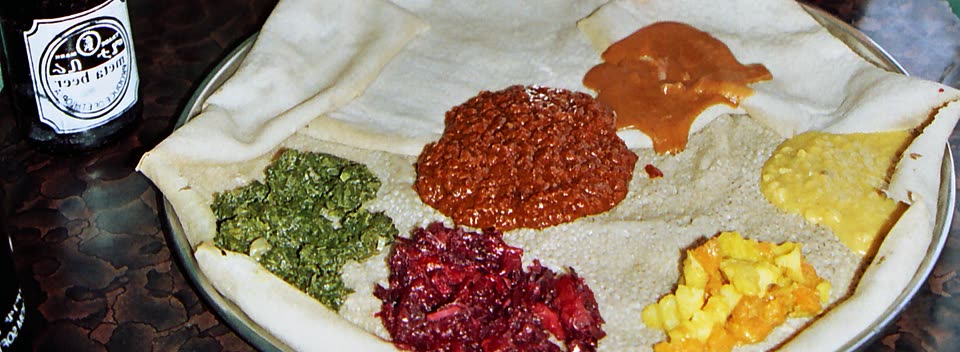
A round metal tray lined with injera, the pale spongy flatbread with its honeycomb of holes, its edge folded loosely over the rim. Six mounds of stew are spooned straight onto the bread: chopped dark greens at the left, a glossy dark-red lentil stew in the middle, a smooth caramel-brown pool of shiro above it, pale yellow split peas at the right, diced potato and carrot below them, and shredded crimson beetroot at the front. There is no meat, no egg and no cheese anywhere on the tray. A dark beer bottle stands at the left edge of the frame.
Dr. Ondřej Havelka (cestovatel) · CC BY 4.0

The fast of the prophets — forty-three days without meat, milk or eggs

ጾመ ነቢያት, Tsome Nebiyat, the Fast of the Prophets, is one of the seven canonically acknowledged fasts of the Ethiopian Orthodox Tewahedo Church. It begins on Hidar 15 and ends on Tahsas 28, the eve; the feast is the next day. Through it the faithful abstain from all animal products — meat, dairy, eggs — and from alcohol. The Church calls it forty-three days. It is also called ye-Lidet Tsome, the Christmas Fast, because Christ is born at the end of it, and it carries the name of the prophets because their prophecy was fulfilled.

The Fast of Prophets — Mahibere Kidusan — Ethiopian Orthodox Tewahdo Church Sunday School Department

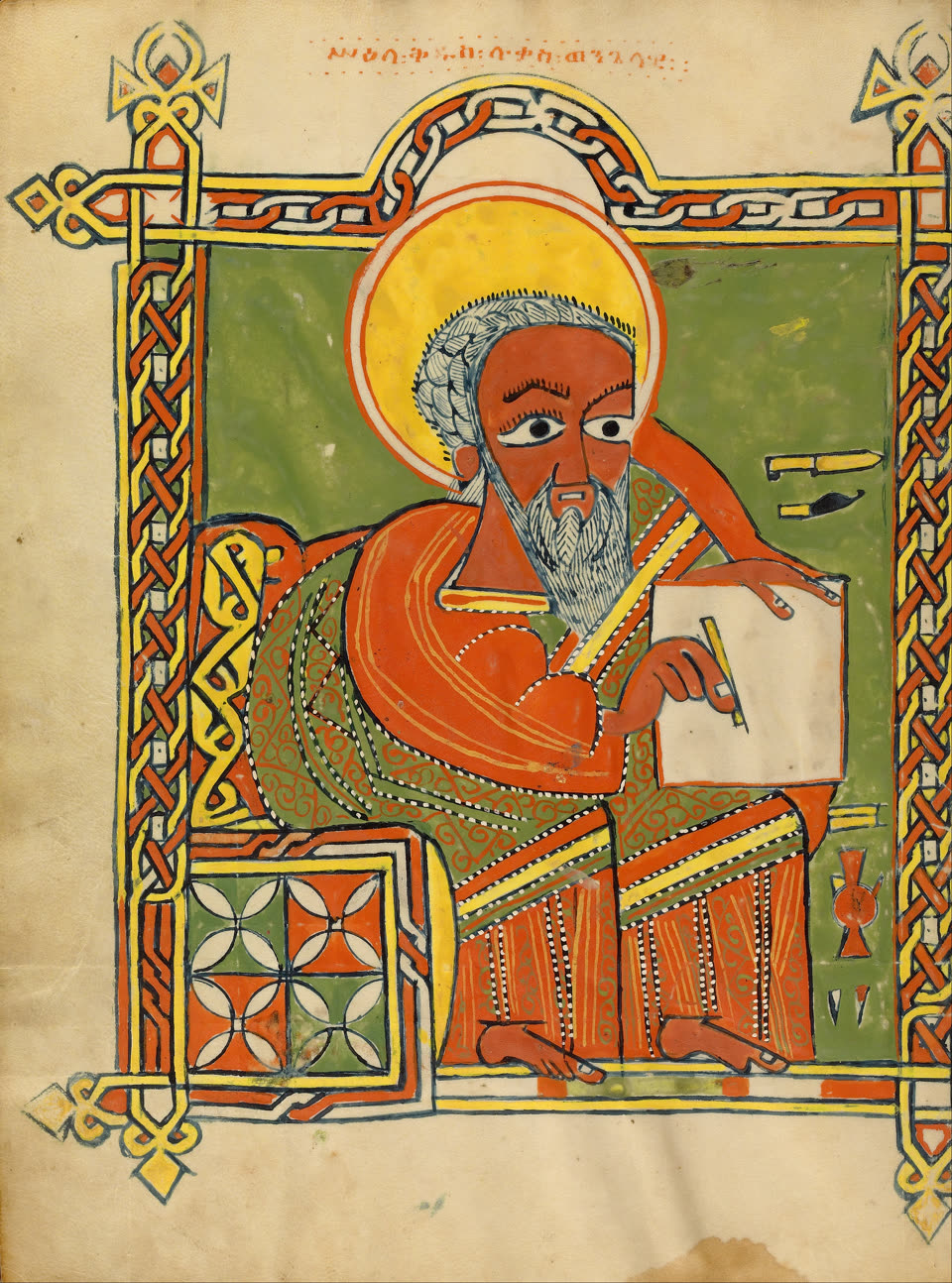
A full-page portrait of Saint Luke from an Ethiopian Gospel book, painted in flat opaque colour on parchment. The evangelist sits on a cushioned stool turned three-quarters to the viewer, his face and hands brick red, his eyes very large and dark, a curled white beard and white hair beneath an enormous yellow halo ringed in orange. He wears a vermilion cloak over a green and gold robe patterned with scrolls, steadies a blank sheet with one hand and writes on it with a reed pen in the other, and rests his bare feet on a step. The ground behind him is plain green, with a pen-case and a small knife hanging at the right. A broad band of red, yellow and white interlace frames the whole page, with cross-shaped finials at its corners, and a line of red Geʽez script runs across the top.
Unknown – illuminator · Public domain

The Gregorian date is fixed and the Ethiopian one moves

The feast is Tahsas 29 and falls on 7 January — but which Ethiopian day it is shifts, because the Ethiopian leap day is inserted in the thirteenth month and the Gregorian one is not. The Church states it directly: the fast «begins every year on Hidar 15 (November 25) and ends on Christmas Eve 29th of Tahsas, while in the evangelical year of John — it rotates in a four-year cycle — ends on Christmas Eve 28th of Tahisas». The years themselves are named for the evangelists: Luke takes the leap year, then John, Matthew, Mark.

The Fast of the Prophets (Tsome Nebiyat) Begins on November 25 — Mahibere Kidusan — Ethiopian Orthodox Tewahdo Church Sunday School Department

ገና is also a game, played with curved sticks between villages

The word names the feast and a sport: a hockey-like game, also called ቃርሳ, played with a curved stick and a round wooden ball on a field of about a hundred yards with no fixed boundaries, between the men and boys of neighbouring villages, each side trying to keep the ball out of the other's. The tradition ties it to the shepherds, who are said to have taken up their crooks and played for joy on the night of the Nativity. Ethiopian men also ride yeferas guks, a horseback sport in which ceremonial lances are thrown.

Ethiopian Christmas — English Wikipedia

The night service, and the white netela

On the eve the faithful go to church for a service that runs through the night, beginning around six in the evening and ending near three in the morning. People form a long looping procession around the circumference of the church, carrying candles. A thin white cotton garment, the netela, is worn. At Lalibela, where eleven churches are cut down into the rock rather than built up from it, the feast draws pilgrims in their tens of thousands.

Ethiopian Christmas — English Wikipedia

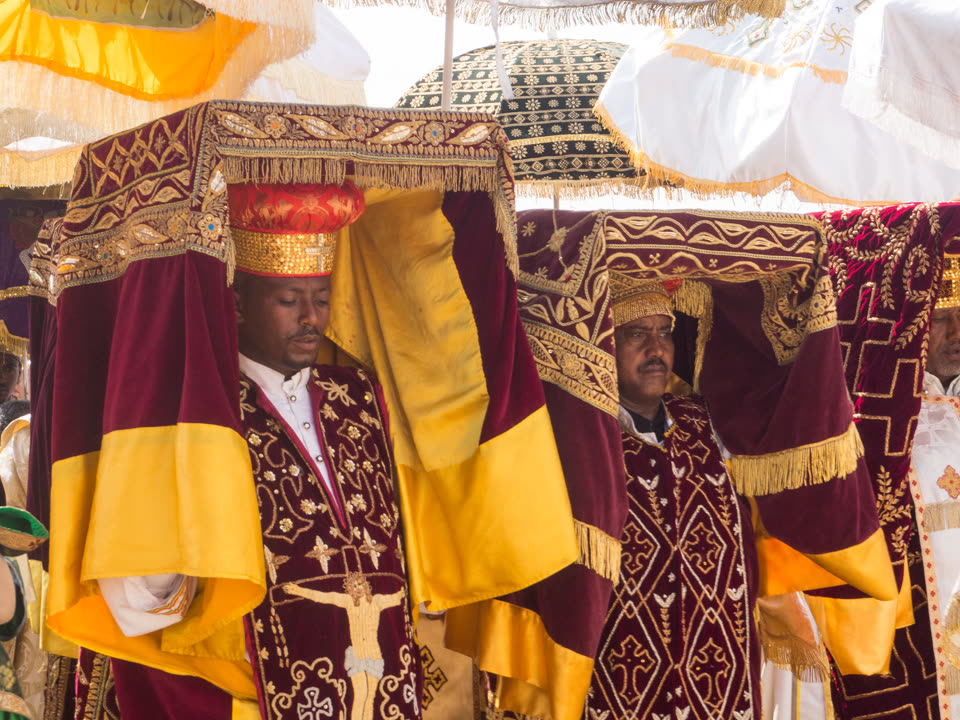
Priests carrying tabots in procession, each tabot invisible beneath the cloth that wraps it: a rectangular bundle borne flat on the head, draped in deep maroon velvet with broad bands of gold bullion embroidery and heavy gold fringe, with panels of plain yellow silk hanging below. The two nearest celebrants wear tall gold filigree crowns and maroon brocade copes worked all over with crosses, one of them carrying a long pale crucifix down the front. Above and behind, a crowd of ceremonial umbrellas fills the top of the frame — fringed, in yellow, in white, and one dark green patterned with gold rosettes. More clergy press in at both edges.
Jean Rebiffé from Addis Ababa, Ethiopia · CC BY 2.0

Twelve days later, Timkat

The Christmas season does not end at the feast. On 19 January — Tir 11 in the Ethiopian calendar — comes Timkat, ጥምቀት, a Geʽez word meaning immersion in water. It is the Ethiopian Epiphany and the larger celebration of the two. Priests carry the tabot, the replica of the Ark of the Covenant that every Ethiopian church holds, out of the sanctuary and down to a river or a pool, escorted by thousands; the water is blessed and the people are sprinkled with it. The feast runs two days, the eve and the day, and extends to a third only in churches whose tabot is dedicated to Archangel Michael, where the miracle at the wedding of Cana is kept.

The Festival of Timket — Mahibere Kidusan — Ethiopian Orthodox Tewahedo Church Sunday School Department

What is eaten

Doro wat ዶሮ ወጥ

The chicken stew that breaks the fast: onions cooked down slowly without fat before anything else is added, then berbere, then niter kibbeh — spiced clarified butter — and chicken, with hard-boiled eggs. After forty-three days without meat, dairy or eggs, a dish that is all three at once is the point rather than the menu.

Wat (food) — English Wikipedia

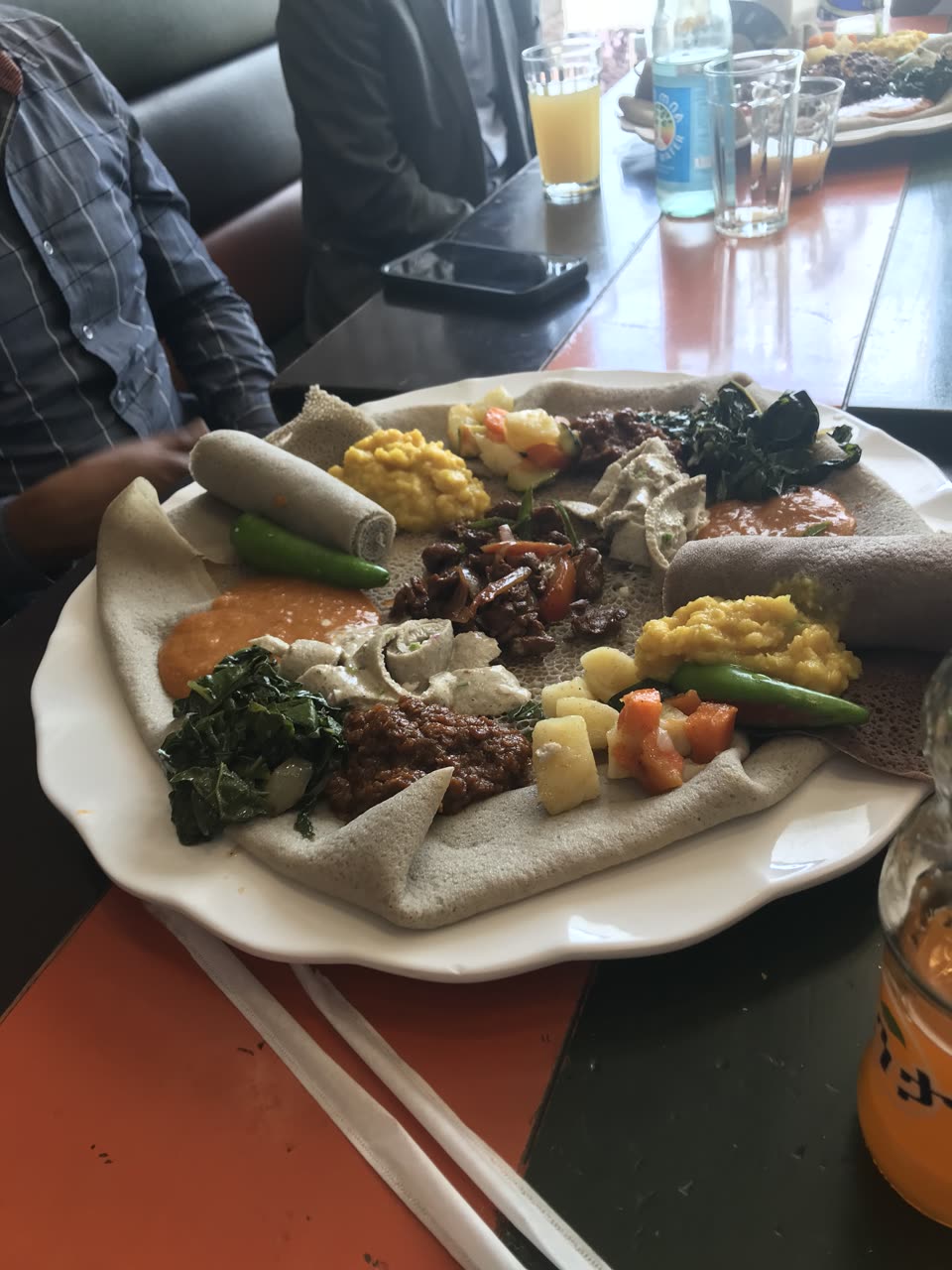
A wide white plate on a cafe table, lined with a single grey-brown injera whose surface is pocked all over with small holes. The bread is both the plate and the food: ten or so dishes are spooned directly onto it in a ring — chopped dark greens, bright yellow split peas, diced potato and carrot, a smooth orange-red sauce, a white curd-like dish scattered with herbs, a dark stew of meat with onion and tomato in the centre, and two whole green chillies. Two tightly rolled injera sit at the back like napkins. Beyond the plate: a dark table with a phone, tumblers, a bottle of mineral water and a glass of orange juice, a second platter at the top right, and two seated people visible only as a check-shirted torso and an arm.
Jbinthecity · CC0

Injera እንጀራ

The sour fermented flatbread of teff that the stew is served on and eaten with — torn, and used as the spoon. It is a staple rather than a Christmas food, and it is on this list because the Christmas table is not a different table: the feast is the same food in quantity, with meat in it again.

Injera — English Wikipedia

What people get wrong

Widely repeated claims about Christmas in Ethiopia that do not survive checking. Each one says what is actually the case, because a correction with nothing in its place leaves you worse off than before.

Contradicted

Ethiopia celebrates Christmas on 7 January because it uses the Julian calendar, like Russia and Serbia.

What is actually the case. Ethiopia uses the ETHIOPIAN calendar, which is not the Julian calendar and is not the Gregorian one either. It has thirteen months — twelve of thirty days and a thirteenth, Pagumen, of five days or six — its months begin on the same days as the Coptic calendar, its month names are in Geʽez, and its year number is seven or eight behind the Gregorian depending on the month. It reckons from the Annunciation as dated by Annianus of Alexandria to AD 9, where Europe followed Dionysius Exiguus and placed it nine years earlier. The feast is Tahsas 29, and it coincides with the 7 January of the Julian-calendar churches without being the same thing: Russia arrives at 7 January by keeping 25 December thirteen days behind the Gregorian, and Ethiopia arrives there by a calendar that never had a 25 December to be late with. The shared date is a coincidence of two different systems, not a shared system.

Ethiopian calendar — English Wikipedia

Oversimplified

«Merry Christmas» in Amharic is Melkam Gena, and that is how Ethiopians greet each other at Christmas.

What is actually the case. መልካም ገና is real Amharic and really used, but it is a translation of an English sentiment rather than the formula the occasion calls for. The greeting the Ethiopian state uses is a split construction: እንኳን … አደረሳችሁ, wrapped around the name of the feast — እንኳን ለእየሱስ ክርስቶስ የልደት በዓል አደረሳችሁ — and it congratulates you on having been brought to the day rather than wishing you a merry one. The same shape appears in Tigrinya as እንኳዕ … ኣብጸሐኩም and in Oromo as baga … isin gahe, so it is the Ethiopian formula and not an Amharic peculiarity. In the Ethiopian News Agency's own Genna coverage the Melkam Gena form appears mostly in messages from foreign embassies, while the President, the regional governments and the Government Communication Service use the እንኳን formula.

ፕሬዝዳንት ታዬ አጽቀስላሴ ለገና በዓል የእንኳን አደረሳችሁ መልዕክት አስተላለፉ — Ethiopian News Agency (ENA / ኢዜአ)

Worth knowing

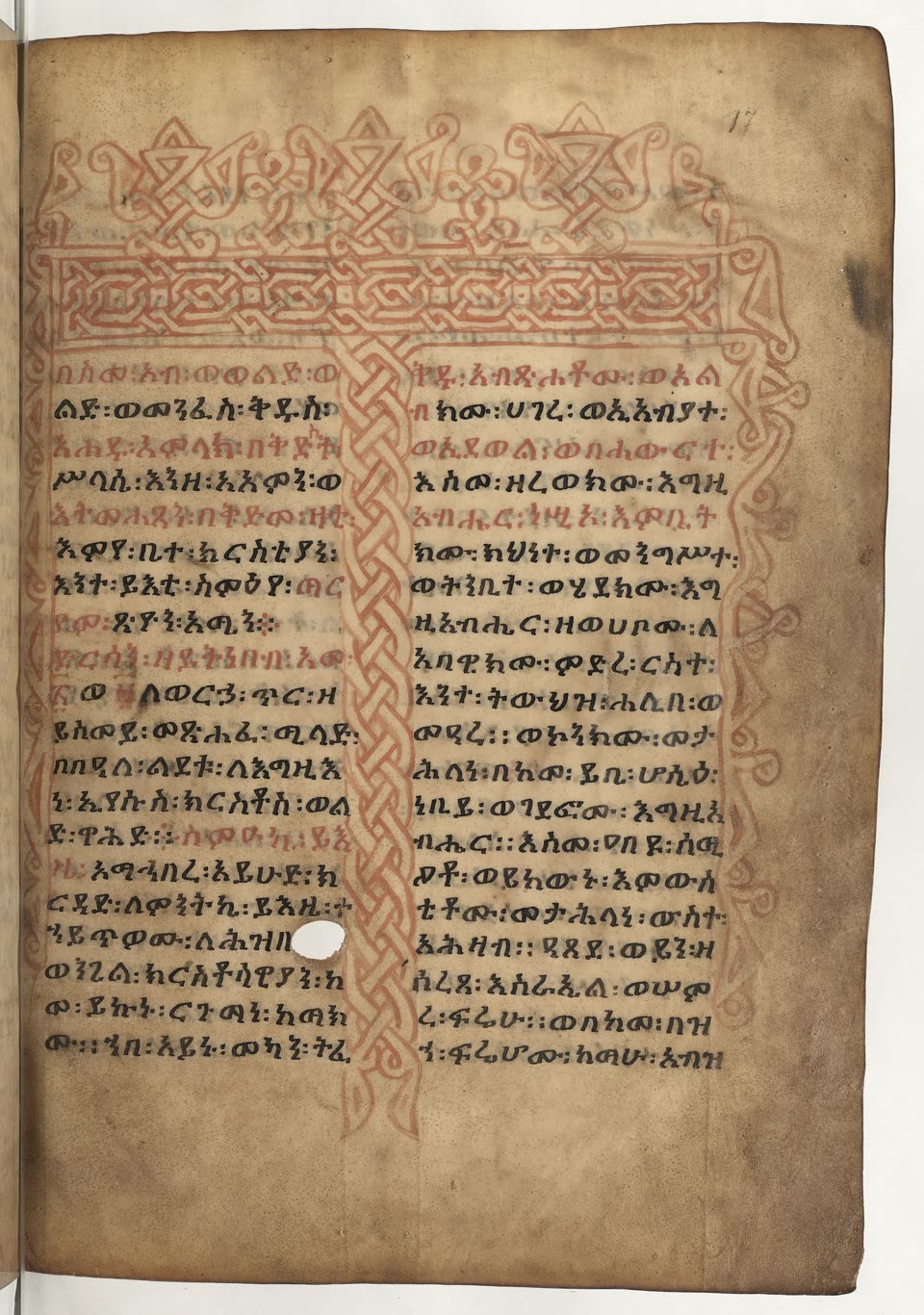
A page from an Ethiopian manuscript on cream-coloured parchment, written in two columns of Geʽez in dense black ink with whole words and phrases picked out in red. Across the top runs a harag — a broad band of red interlace, woven like basketwork, crowned with a row of looped and knotted finials — and a narrower column of the same interlace runs the full height of the page down the gutter between the two text columns, with red tendrils curling out into the right margin. A small round hole in the parchment sits in the lower left column, and the scribe has simply written around it. The page is numbered 17 in pencil at the top right; the edges are worn and faintly stained.
· Public domain

In the Ethiopian account the Magi are not three men on camels. They are three kings with an army: «the number of these men was thirty thousand; the kings are three, each king having ten thousand soldiers». The star they followed looked like a woman holding a child, travelled by day and hid at night, and they were not astronomers but students of Balaam — reading Balaam's own prophecy that a star would come out of Jacob. By the time they found the child he was two years old.

ገና — Amharic Wikipedia

Ethiopia counts its years in a four-year cycle named after the evangelists — Luke takes the leap year, then John, Matthew, Mark — and the year number itself runs seven or eight behind the Gregorian depending on the month. The gap is not a constant: it is eight years from 1 January until 10 or 11 September, and seven for the rest.

Calendario etiopico; and Ethiopian calendar — Italian Wikipedia; English Wikipedia

The Amharic name of the feast has two competing origins and the record does not pick one. Amharic Wikipedia derives ገና straight from the Greek Χριστούγεννα, Christoúgenna, the birth of Christ. A widely repeated alternative derives it from «gennana», meaning imminent, for the coming of the Lord. The first is in the native-language encyclopaedia; the second is in diaspora and popular sources, several of which also state that Ethiopia uses the Julian calendar, which it does not.

ገና; and Melkam Genna! መልካም ገና! — Amharic Wikipedia; Lion of Judah Society

No figure brings the presents, because there are not really any presents. The Ethiopian Christmas is kept by going to church through the night, eating after forty-three days of fasting, and playing a game in the field between two villages. Children are sometimes given a little clothing by their family, which is a family being kind rather than a figure arriving. Where Santa Claus is known he is recent and Western, and Amharic has made him a name by translation — የገና አባት, Yegena Abat, «Christmas Father». The name exists; the custom behind it does not.

Christmas in Ethiopia — WhyChristmas.com

Amharic does not have one word for Christmas. It has ገና, the feast on Tahsas 29, and it has የፈረንጆች ገና — the Franks' Christmas — for the 25 December one. The Ethiopian state keeps the distinction and greets them separately. On 25 December 2023 the Prime Minister sent a message to friends of Ethiopia and members of the diaspora who celebrate the Franks' Genna, or Krismas. Twelve days later, on Tahsas 28, the President sent the feast's greeting to Ethiopians. Two feasts, two names, two audiences, and the difference is carried by one qualifier on the same noun.

ጠቅላይ ሚኒስትር ዐቢይ አሕመድ (ዶ/ር) የፈረንጆቹን ገና ለሚያከብሩ የእንኳን አደረሳችሁ መልዕክት አስተላለፉ — Ethiopian News Agency (ENA / ኢዜአ)

Ethiopia's holiday law gives Christmas two dates, and they are both right. Proclamation No. 1334/2024 is printed in the Federal Negarit Gazette in two columns, Amharic and English, and in the sub-article that makes Christmas a national religious holiday the English column says January 07 while the Amharic column says Tahsas 29 — each fixing the feast in its own calendar. The same sub-article also carries a caveat no other holiday in the act gets: the English allows for «a change of date in a leap year», and the Amharic for «the difference that comes every four years». Meskel is Meskerem 17 and 27 September with no such clause, and Epiphany is Tir 11 and 19 January without one either. The law legislates around a four-yearly wobble in one feast and leaves the rest alone.

Proclamation to Determine Public Holidays and Celebration of Public Holidays, Proclamation No. 1334/2024, Article 6(2) — Federal Negarit Gazette of the Federal Democratic Republic of Ethiopia, 30th Year No. 55

Sources

Every claim on this page carries its own citation. They are collected here so you can see what this page is built on, and how much of it comes from where.

  1. ገና — Amharic Wikipedia. Retrieved 2026-10-10.«የእሊህም ሰዎች ቊጥራቸው ሠላሳ ሽህ ነው ነገሥታቱ ሦስት ናቸው ለየእንዳንዱ ንጉሥ ዐሥር አሥር ሽህ ሠራዊት አለው»; «ሕፃን የታቀፈች ድንግል ብላቴናን ይመስላል እርሱም በቀን ይጓዛል በሌሊትም ይሠወራል»; «ከበለዓም ወገን ናቸው»; «ከተወለደም ዕድሜው ሁለት ዓመት ሆኖት ነበር». Verbatim. AN ENCYCLOPAEDIA, and the article is a devotional text reproducing church tradition rather than a critical one — which is what makes it worth quoting here, because the claim being recorded is what the tradition says, not what happened. Nothing in English carries any of it.
  2. Ethiopian Christmas — English Wikipedia. Retrieved 2026-10-10.«Gena (ገና) or Qarsa (ቃርሳ) is a traditional field hockey game popular in the Ethiopian Highlands… played in the space between villages, a field of about 100 yards, but with no defined boundaries… The game is closely associated with Gena, the January 7 celebration of Christmas, from which it gets its name.» The shepherds' origin and yeferas guks are from WhyChristmas.com's Ethiopia page, retrieved the same day.
  3. Wat (food) — English Wikipedia. Retrieved 2026-10-10.«Wat or wet (Amharic: ወጥ) or ito (Oromo: Ittoo) or tsebhi (Tigrinya: ጸብሒ) is an Ethiopian and Eritrean stew… Perhaps the most obvious is an unusual cooking technique: the preparation of a wat begins with chopped onions slow-cooked, without any fat.» The dish's three names in three languages are the same split as the greetings.
  4. Injera — English Wikipedia. Retrieved 2026-10-10.«Injera, also known as taita (Amharic: እንጀራ; Tigrinya: ጣይታ; Oromo: buddeena), is a sour fermented pancake-like flatbread with a slightly spongy texture, traditionally made of teff flour… Injera is central to the dining process in Amhara society, like bread or rice elsewhere, and is usually stored in the mesob.»
  5. Ethiopian calendar — English Wikipedia. Retrieved 2026-10-10.«The Ethiopian calendar has twelve months, all thirty days long, and five or six epagomenal days, which form a thirteenth month. The Ethiopian months begin on the same days as those of the Coptic calendar, but their names are in Geʽez… This causes the Ethiopian year number to be eight years less than the Gregorian year number from January 1 until 10 or 11 September, then seven years less.»
  6. ፕሬዝዳንት ታዬ አጽቀስላሴ ለገና በዓል የእንኳን አደረሳችሁ መልዕክት አስተላለፉ — Ethiopian News Agency (ENA / ኢዜአ). Retrieved 2026-10-10.Dateline አዲስ አበባ፤ ታህሳስ 28/2018 (ኢዜአ) — Tahsas 28, 2018 in the Ethiopian calendar, 6 January 2026. The agency reports President Taye Atske Selassie's own words: «እንኳን ለእየሱስ ክርስቶስ የልደት በዓል አደረሳችሁ ብለዋል». The national news agency of the country, in the country's federal working language, quoting its head of state, on the day — which replaces the hobbyist reference site this record carried.
  7. ፕሬዚዳንት ታዬ ኣፅቀስላሴ ንበዓል ልደት መልእኽቲ እንኳዕ ኣብፀሐኩም ኣመሓላሊፎም — Ethiopian News Agency (ENA / ኢዜአ). Retrieved 2026-10-10.Dateline ኣዲስ ኣበባ/ታሕሳስ 28/2018 (ኢዜኣ) — the same 6 January 2026. «እንኳዕ ንበዓል ልደት ኣብፀሐኩም ኢሎም». ENA's Tigrinya service is at /web/tig, not /web/tir — the site uses the ISO code of a different language, and two guessed URLs 404ed before the page's own language switcher gave the real path.
  8. Barreessaan olaanaa IGAD doktar Warqinaa Gabayyoo baga ayyaana Qilleetiin isin gahe jechuun ergaa dabarsaniiru — Ethiopian News Agency (ENA / ኢዜአ). Retrieved 2026-10-10.Dateline Mudde 28/2018 (ENA) — Muddee is the Oromo name of the Ethiopian month Tahsas, so this is the same 6 January 2026 as the Amharic and Tigrinya entries. «Barreessaan olaanaa IGAD doktar Warqinaa Gabayyoo hordoftoota amantaa kiristaanaa hundaan baga ayyaana Qilleetiin isin gahe jechuun ergaa dabarsaniiru.» The embassies' report of the following day, https://www.ena.et/web/orm/w/orm_8074416, carries the long form.
  9. ጠቅላይ ሚኒስትር ዐቢይ አሕመድ (ዶ/ር) የፈረንጆቹን ገና ለሚያከብሩ የእንኳን አደረሳችሁ መልዕክት አስተላለፉ — Ethiopian News Agency (ENA / ኢዜአ). Retrieved 2026-10-10.Dateline ታህሳስ 15/2016 (ኢዜአ) — 25 December 2023. «ዛሬ የሚከበረውን የፈረንጆቹን ገና ወይም ክሪስማስ በዓል በማስመልከት» — the Franks' Genna, or Krismas. Paired with the President's Tahsas 28 message at https://www.ena.et/web/amh/w/amh_8073171, which is the other feast. The etymology of ፈረንጅ is NOT claimed here: «the Franks'» is the ordinary reading of the word, and the history behind it has not been checked against a reference work.
  10. Proclamation to Determine Public Holidays and Celebration of Public Holidays, Proclamation No. 1334/2024, Article 6(2) — Federal Negarit Gazette of the Federal Democratic Republic of Ethiopia, 30th Year No. 55. Retrieved 2026-10-10.The gazette itself — the bilingual two-column Negarit Gazette, Addis Ababa, 14 August 2024, the Christmas sub-article on page 15783 — read as a PDF and verified from its text layer, not from the page image. Article 6 lists the Religious Holidays celebrated at national level, and 6(2) is Christmas. Article 19 REPEALS Proclamation 16/1975 and its amendments 28/1975 and 29/1995 «save the section that deals about rest days», and Article 20 brings the act into force on publication. That matters: Wikipedia's holiday table, and every English-language Ethiopian-holidays page checked, still describe the repealed act. Signed by President Sahle-Work Zewde. The URL is a mirror. metaappz.com hosts the gazette PDF and carries a disclaimer that its texts are collected rather than official; the document served is the gazette's own bilingual typesetting with its page numbers and issue line intact. The official Negarit Gazette host, the ILO's NATLEX and FAOLEX all refused the request with 403, which is «could not be asked», not «does not exist».
  11. Calendario etiopico; and Ethiopian calendar — Italian Wikipedia; English Wikipedia. Retrieved 2026-10-10.«gli anni sono distinti dal popolo coi nomi degli evangelisti, Lucàs l'anno bisestile, e successivamente gli altri 3 Iohannès, Mattieuòs, Marcòs» — from the ITALIAN article, and not found in English or Amharic. The shifting offset is from en:Ethiopian calendar: the Ethiopian year number is «eight years less than the Gregorian year number from January 1 until 10 or 11 September, then seven years less».
  12. The Fast of Prophets — Mahibere Kidusan — Ethiopian Orthodox Tewahdo Church Sunday School Department. Retrieved 2026-10-10.«This year's fast begins at November 24, (Hidar 15) 2022 (2015 E.C) and lasts until January 6, (Tahisas 28), 2023. At January 7 (Tahisas 29), on the celebration of the Birth of Lord Jesus Christ, it is festival.» And from the same body: «The Orthodox Church has observed the Feast of the Nativity of Jesus Christ with 43 days fast… it has been recognized officially as the Fast of the Prophets because the prophecy about the coming of Christ was fulfilled.»
  13. The Fast of the Prophets (Tsome Nebiyat) Begins on November 25 — Mahibere Kidusan — Ethiopian Orthodox Tewahdo Church Sunday School Department. Retrieved 2026-10-10.Verbatim, including «while in the evangelical year of John (it rotates in a four-year cycle)». The evangelist naming of the four-year cycle is corroborated independently by it:Calendario etiopico: «gli anni sono distinti dal popolo coi nomi degli evangelisti, Lucàs l'anno bisestile, e successivamente gli altri 3 Iohannès, Mattieuòs, Marcòs».
  14. The Festival of Timket — Mahibere Kidusan — Ethiopian Orthodox Tewahedo Church Sunday School Department. Retrieved 2026-10-11.By Kassa Nigus, 18 January 2017. «'Timket' is a Geʽez word meaning "immersion in water" similar to the Baptism of Jesus Christ. The word also denotes epiphany which is driven from the Greek word epiphaneia meaning "appearance". The annual Timket celebration is held across Ethiopia on Tir 11 E.C (January 19 G.C) with processions of priests carrying replicas of the Ark of Covenant, locally known as 'Tabot', escorted by thousands of believers.» And on the span: «The festive lasts two days, the 18th (the eve of Timket) and the 19th of January, even extending to a third day where there is Tabots dedicated to Archangel Michael whereby celebrated the feast of the miracle of Jesus at the wedding of Cana.» This REPLACES WhyChristmas.com for the tabot and the span, and it corrects the span: the record said three days flat, and the church says two, with a third only where the church's own tabot is Saint Michael's. Reached through the site's WordPress API after its search page turned out to render results client-side — the HTML carried nineteen hrefs and not one of them was an article.
  15. Christmas in Ethiopia — WhyChristmas.com. Retrieved 2026-10-10.The page states that presents are not given or received at Ganna or Timkat, that children are sometimes given a small gift of clothes by family, that the day is for church, food and games, and that Santa Claus is a recent arrival known through Western tradition under the Amharic name «Yágena Abãt», Christmas Father.