Шинэ он, шинэ жилийн баярын мэндийг өргөн дэвшүүлье
Shine on, shine jiliin bayaryn mendiig örgön devshüülye
A New Year greeting rather than a Christmas one. These are the words the President of Mongolia used at the turn of 1 January 2026 — roughly, I respectfully offer you the greetings of the new year. The register is high: in ordinary speech it shortens to «мэнд хүргэе».
Mongolian has a name for Christmas as well, «Зул сарын баяр», and the newspapers use it. But the greeting Mongolians exchange in December belongs to the new year, and so does the holiday.
Christmas is a working day, and the tree in the window is a New Year tree
Nothing stops on 25 December in Mongolia. Offices and businesses open, people go to work, and the missionaries who have spent two decades in the country report that very few churches hold a service on the day at all — Christmas is kept in church on the Sunday before it.
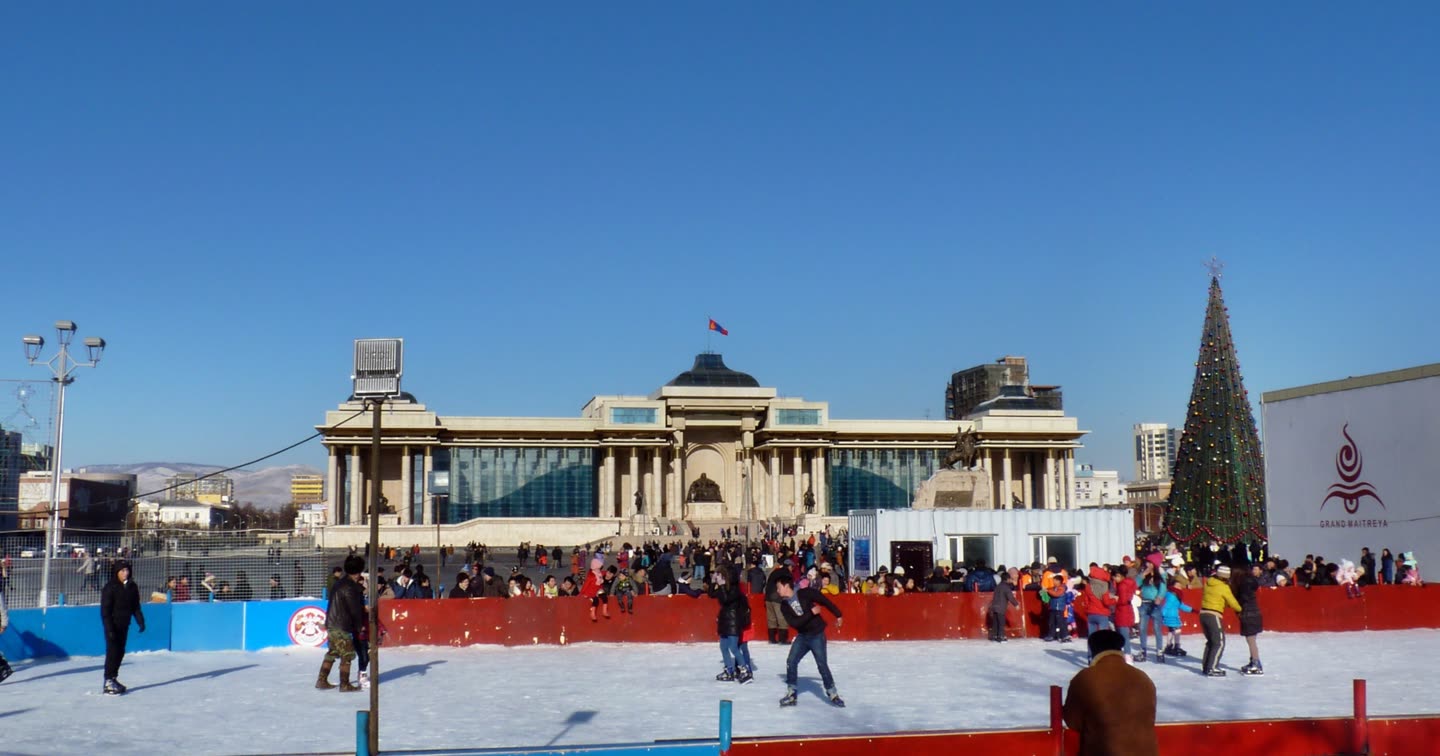
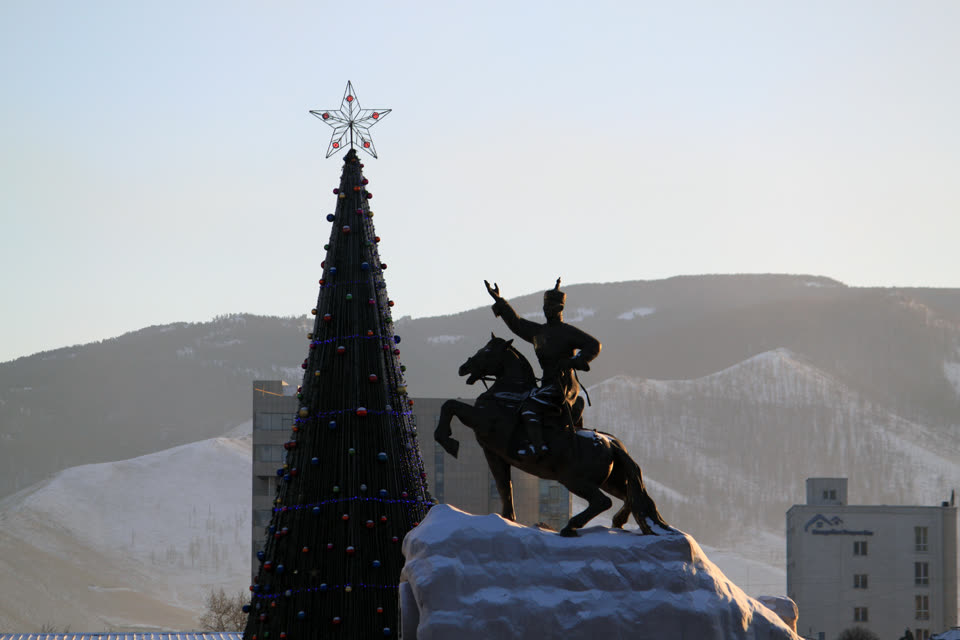
The decorated conifers do go up, in numbers, from the start of December. They are not Christmas trees and are not called them: in Mongolian they are New Year trees, and they belong to 1 January, which is the day the law actually gives the country off.
Christmas in East Asia: Mongolia — OMF International (U.S.), 25 December 2015 — answers written by Kirk and Esther Lynn Matthews, missionaries in Mongolia
Grandfather Winter came out of a theatre, and the dates do not agree with each other
Mongolia's winter gift-bringer is Өвлийн өвгөн, Grandfather Winter — the Soviet Дед Мороз, arrived through the Mongolian People's Republic and dressed in a deel. He does not come down a chimney. He is booked, and he appears at the party.
The usual story gives him a single birthday, 1947. A historian working from named documents gives three and reconciles none of them: the actor Д.Чимид-Осор played the part at the Central Theatre's tree «in the early 1940s»; Г.Гомбосүрэн, interviewed by Улаанбаатарын мэдээ on 1 January 1985, is described as having created the first Grandfather Winter of the STATE tree in 1946; and it is from the New Year of 1947 that the state tree began inviting the theatre's Grandfathers Winter in.
A Consolata missionary writing from Arvaiheer in 2018 set down what the thirty years since 1990 had done. In the 1990s, he wrote, Christmas was unheard of; until the early 2000s there was no visible sign that 25 December was anything special, and it was a working day like any other.
What has changed since is commercial rather than religious, and his sentence for it is the one worth keeping: people exchange gifts wrapped in shiny paper, and they do not know why.
The smallest Catholic community in the world keeps Christmas in a cathedral built like a ger
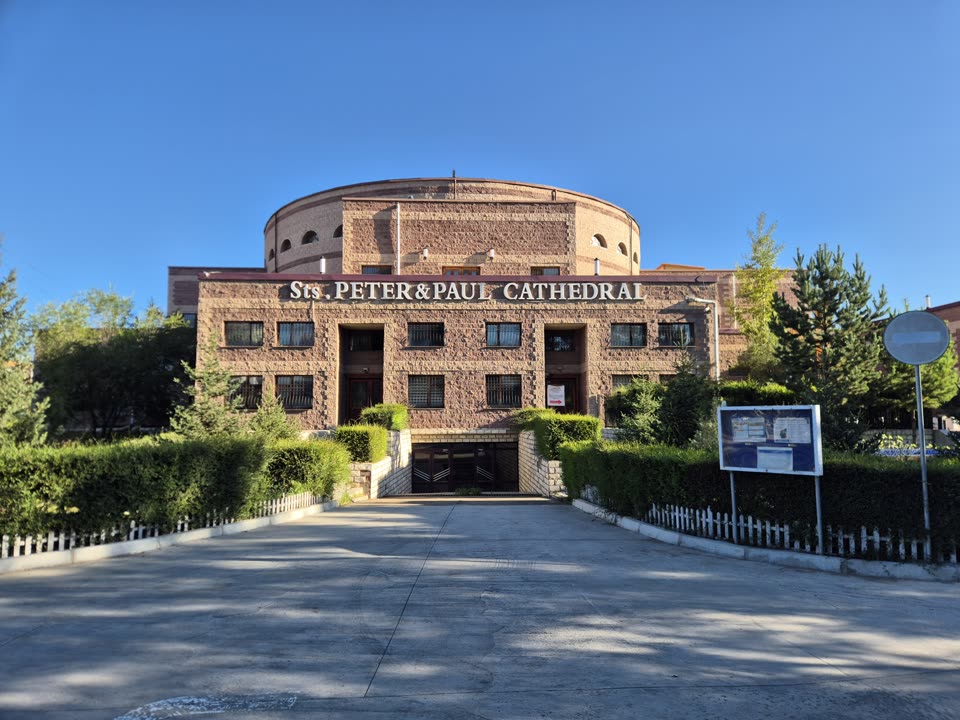
Ulaanbaatar's Catholic cathedral, Saints Peter and Paul, is built in the shape of a ger. Pope Francis went there on 2 September 2023, on a journey the Holy See had announced for 31 August to 4 September, and was met at a ger on the cathedral grounds with a glass of milk before he went in.
The community he came to see numbers fewer than fifteen hundred people. A priest of nineteen years in the country called it the world's smallest Catholic community, and the Holy See's own announcement put it plainly: there are fewer than 1,500 Catholics in all of Mongolia.
Widely repeated claims about Christmas in Mongolia that do not survive
checking. Each one says what is actually the case, because a correction
with nothing in its place leaves you worse off than before.
Oversimplified
Mongolia celebrates Christmas — the trees, the lights and the Santa figures all over Ulaanbaatar in December prove it.
What is actually the case. The decorations are real and they are not Christmas decorations. In Mongolian they are New Year trees, and the holiday they belong to is 1 January, which is the day the statute gives the country off. On 25 December offices and businesses open as usual.
The figure beside the tree is Өвлийн өвгөн, Grandfather Winter, who arrived from Soviet Russia through the state New Year tree in the 1940s and belongs to the same 1 January.
What is also true is that the look of the season is converging on Christmas, and that a Catholic missionary who watched it happen described it as the commercial trappings arriving without anybody understanding them.
Christmas in East Asia: Mongolia — OMF International (U.S.), 25 December 2015 — answers written by Kirk and Esther Lynn Matthews, missionaries in Mongolia
Contested
Mongolia's Grandfather Winter dates from 1947.
What is actually the case. 1947 is one of at least three dates, and the account that gives it also gives the others. Writing from a 1985 newspaper interview and a 1946 Ministry of Enlightenment booklet, the historian Х.Мөнхбаяр has the actor Д.Чимид-Осор playing the part at the Central Theatre's tree in the early 1940s, Г.Гомбосүрэн creating the first Grandfather Winter of the state tree in 1946, and the state tree beginning to invite theatre Grandfathers Winter from the New Year of 1947.
The three are not rivals so much as answers to three different questions — the first on any stage, the first on the state's own tree, and the year the practice became regular — and the familiar 1947 does not say which of them it means.
Mongolian law prints two lists — every day the country takes off, and every day it marks without taking off — and Christmas is on neither. What the country does take off that week is 29 December, which the statute calls «the day of the restoration of national freedom and independence» and which was added to it by the amending law of 23 December 2011. Four days after Christmas, Mongolia takes a day off for its own independence.
A religious feast was added to Mongolia's holiday law, and recently: the Buddha's Great Day, on the fifteenth of the first summer lunar month, became a day off by the amending law of 20 December 2019. The statutory calendar is not closed to religion. It has simply never had Christmas on it.
The missionary who wrote in 2018 that Mongolians were exchanging gifts in shiny paper without knowing why was Giorgio Marengo, then living at Arvaiheer in the Gobi. In August 2022 he was made the first cardinal in Mongolia's history, and in September 2023 he received the Pope in the ger-shaped cathedral in Ulaanbaatar.
When a Mongolian news site marks the approach of Christmas, it runs photographs of somebody else's. A December 2025 gallery on ikon.mn, headlined that the world's cities have begun preparing for Christmas, is Dublin, New York, Vienna, Tokyo, Paris, Brussels, Sofia, Athens and São Paulo. Not one frame in it was taken in Mongolia.
Every claim carries its own citation. They are collected below, so you
can see what the page rests on and how much of it comes from where.
Pope Francis encourages Mongolian Catholic flock in faith, unity, witness — Cindy Wooden, Catholic News Service, datelined Ulaanbaatar, 2 September 2023; read at America. Retrieved 2026-11-21.The lead is the description used here: «In a cathedral shaped like a ger, Pope Francis met leaders of Mongolia's tiny Catholic community». The building is named as «the Cathedral of Sts. Peter and Paul in Ulaanbaatar», and the piece gives «Mongolia's 1,450 Catholics». A Consolata priest of nineteen years in the country, Fr Ernesto Viscardi, calls it «the world's smallest Catholic community».
Christmas in Mongolia amid signs of consumerism and the memory of Mgr Padilla — Giorgio Marengo, then a Consolata missionary at Arvaiheer, for AsiaNews; read in a reproduction on the MongolianViews blog dated 29 December 2018. Retrieved 2026-11-21.The reproduction carries the dateline «Arvaiheer (AsiaNews)» and the byline «by Giorgio Marengo*», footnoted «Consolata missionary in Arvaiheer».The sentences used: «In the 1990s, Christmas was unheard of», «Until the early 2000s there was no visible sign that 25 December was anything special» and that it was «a working day like any other», «the commercial trappings of Christmas have arrived, without people understanding them», and «People exchange gifts wrapped in shiny paper but they don't know why.»
Нийтээр тэмдэглэх баярын болон тэмдэглэлт өдрүүдийн тухай хууль, 4, 5 дугаар зүйл — Law of Mongolia of 18 December 2003, as amended, on the state legal-information system legalinfo.mn. Retrieved 2026-11-21.Article 4.1 is the complete list of days the whole country takes off: Naadam on 10–15 July; Цагаан сар, the lunar new year, on the 1st, 2nd and 3rd of the first spring month; «Шинэ жил: 1 дүгээр сарын 1»; International Women's Day; Children's Day; «Үндэсний эрх чөлөө, тусгаар тогтнолоо сэргээсний баярын өдөр: 12 дугаар сарын 29»; Chinggis Khaan's Day; Republic Day on 26 November; and «Бурхан багшийн Их дүйчин өдөр», the Buddha's Great Day, added by the amending law of 20 December 2019.
Christmas in East Asia: Mongolia — OMF International (U.S.), 25 December 2015 — answers written by Kirk and Esther Lynn Matthews, missionaries in Mongolia. Retrieved 2026-11-21.What it is good for is the flat practical detail nobody else writes down: «Every office and business is open on Christmas Day», «People go to work as usual», «Very few churches have a special service on Christmas day», «Christmas is celebrated in church the Sunday before Christmas», and «There will be Christmas trees but here people call them New Year Trees».
Монголын анхны ёолк болон өвлийн өвгөн аавын тухай шинэ түүх — Түүхч, Тайжууд Х.Мөнхбаяр, news.mn, 31 December 2017. Retrieved 2026-11-21.It works from an interview Г.Гомбосүрэн gave «Улаанбаатарын мэдээ» сонины 1985 оны 1 дүгээр сарын 01-ний өдрийн №2 (4962) дугаарт, and from a 1946 booklet of school sketches issued by the Ministry of Enlightenment with a foreword by Д.Чимид-Осор.And it does not reconcile its own dates, which is recorded here rather than resolved: for the tree «Орос ёолк 1925 оноос монголд ийнхүү нутагшиж эхэлсэн боловч», and separately the 1931–32 New Year's Eve gathering at the writer Д.Нацагдорж's house; for the Winter Grandfather, Д.Чимид-Осор «1940-өөд оны эхэн үеэр Төв театрын ёолконд өвлийн өвгөний дүр бүтээж», Г.Гомбосүрэн «1946 онд Төрийн ёолконы анхны өвлийн өвөөгийн дүрийг бүтээснээс хойш», and «1947 оны шинэ жилээс төрийн ёолкон дээр театрын өвлийн өвөөг урин залах болсон».
ФОТО: Дэлхийн хотууд Зул сарын баяртаа бэлдэж эхэллээ — Э.Тэмүүлэн, ikon.mn, 4 December 2025. Retrieved 2026-11-21.Its own text calls the feast «Зул сарын баяр» and says «Дэлхий даяар хоёр тэрбум хүн жил бүрийн арванхоёрдугаар сарын 25-нд Зул сарын баярыг тэмдэглэдэг уламжлалтай» — around the world, two billion people.