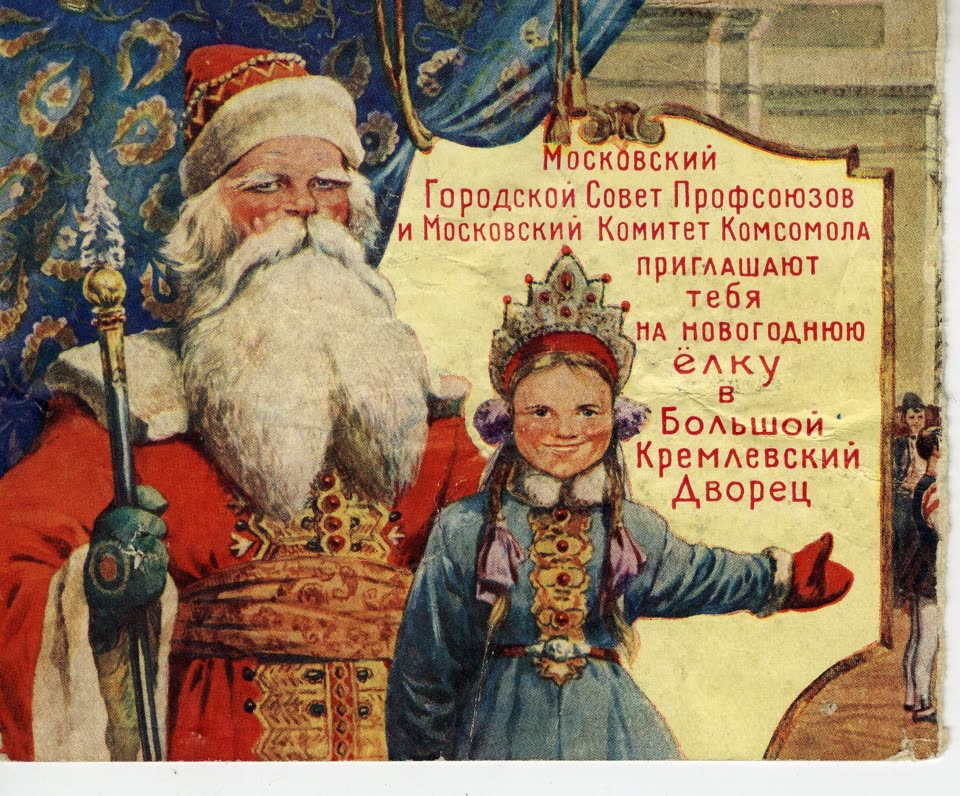
Ded Moroz — Grandfather FrostДед Мороз · arrives 31 December
—days
—hrs
—min
—sec
Next: Thursday 7 January 2027
How to say it
С Рождеством Христовым!
S Rozhdestvom Khristovym!
say it: s ruzh-dyist-VOM KHRIS-tuh-vym
A synthesised voice — not a recording of a person — saying С Рождеством Христовым!
in ru-RU.
Literally «(congratulations) with the Nativity of Christ» — the verb поздравлять is implied and dropped, which is why the phrase begins with a preposition and has no verb in it. The shorter «С Рождеством!» is the everyday form. Note the register: this is the greeting for the feast, and it is not the one most Russians say most often in the season. That is «С Новым годом!» — happy New Year — which is the greeting of the holiday this country actually keeps on a national scale.
A synthesised voice — not a recording of a person — saying С Новым годом!
in ru-RU.
The greeting that actually carries the Russian winter, and it belongs in this record rather than beside it. The statute gives 1–6 and 8 January to Новогодние каникулы, the tree is a New Year tree, the gift bringer arrives on 31 December, and the feast on the 7th sits inside that block. A record that listed only the Nativity greeting would describe the smaller of the two occasions and imply it was the larger.
Сочельник — the eve named after what is eaten on it
The eve of the Nativity is навечерие Рождества Христова, and is commonly called сочевник or сочельник after the character of the day's meals. The food it is named for is сочиво — grain boiled with honey. The Orthodox Encyclopedia's rule for the day is «сочиво обварено или кутию с медом», eaten at the second meal. The services are the Royal Hours in the morning and, in the afternoon, Vespers with the Liturgy of St Basil the Great carrying the feast's readings.
НАВЕЧЕРИЕ — Православная энциклопедия, т. 48, С. 222–223
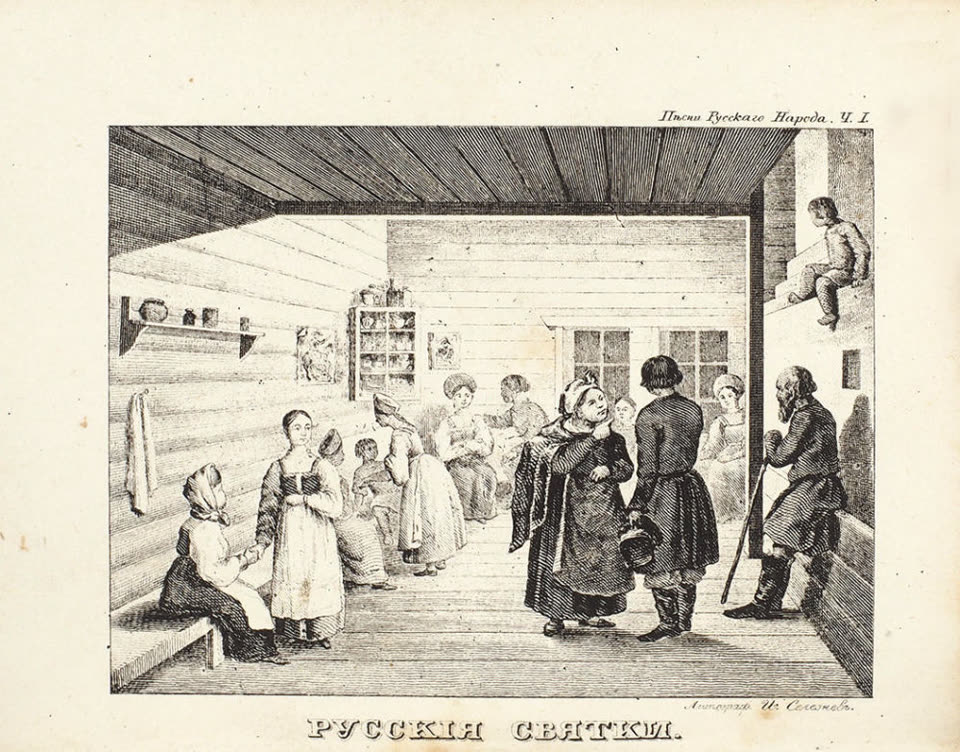
Святки — the twelve days, and the games the church kept trying to stop
The twelve days from the Nativity to Theophany are Святки — 25 December to 5 January old style, 7 to 18 January new style. The name is from the Old Russian «святокъ», a feast, in use from the seventeenth century. In Russian popular tradition they were a period of games, divination (гадания) and customs the church read as pagan survivals, and the record of that reading is a long series of prohibitions: the Stoglav of 1551 (ch. 41 q. 24; ch. 92), and a Patriarchal decree of 24 December 1684 forbidding, over the Nativity eve and through Svyatki, the holding of игрища and «наряжаясь в кумирские одеяния, производить по улицам пляски и петь соблазнительные песни».
СВЯТКИ — Православная энциклопедия, т. 62, С. 98–99, published 1 October 2025
The fast is not broken at a star
The best-known rule about Russian Christmas Eve — that nothing is eaten until the first star appears — is a pious Russian custom and not a rule of the church. The Typikon does not contain it. What the service actually has is a candle, brought out from the altar after the liturgy, which stands for the star over Bethlehem; the fast runs to the end of that service rather than to the sky.
The Christmas Eve table is laid for the dead as well
The сочельник meal is a family supper that popular belief understood as repeating the meal of the Holy Family after the birth. The food is fasting food — blini with honey, pies with mushrooms, potato and grain, kasha — with кутья and узвар obligatory. And the people at it are not only the living: among the Russians of the Southern Urals the dead members of the family, «родители», were held to take part, released by God onto the earth to rejoice at the Nativity too. The shared meal bound ancestors and descendants, and was a kind of offering to the dead in exchange for the goods they could give the living.
On Christmas Eve evening or Christmas morning a small straw fire — a пурына — was lit by every house in the Southern Urals, with a piece of incense and a candle-end brought from church thrown in for holiness. The rite is called «ножки греть родителям», warming the parents' feet: the fire is for the dead relatives coming from the other world, and each household burned its own. The family stood around it in silence remembering their dead, and the head of the house might say «Мама, папа, няня, дядя, мы тебе ножки греем». In the Orenburg Cossack stanitsas the same fire was explained differently — it was lit to warm the infant Christ, born into a winter frost with nothing but a cold sky above him.
«Славление Христа» — the star on a pole, and the carol that threatens you
House-visiting is the characteristic Svyatki rite: groups of children, then youths, then young married couples, going round the village with congratulations. «Славление Христа» entered Russian folk practice in the second half of the seventeenth century under Tsar Alexei Mikhailovich, and re-enacted the magi arriving at the manger — the славельщики carried a рождественская звезда on a long pole, made of straw, paper, or a wooden hoop covered with paper and fitted with long rays of splinters. They knocked at the window, were invited in, went to the icon corner, prayed, and sang the Christmas troparion, closing with «С Рождеством, с праздничком!».
The songs then asked to be paid, and threatened the household if they were not. One recorded in the Southern Urals runs: «Не дадите пирожка, я корову за рога, / Возьму корову за рога, телушку за хвост / И уведу их в колхоз…»
Васильев вечер — sowing grain indoors, and a pig named after a saint
14 January, which is 1 January on the old calendar, is Васильев день — St Basil the Great, Basil of Caesarea. Its eve carries щедрование, also called посевание: boys, or in some places the village shepherds, go from house to house scattering grain and singing congratulation songs, and are paid in baked goods, sweets or coins. The required dish of the meal is the «кесаретский» поросёнок — Basil's pig, or any pork dish — eaten as a rite to secure a good harvest. A saint of Caesarea gives his name to a pig eaten for the crops.
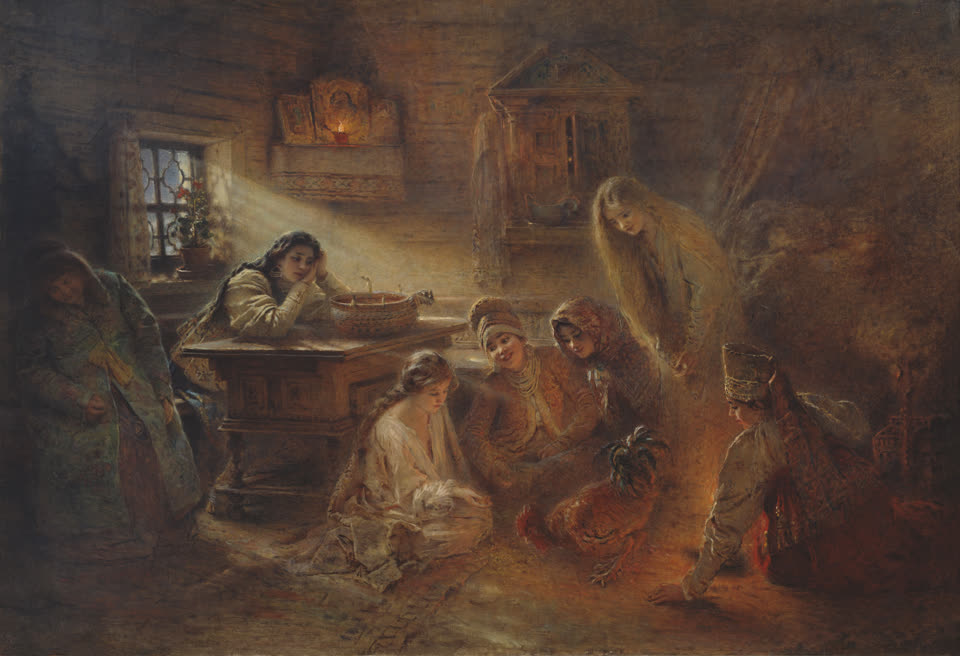
Гадания — the half of Svyatki the church never stopped
The second half of Svyatki is the «страшные вечера», and it carries the divination. Girls told their fortunes about marriage — whether, when, where, and the name of the betrothed — by pouring melted wax or molten tin into water and reading the shape, and by drawing lots. The mummers belong here too: bright costumes and masks, arriving at the youth gatherings or at houses with noise, singing and dancing, and taking food or money for it. Four centuries of prohibition, from the Stoglav of 1551 to the Patriarchal decree of 1684, did not remove any of it; it is what the museum still describes as the content of the period.
Святки — Российский этнографический музей (Russian Ethnographic Museum), Этнокалендарь
Calling Frost to the table — «гукание Мороза»
Before the Christmas Eve meal begins, the householder or one of his sons throws the door wide and calls Frost in to eat. In Melovoye, Rakityansky district: «Мороза, Мороза, / Ходи до нас вечерять, / Да только не морозь ягнят, телят / И маленьких ребят!» Only then does the family sit, in strict order — the host in the centre, grown sons to his right, the mistress, the parents and the youngest children to his left — and only the host may taste the kutya first.
In the Belgorod–Kursk villages he carries that first spoonful out to the threshold instead, and the invitation turns into a threat: «Мороз, Мороз, ходи к нам в хату куттю есть! А в летку не приходи, под кореньями сховайся! А станешь морозить, будем тебя кнутом сечь!» — come and eat, but do not come in summer, hide under the roots, and if you freeze anything we will take a whip to you. Recorded in Terebreno, Krasnoyaruzhsky district.
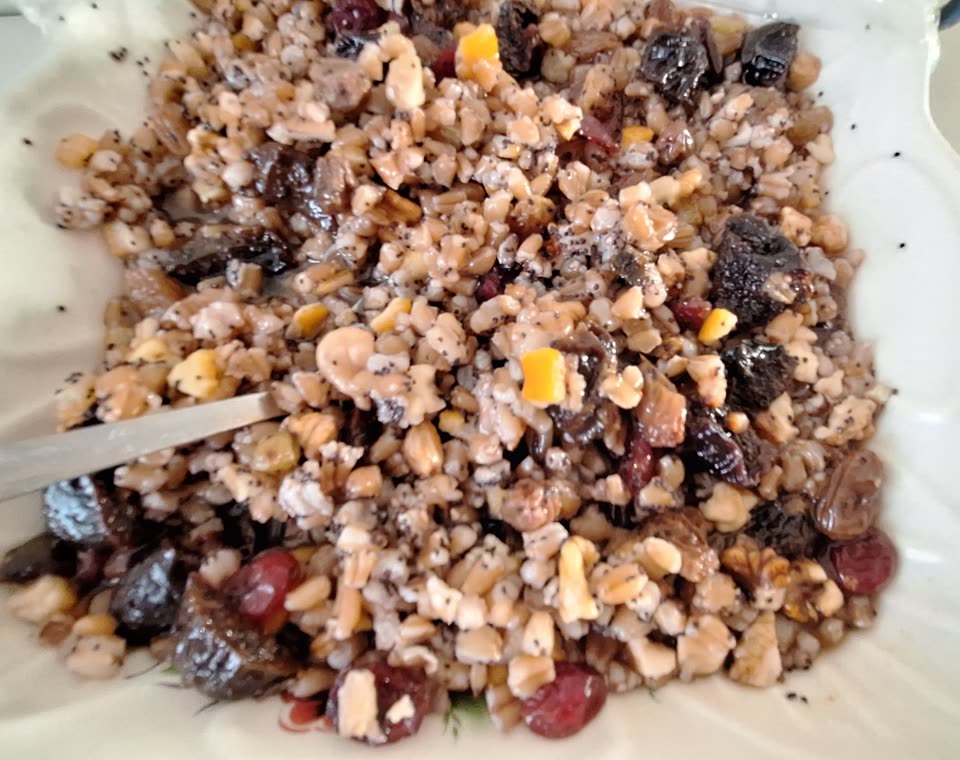
Sochivo, or kutya — grain boiled with honey сочиво, кутья
The dish the eve is named after, and the only Russian Christmas food this record currently carries with a source. Wheat, barley or rice boiled with honey; the church rule for the eve names it directly as «сочиво обварено или кутию с медом». The name сочиво is Church Slavonic for soaked grain — wheat, lentils, peas, barley — which is why the eve is сочельник.
НАВЕЧЕРИЕ — Православная энциклопедия, т. 48, С. 222–223
Uzvar — dried fruit boiled with honey узвар, взвар
The other half of the ritual pair. Узвар is made from dried fruit and berries — apples, pears, plums, cherries, currants — stewed in a pot with honey. Shangina records кутья and узвар as the two обязательные dishes of the Christmas Eve table, and reads them together: both are built from grain and fruit, and their symbolism is the renewal of life through death, because grain and berries die and are reborn every year. The honey is from the bee, which the same tradition calls «божья угодница».
The Christmas table after the fast — and three different kutyas рождественский стол; кутья постная, богатая, васильевская
What the fast ends into, recorded in Belgorod villages: кутья, fish dishes, заливное, студень from pig and beef trotters, home-made pork sausage, ham, blini, взвар, small baked goods («бабышки», «куличики»), honey gingerbread, biscuits shaped as farm animals, meat pies and round loaves. The Christmas loaf itself was wheat flour decorated with lozenges, circles and zigzag «ковылышки».
And the kutya is not one dish but three, by an informant's own count — Ломатина М. Г., born 1931, of Nizhnyaya Pokrovka, Krasnogvardeysky district: «Три кутти бывает. Под Рожство – постная, и под Хрященье, а под Новый год – васильевская кутя – жирная». A lenten one for Christmas Eve, another for Epiphany, and a rich one for the New Year, Basil's kutya, made with fat. The Christmas one is «голодная», hungry kutya, cooked on взвар with honey or sugar, ground nuts and pounded poppy seed.
The thirteen days between Russian and Western Christmas are written into a Bolshevik decree about banking. The Sovnarkom decree introducing the Western European calendar orders that «Первый день после 31 января сего года считать не 1 февраля, а 14 февраля» — and then spends eight of its ten clauses on wages, pensions, loan interest and contract deadlines, adding thirteen days to each. The state moved to the Gregorian calendar and the church did not, and that administrative gap is the whole reason Russian Christmas is on 7 January.
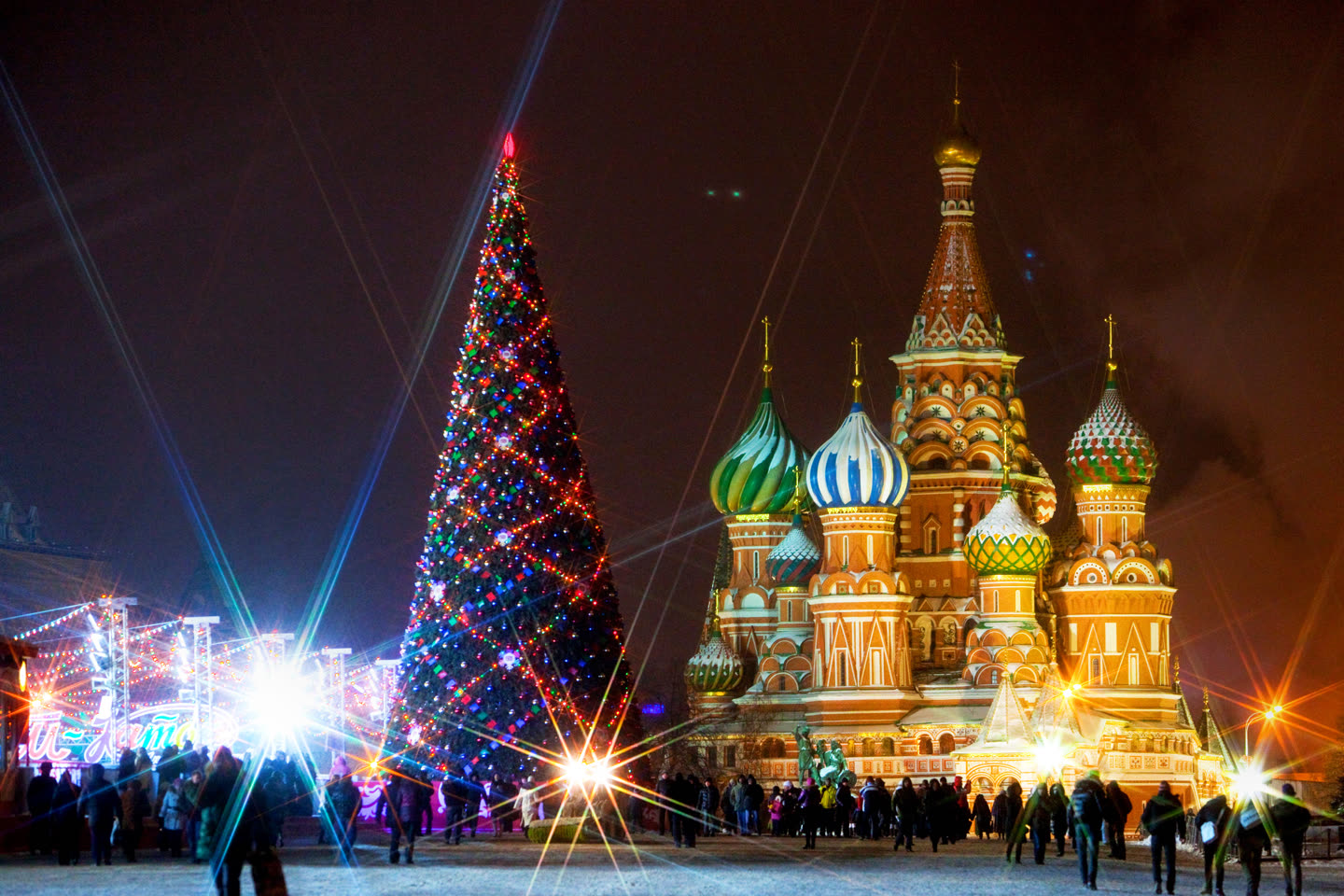
The New Year tree came back in 1935, and for another twelve years people still went to work the next morning. The tree was rehabilitated by an article P. P. Postyshev published in «Правда» on 28 December 1935 — «Давайте организуем к новому году детям хорошую ёлку» — and the first Soviet New Year tree was held three days later, on 31 December 1935, at the Palace of Pioneers in Kharkiv. Moscow's came on 1 January 1937. But 1 January did not become a holiday and a day off until a decree of the Presidium of the Supreme Soviet on 23 December 1947.
Snegurochka has no folk original. Ded Moroz has a plausible ancestor in an East Slavic ritual Frost, but the Snow Maiden is not recorded in Russian folk ritual at all — she arrives through Ostrovsky's «весенняя сказка» of 1873, and only becomes the winter figure's granddaughter when the two of them are put on a stage together at a Soviet children's New Year party in the Moscow House of Unions at the beginning of 1937.
The sentence that ended Christmas in the Soviet Union does not mention Christmas. A labour regulation of September 1929, setting out shift rotas for factories moving to the continuous working week, names the three occasions on which work is forbidden — the 1905 dead and Lenin, the Internationale, the October Revolution — and then deals with everything else in a single line: on New Year's day and on the days of all religious holidays, «former special rest days», work proceeds on the usual basis. The entire church calendar is disposed of inside a bracket.
There is a tsar's complaint about Moscow carol-singing, and it reads like a noise ordinance. Russian documents of the sixteenth and seventeenth centuries describe the Svyatki house-visiting in detail, and a decree of Alexei Mikhailovich begins by naming where it happens: «Ведомо нам учинилося, что на Москве, наперед сего в Кремле, и в Китае, и в Белом, и в земляных городах, и за городом, и по переулкам, и в черных, и в Ямских слободах по улицам и по переулкам, в навечерие Рождества Христова кликали многие люди Коляду и Усень». The Kremlin, Kitai-gorod, the White and Earthen towns, the lanes and the coachmen's quarters — the authorities knew exactly which streets, because they were trying to stop it.
Russia has moved its New Year twice, and the first move was a bigger jump than the second. In December 1699 Peter I decreed that the day after 31 December of the year 7208 «от сотворения мира» would be 1 January 1700 «от Рождества Христова» — the year number changed by more than five and a half thousand, and the New Year moved from September to January in one night. The second move was the 1918 shift to the Gregorian calendar, which cost thirteen days. The familiar Russian winter — New Year on 1 January, Christmas on the 7th — is the result of two state decrees two hundred and eighteen years apart.
Новый год — Российский этнографический музей (Russian Ethnographic Museum), Этнокалендарь
The Christmas tree survived the Soviet Union because it had never been religious in Russia. The museum puts it plainly: the custom of dressing an evergreen came to Russia from Germany and «не приобрел здесь религиозного значения» — it acquired no religious meaning here. That is why 1935 could do what it did. A tree that had always been a party decoration rather than a devotional object could be handed back to children as a New Year tree without conceding anything to the church, and the thing that returned was genuinely the thing that had been taken away. The feast did not come back for another fifty-six years.
Новый год — Российский этнографический музей (Russian Ethnographic Museum), Этнокалендарь
Russian carols treat the feasts as three men walking over a bridge. In Belgorod villages the колядки speak of Kolyada and Ovsen as living persons, and of the holidays themselves the same way: Kolyada goes to the smithy, forges an axe, cuts an oak, builds a little bridge — and over it come «три братца»: «Первый братец – Рождество Христово, / Второй братец – Василь Косарецкий, / Третий братец – Крещенье Христово». Christmas, St Basil's day and Epiphany, crossing in order over a bridge a mythological figure built for them.
The law that gave Russia its Christmas back is two sentences long. «В связи с обращением Патриарха Московского и всея Руси Алексия и уважая религиозные чувства верующих, Верховный Совет РСФСР постановляет: Объявить 7 января (Рождество Христово) нерабочим днем.» — in response to the appeal of Patriarch Alexy of Moscow and All Russia, and respecting the religious feelings of believers, the Supreme Soviet of the RSFSR resolves: to declare 7 January, the Nativity of Christ, a non-working day. Dated 27 December 1990, signed in the House of Soviets by the first deputy chairman, R. I. Khasbulatov. So 7 January 1991 was the first Russian Christmas in sixty-two years that was a day off — the tree had come back in 1935 and 1 January had been a holiday again since 1947, and the feast itself waited until the last days of the Soviet Union.
Widely repeated claims about Christmas in Russia that do not survive
checking. Each one says what is actually the case, because a correction
with nothing in its place leaves you worse off than before.
Oversimplified
Russians celebrate Christmas on a different date from everyone else.
What is actually the case. It is the same date. Russian Orthodox Christmas is 25 December on the Julian calendar, which is 7 January on the Gregorian one — a thirteen-day difference that exists because the Russian state adopted the Western calendar by decree in 1918 and the church did not follow. Nobody moved the feast. The civil calendar moved out from under it. The thirteen days in the decree and the thirteen days between 25 December and 7 January are the same thirteen days.
You must not eat anything on Russian Christmas Eve until the first star appears in the sky.
What is actually the case. It is a pious Russian custom and the church's own rule book does not contain it — «Устав такого не предусматривает» in as many words. The Typikon ties the meal to the end of the service, not to the sky: on a weekday, one meal after the liturgy. The star in the liturgy is a candle, carried out from the altar, standing for the star over Bethlehem.
What is actually the case. Christmas was never banned by name. It was abolished as a class, in a regulation about shift rotas. Article 6 of the labour regulation approved by Sovnarkom on 24 September 1929 lists the only days on which work is forbidden — 9 January 1905 and Lenin's memory, the Internationale, the October Revolution anniversary — and then disposes of everything else in one sentence: «В день нового года и в дни всех религиозных праздников (бывших особых дней отдыха) работа производится на общих основаниях». New Year and the Nativity go together, in the same clause, and the whole of the church calendar is handled by a parenthesis: former special rest days.
The rest of the shape matters too, and it is why «banned» is the wrong word rather than merely a strong one. The word collapses three separate things that were removed together in one clause and came back one at a time, across sixty-two years. The tree returned in December 1935, as a New Year object rather than a Christmas one. The day off returned in 1947, and it was 1 January rather than the Nativity. The feast itself waited until 7 January 1991, the first after the Supreme Soviet declared it a non-working day on 27 December 1990 — three weeks before the Union it had been removed by stopped existing. All three came back. Not one of them came back as what it had been.
Every claim on this page carries its own citation. They are collected
here so you can see what this page is built on, and how much of it comes from where.
с Рождеством — Russian entry — Wiktionary. Retrieved 2026-10-05.Gives IPA [s‿rəʐdʲɪstˈvom] for the short form and names «с Рождеством Христовым» as the fuller synonym, with the elliptical поздравлять explained in the etymology.
Постановление Верховного Совета РСФСР от 27 декабря 1990 г. «Об объявлении 7 января (Рождества Христова) нерабочим днем» — ГАРАНТ / Garant legal database. Retrieved 2026-10-06.Read in full from the page itself rather than from a summary of it. The operative text quoted above appears there once, word for word. The decree records its own publication: «Текст постановления опубликован в "Ведомостях Съезда народных депутатов РСФСР и Верховного Совета РСФСР" от 3 января 1991 г. N 1 ст. 1».
Трудовой кодекс Российской Федерации, Статья 112. Нерабочие праздничные дни (Labour Code of the Russian Federation, Article 112, non-working public holidays) — КонсультантПлюс / ConsultantPlus. Retrieved 2026-10-02.Verbatim, part one: «Нерабочими праздничными днями в Российской Федерации являются: 1, 2, 3, 4, 5, 6 и 8 января — Новогодние каникулы; 7 января — Рождество Христово; …». The list as amended by Federal Law 201-ФЗ of 29.12.2004 and 35-ФЗ of 23.04.2012.
The citation is a commercial database, and that is a known weakness of this entry. ConsultantPlus is the standard legal reference inside Russia and is reliable, but it is not the state. The official portals pravo.gov.ru and publication.pravo.gov.ru are live and respond, and the text of Article 112 has not been retrieved from either. The likely reason is structural rather than a failure to look: the state publishes the law and each amending act, while a consolidated current text is the thing commercial databases sell. If that is right, the honest citation is the consolidated text plus the amending laws by number, which is what this note gives.
Постановление о рабочем времени и времени отдыха в предприятиях и учреждениях, переходящих на непрерывную производственную неделю, ст. 6 — утверждено СНК СССР 24 сентября 1929 г. — Музей истории российских реформ имени П. А. Столыпина (Stolypin Museum of the History of Russian Reforms), «Законы о непрерывной рабочей неделе 1929–1931 гг.». Retrieved 2026-10-05.Official publication reference given in the same collection: Собр. Зак. Союза ССР, 1929, № 63, ст. 586.
Article 6 verbatim, in two parts. First the days on which work is forbidden: «а) день памяти 9 января 1905 года и памяти В.И. Ленина (22 января); б) дни Интернационала (1 и 2 мая); в) дни годовщины Октябрьской революции (7 и 8 ноября)». Then: «В день нового года и в дни всех религиозных праздников (бывших особых дней отдыха) работа производится на общих основаниях.»
Зимние Святки на Белгородчине: опыт фольклорно-этнографических исследований, с. 50–57 — Наука. Искусство. Культура, выпуск 1 (9), 2016 — via КиберЛенинка (open access). Retrieved 2026-10-05.Two university ethnomusicologists reporting their own folklore expeditions in Belgorod villages over several decades, with informants named and dated and the village and district given for each text. This is the second region and the second institution the record needed: south Russian, a thousand miles from Shangina's Southern Urals, and nothing to do with the Russian Ethnographic Museum.
Дед Мороз и Снегурочка (fragments from «Русская ёлка», СПб., 2002) — Отечественные записки, № 1 (10), 2003. Retrieved 2026-10-05.Dushechkina is the scholarly authority on the Russian tree and on these two figures; the Boris Yeltsin Presidential Library cites her for the same material. Verbatim used above: «образа Снегурочки в русском народном обряде не зафиксировано»; «В начале 1937 года Дед Мороз и Снегурочка впервые явились вместе на праздник ёлки в московский Дом союзов»; «К началу XX века образ Деда Мороза окончательно оформился».
НАВЕЧЕРИЕ — Православная энциклопедия, т. 48, С. 222–223. Retrieved 2026-10-05.The scholarly Russian church reference, published under the Moscow Patriarchate. The fasting rule as given: on a weekday one meal after the liturgy with «варение со елеем»; when the eve falls on a Saturday or Sunday, two meals, the first after the liturgy («по уломку хлеба и от вина мало»), the second after Vespers.
СВЯТКИ — Православная энциклопедия, т. 62, С. 98–99, published 1 October 2025. Retrieved 2026-10-05.Dates, etymology, and both prohibitions quoted from this article. The 1684 decree is the best single receipt in this record so far: a dated document that describes the custom precisely by banning it, which is how most of what is known about Svyatki street practice survives.
Как правильно провести сочельник? — Православный журнал «Фома». Retrieved 2026-10-05.Verbatim: «Не есть до появления первой звезды — это благочестивый русский обычай. Устав такого не предусматривает.» And on the candle: «А можно вспомнить, что свеча, которую утром после литургии выносят из алтаря, символизирует Вифлеемскую звезду.» Foma is a mainstream Russian Orthodox magazine; the underlying rule is the one in НАВЕЧЕРИЕ above, which ties the meal to the service and never mentions a star.
В Москве состоялась первая новогодняя ёлка / 1 января объявлено праздничным и выходным днём — Президентская библиотека имени Б. Н. Ельцина (Boris Yeltsin Presidential Library). Retrieved 2026-10-05.Two pages of the same state library. The 1935 and 1937 dates and the Postyshev quotation are from /history/2074168, which cites «Правда» of 2 January 1937, Khrushchev's memoirs, and Душечкина Е., Берсенева Л., «Три века русской ёлки» // Наука и Жизнь, 2007 № 12. The 1947 decree is from /history/619836: «23 декабря 1947 г. Указом Президиума Верховного Совета СССР 1 января был объявлен праздничным и выходным днём».
Праздники народного календаря, в сб. «Русские Южного Урала», с. 78–90 — Российский этнографический музей (Russian Ethnographic Museum), digital library. Retrieved 2026-10-05.Izabella Shangina is a senior ethnographer of the Russian folk calendar and this text is published by the Russian Ethnographic Museum itself — institution and author in one citation. It is field material with named informants from named villages in Orenburg and Chelyabinsk oblasts.
Regional scope, stated honestly: the volume is about the Russians of the Southern Urals, a settler population drawn from many parts of the empire. Shangina marks which customs are wider — the сочельник family meal «как и по всей России», «Славление Христа» «известен не только на Южном Урале, но и во всей России», ряженье «как и во всех русских селах России» — and this record generalises only where she does.
Васильев вечер и Васильев день — Российский этнографический музей (Russian Ethnographic Museum), Этнокалендарь. Retrieved 2026-10-05.The museum's own calendar entries, written at national scope rather than for one region. Cited here deliberately alongside Shangina, whose field material is Southern Urals only: where the museum states a custom for Russians generally and Shangina records it in one place, the record can say it of Russia.
Святки — Российский этнографический музей (Russian Ethnographic Museum), Этнокалендарь. Retrieved 2026-10-05.The museum's own calendar entries, written at national scope rather than for one region. Cited here deliberately alongside Shangina, whose field material is Southern Urals only: where the museum states a custom for Russians generally and Shangina records it in one place, the record can say it of Russia.
Новый год — Российский этнографический музей (Russian Ethnographic Museum), Этнокалендарь. Retrieved 2026-10-05.The museum's own calendar entries, written at national scope rather than for one region. Cited here deliberately alongside Shangina, whose field material is Southern Urals only: where the museum states a custom for Russians generally and Shangina records it in one place, the record can say it of Russia.
Декрет о введении западноевропейского календаря, 24 января (6 февраля) 1918 г. — Электронная библиотека исторического факультета МГУ, from «Декреты Советской власти», Том I, М.: Госполитиздат, 1957. Retrieved 2026-10-05.Signed «Председатель Совета Народных Комиссаров В. Ульянов (Ленин)» with Чичерин, Шляпников, Петровский, Алгасов, Оболенский and secretary Горбунов.
Two dates are given for this decree and both are right about different things: it was adopted at the Sovnarkom session on 24 January (6 February) 1918 and signed by Lenin on 26 January (8 February). ru.wikipedia titles its article by the signature date; the Presidential Library and the published edition cited here date it by adoption. The disagreement is resolved rather than averaged.