Christmas Eve is a night out for couples, and the reason is a curfew that lasted until 1982
The single most reported thing about Christmas in South Korea is that it belongs to couples rather than to families, and two newspapers give the same explanation for it. From 1945 to 1982 the country had a midnight curfew, and Christmas Eve was one of the few nights it was lifted: «From 1945 to 1982, the country had a midnight curfew, and Christmas Eve was one of few days that the curfew was lifted. Since then, Christmas Eve has been synonymous with a night out on the town for young people – rather than a day with family or a religious holiday.»
The Korea JoongAng Daily puts the same fact the same way and draws the obvious conclusion: «allowing people to freely roam the streets at night — a perfect opportunity for lovers to meet». The curfew and its Christmas exception are reported fact; the link to couples is the papers' explanation of a habit that outlived it by forty years.
The restaurants and the hotels are booked, and the price of the night goes up
What the couples' Christmas looks like in practice is a reservation. Restaurants put on Christmas dinners and a table at a popular place is competed for; hotels sell packages for the night. The Korea JoongAng Daily, reporting in 2024, found the rooms that were left were not cheap: «Even the hotels that have rooms available see at least a twofold price increase for those trying to check in on Christmas Eve.»
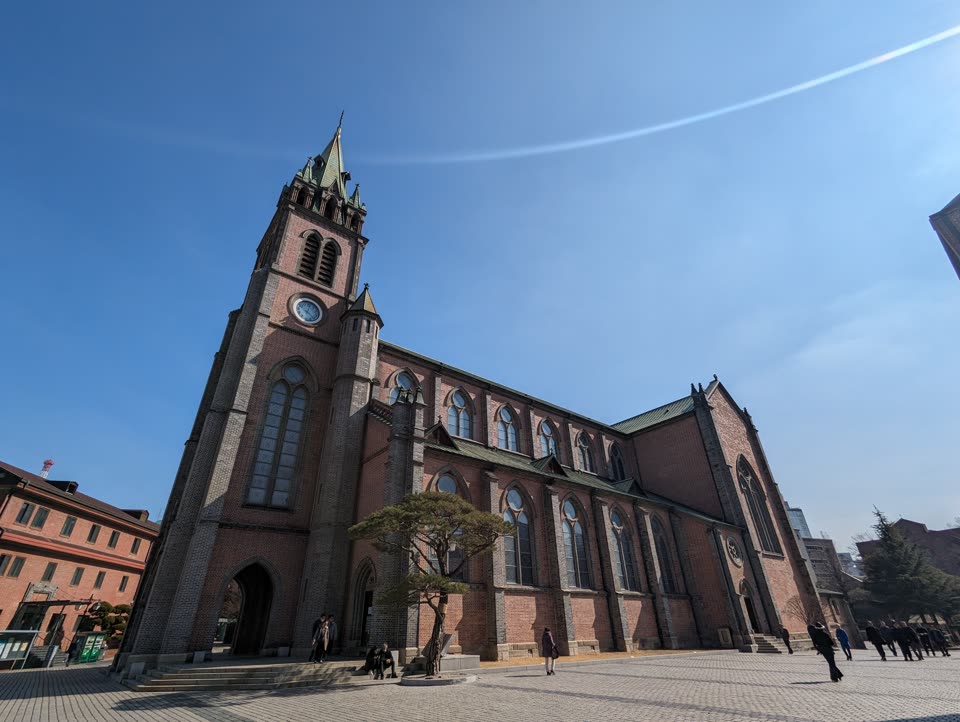
At Myeongdong Cathedral the Christmas Mass opens by laying the infant in the manger
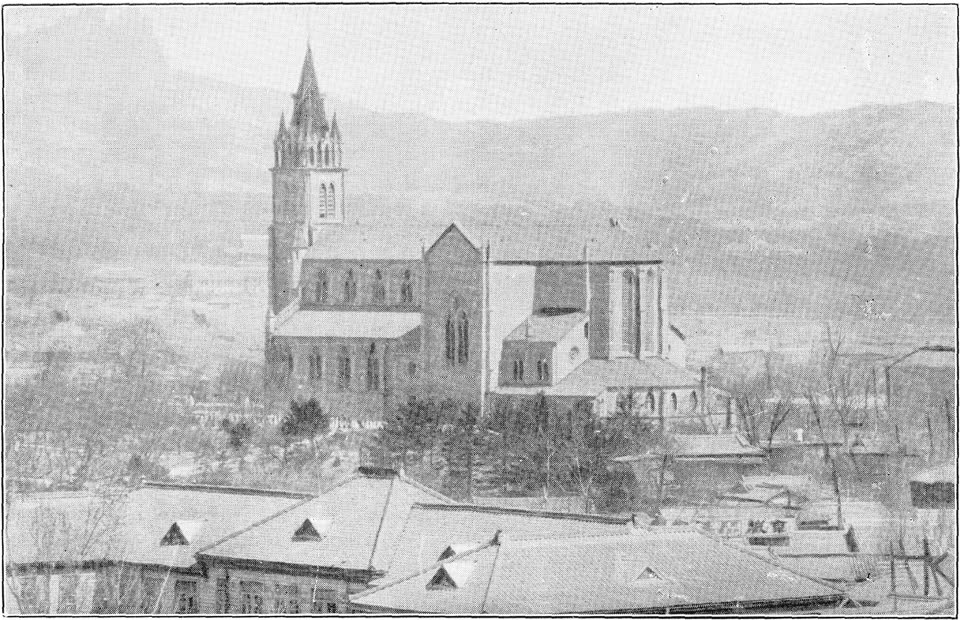
The oldest cathedral in the country, consecrated in 1898, fills for Christmas, and the liturgy begins with a small action rather than with a word: 구유예절, the rite of placing the figure of the infant Jesus in the manger. Yonhap News TV, filming it in 2025, describes the service as beginning «아기 예수 안치하는 '구유예절'로 시작», with the Archbishop of Seoul, Peter Chung Soon-taick, celebrating.
The two papers that carried it disagree about when it happens. Yonhap News TV calls it the 밤미사, the night Mass; the Korea JoongAng Daily's photograph of the same archbishop performing the same rite is captioned «at dawn on Christmas Day, Dec. 25». Both describe 2025.
The street that lights up at Christmas is the street the Japanese department stores were on
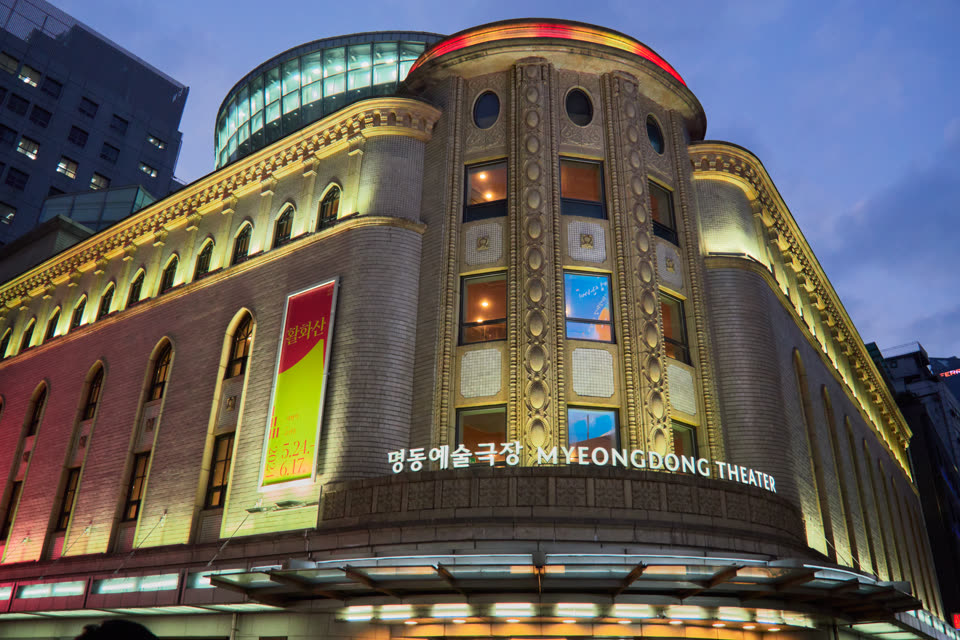
Seoul's Christmas is photographed in Myeong-dong, in front of the Shinsegae department store's illuminated facade. That is not a coincidence of retail geography. The business district there was built in the 1920s, under Japanese rule, around department stores and entertainment, in a quarter where «90 percent of the residents were Japanese» — and the building Shinsegae occupies was the Mitsukoshi Department Store, one of the largest of its day.
It was in that decade, and through those shops, that Christmas in Korea turned commercial, according to the researchers the Korea Herald quotes. The window displays on that corner have been selling Christmas for about a century, under three different states.
The Salvation Army kettle has been on the street since before the war
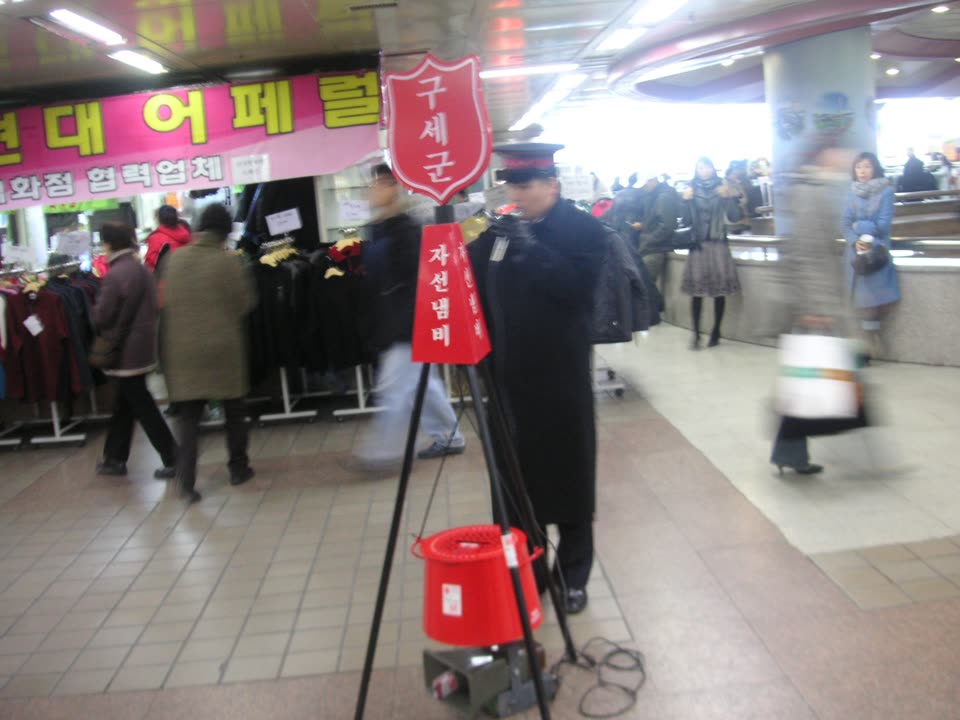
December in a Korean city means the 구세군 자선냄비, the Salvation Army's charity kettle, and the hand bell beside it. The National Archives of Korea opens its own account of Christmas with the sound — «“딸랑∼ 딸랑∼” 온정이 가득 넘치는 빨간 냄비와 함께 구세군의 종소리가 정겨다» — and keeps a photograph of people dropping money into one in 1964.
The same page argues that this is now what the day is for: a feast that has gone past its religious meaning into «소외된 이웃에게 나눔을 실천하고 사랑과 용서의 메시지를 전하는 날», a day for giving to people who have been left out.
The carols went quiet over copyright, and came back by agreement in 2015
Korean shopping streets stopped playing carols in the early 2010s, and the reason was not taste. The National Archives puts it plainly: «2010년대에 들어서서 성탄 무렵 캐럼이 들리지 않게 됐는데 이유는 엄격해진 저작권료 문제 때문이었다» — shops that played music owed royalties, so they stopped.
It was settled by negotiation rather than by litigation: the Ministry of Culture, Sports and Tourism agreed with the Korea Copyright Federation and four music-rights bodies, and on 9 December 2015 the royalty on Christmas carols was removed.
Christmas is one day and Lunar New Year is three, and the three-day one is the family holiday
Christmas gets a single day in the decree. 설날, Lunar New Year, gets the day before, the day itself and the day after; 추석 in autumn gets the same. The Korea JoongAng Daily draws the consequence out loud: those two «were each designated as a three-day holiday, making them convenient for spending time with family as opposed to the one-day Christmas holiday».
An American reporting for the government portal Korea.net reaches the same conclusion from the other end: Koreans mark New Year's Eve and Day, «but Lunar New Year (Seollal) in January or February is a far bigger event», and Christians «often attend church on Dec. 24 or 25» while the rest of the country shops.
Twenty thousand or forty thousand singles turned up in Yeouido Park on Christmas Eve 2012
A Facebook suggestion turned into a mass blind date in Yeouido Park on Christmas Eve 2012, with versions in Busan, Daejeon and Gwangju, and it was reported in two places with two different numbers. The Korea Herald, on the day: «Around 40,000 singles signed up to participate in the romantic mob gathering first suggested by an SNS user.» Al Jazeera, on the same day: «more than 20,000 people signed up», in sub-zero temperatures.
It happened once and it is not a custom. What it shows is what the night is understood to be for, and two serious newsrooms covering one evening in one park came away with counts that differ by a factor of two.
Churches used to carol down the street, and the apartment blocks ended it
Street carolling was a Korean church custom within living memory. «As recently as the 1970s and 1980s, Korean churches used to carol in the streets and hand out gifts and snacks in less-urban neighborhoods» — and then the housing changed. People moved into apartment blocks, particularly in Seoul, and the close neighbourhoods the carollers walked through stopped existing.
It is a custom killed by a floor plan rather than by unbelief, and it is the reverse of what happened to the commercial Christmas on the same streets.
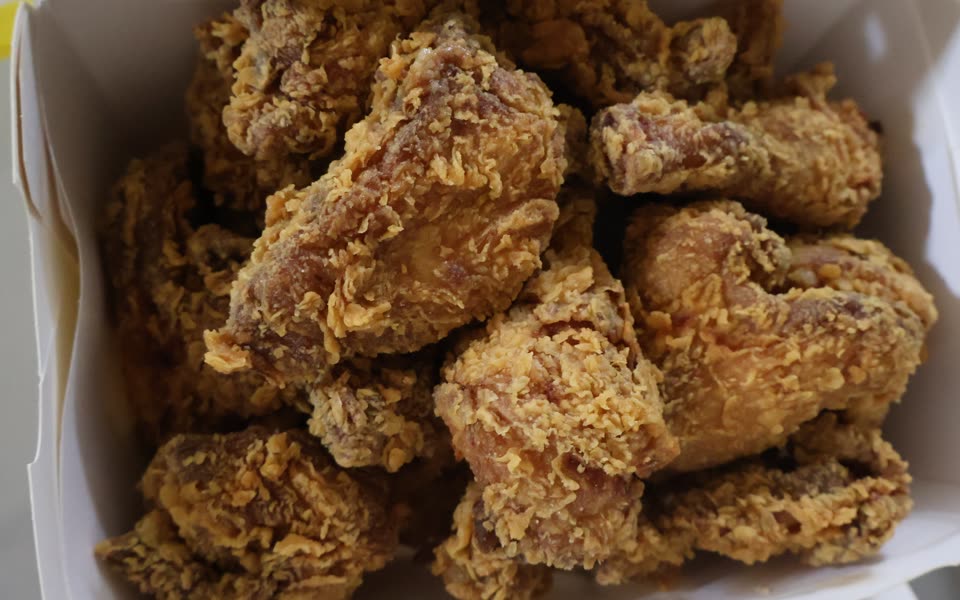
Korea's Christmas bird is a chicken, and it was advertised as one. The National Archives records the slogan of the 1960s and 1970s in as many words — «크리스마스는 가족과 함께 통닭», Christmas is whole roast chicken with the family — for the electric-grilled 통닭 that was then the treat. Fried chicken took the same place from the middle of the 1980s and has not given it back.
This is the same dish and the same decade as the Japanese Christmas chicken, arrived at separately: a 1970s advertising campaign in a country with no Christmas dinner of its own.
Beside the chicken, a cake: «버터크림케이크로 성탄절 분위기를 냈다» — a butter-cream cake made the Christmas mood, in the years when a bought cake was still an occasion.
What goes with it has changed by decade in a way the archive tracks through the presents rather than the plate: a robot toy in the 1970s, a boxed assortment of sweets and a Barbie in the 1980s, a family restaurant in the 2000s.
Widely repeated claims about Christmas in South Korea that do not survive
checking. Each one says what is actually the case, because a correction
with nothing in its place leaves you worse off than before.
Oversimplified
Christmas in South Korea is a Christian occasion, because it is a Christian country by Asian standards.
What is actually the case. Both halves are partly right and the conclusion does not follow. Christians are about a quarter to a third of the population depending on the count, which is high for the region, and the legal holiday carries a Christian name, 기독탄신일. Myeongdong Cathedral fills on the night.
What the day is for most people is a night out. The Korea Herald's feature is titled «How Christmas evolved into a day for merrymaking» and quotes a church historian explaining that the cultural half arrived without the religious half: «Because Christmas is one of the United States' most important holidays, it permeated into Korea, but due to the low percentage of Christians in Korea, the cultural aspects were embraced more than the religious aspects.» It is one day, where the family feasts are three, and the newspapers trace what people do with it to a curfew rather than to a church.
Santa Claus came to Korea with the American soldiers after 1945.
What is actually the case. He was in a Seoul newspaper twenty-one years before the Americans arrived, and in a Korean schoolroom thirty-seven years before that. Pai Chai School handed out the first Christmas stockings in 1887, «which also became the first time Koreans learned of Santa Claus», and the Korea Herald reproduces the photograph that ran in the 매일신보 on 25 December 1924 — a man in a Santa suit with a sack over his shoulder, under the headline «Old Man Santa Claus», held by the National Library of Korea.
The American period did matter, but to the calendar rather than to the figure: the military government made the day a public holiday between 1945 and 1948.
South Korea is the only country in East Asia that has made Christmas a legal holiday.
What is actually the case. The claim is one newspaper's, and it turns entirely on where East Asia is held to stop. The Korea JoongAng Daily writes «It’s the only East Asian country that has designated Christmas a legal holiday».
Two things complicate it. Hong Kong gazettes Christmas Day and the first weekday after it as general holidays every year, and Hong Kong is in East Asia on any definition — what it is not is a country. And immediately beyond whatever line is drawn, Christmas is a public holiday in Indonesia, the Philippines, Brunei, India, Pakistan, Kazakhstan and Armenia. What is true is narrower and more interesting: South Korea is the only state in the region where Christmas is a public holiday and Christians are a minority of the population.
Christmas was a public holiday in Korea before the Republic of Korea existed. The American military government designated it between 1945 and 1948, when Christians were about three percent of the population — «Christmas was designated a legal holiday while Korea was under U.S. military rule between 1945 and 1948, despite the percentage of Christians at the time being only 3 percent» — and the first president of the new state, Syngman Rhee, who had been to a Methodist school, kept it there.
The National Archives of Korea tells it the same way: after liberation in 1945 the day was designated a holiday by the American military government. The decree that now carries it is a different document from a later decade, and the name it uses, 기독탄신일, is still the Christian one.
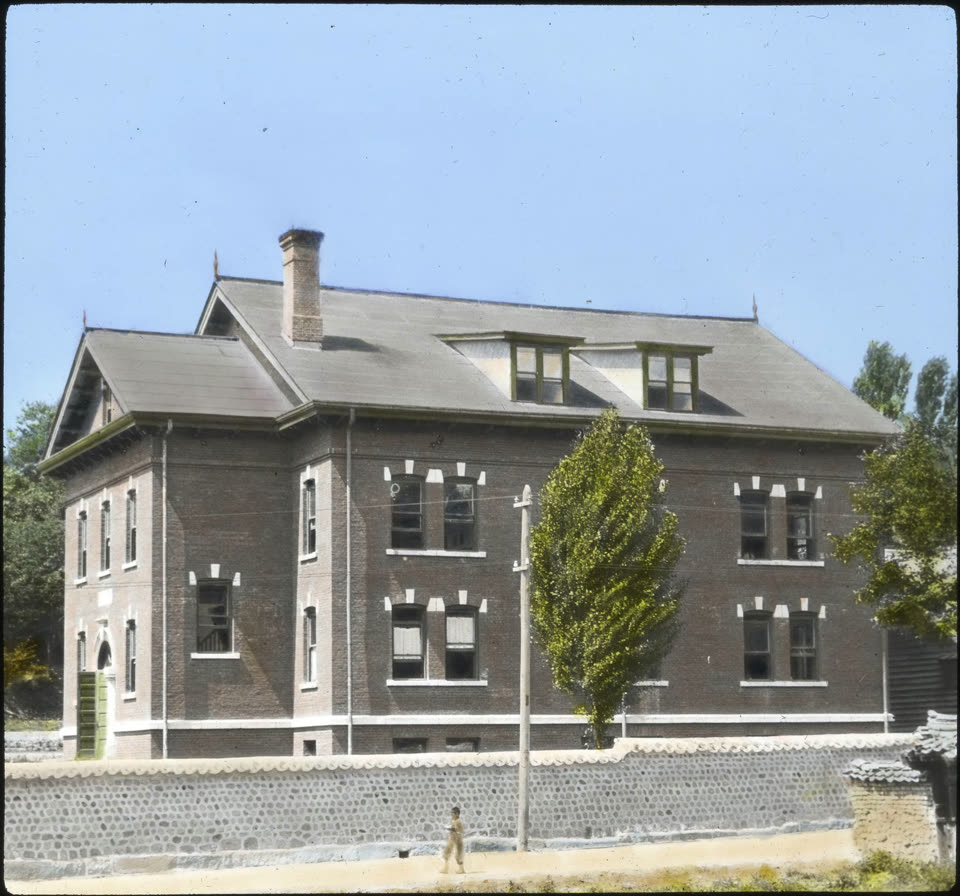
The first Christmas tree in Korea was put up by a woman who had come to found a girls' school. Mary F. Scranton, the American missionary behind Ewha Haktang — the first modern educational institution for women in the country — «set up the country’s first Christmas tree in 1886». The year after, Pai Chai School, founded by Henry Appenzeller, «gave students presents in Korea’s first Christmas stockings in 1887, which also became the first time Koreans learned of Santa Claus».
Christmas in Korea therefore begins in two classrooms, two years apart, and both of them were schools before they were anything else.
In 1897 the students at Pai Chai hung hundreds of lanterns in front of their hall for Christmas, and the National Archives points out what that made: «한국 불교에서 소원을 비는 '등'으로 만들어진 트리는 한국의 전통과 서양 종교가 빚어낸 색다른 크리스마스 풍경이었다» — a Christmas tree made out of the wish-lanterns of Korean Buddhism.
A year before that, on 24 December 1896, the newspaper 독립신문 marked the birth of Jesus by asking its readers to pray — for the Emperor's health, for the fortunes of the dynasty, for peace in the country and for the people to be free of sickness and to prosper. The feast arrived in Korean as a wish for the Korean state.
Christmas in colonial Korea got big enough to be worth complaining about, and then big enough to be banned. In the 1930s Seoul's lit streets were «불야성을 이룬 별천지» in the archive's phrase, modern girls and modern boys walked them, and the department stores sold the new habit of exchanging presents. The 매일신보 ran an article under the title «기독교인에서 상인의 손으로 넘어간 크리스마스» — Christmas passed from Christians into merchants' hands. That complaint is ninety years old.
Then the Sino-Japanese war began in 1937 and the Japanese authorities prohibited festive Christmas events. In 1938 the 동아일보 carried the headline «산타클로스는 안온다» — Santa Claus is not coming — beside articles about sending Christmas comfort parcels to Japanese soldiers.
When Buddhists asked for the Buddha's birthday to be made a public holiday in 1963, the government's answer was that a particular religion's day could not be a holiday — and that Christmas was different because it was worldwide. The National Archives of Korea quotes the reply: «특정 종교의 기념일을 공휴일로 제정할 수 없다. 크리스마스의 공휴일 제정은 범세계적인 것으로 대내외적으로 유기적 연관을 가진 현 사회실정에 비추어 공휴일로 제정한 것이다.»
It took three hundred thousand signatures, a committee founded in 1971, a cabinet decision on 14 January 1975 and a presidential decree on the 27th of that month before Buddha's Birthday became a holiday too. Christmas had been one for thirty years by then, in a country where Buddhists outnumbered Christians.
Korea's Christmas seals are older than the holiday. They were brought in by Sherwood Hall, a Canadian missionary doctor running a tuberculosis sanatorium at Haeju, in December 1932, and the first seal had Namdaemun on it — the great south gate of Seoul, on a stamp invented in Denmark in 1904.
From the 1960s to the 1980s buying them was close to compulsory in spirit: the archive calls it «'도덕적 의무'», a moral duty, a token stuck beside the stamp on a Christmas card to show you had helped. Sales fell with the handwritten letter: 6.4 billion won in 2003, 3.9 billion in 2013, 3.41 billion in 2014.
How many Korean Christians there are depends on who counted and when, and the two available answers are eight years and several points apart. The 2015 census, the last with a religion question, put Protestants at 19.7 percent and Catholics at 7.9 — about 28 percent together, ahead of Buddhists at 15.5 — with 56.1 percent of the country saying they had no religion at all.
A survey by the Korean National Association of Christian Pastors, reported for January 2024, has Protestants at 17 percent and Catholics at 8, and the non-religious share up to 63 percent. A census and a church survey are not the same instrument, and the two disagree about the size of the Protestant share. What they agree on is the direction: fewer Protestants than in 2015, and more people with no religion at all.
Every claim carries its own citation. They are collected below, so you
can see what the page rests on and how much of it comes from where.
General holidays for 2026 — Government of the Hong Kong Special Administrative Region. Retrieved 2026-10-30. archived 24 October 2026Its last two lines are «Christmas Day 25 December» and «The first weekday after Christmas Day 26 December», among seventeen general holidays that also include Lunar New Year, Good Friday, the Buddha's Birthday and National Day.
[WHY] 'Valentine's Day, with Santa': How Christmas became a couples' holiday in Korea — Korea JoongAng Daily, 21 December 2024, by Shin Min-hee. Retrieved 2026-10-30. archived 16 July 2026Scranton, who founded Ewha Haktang, «set up the country’s first Christmas tree in 1886»; «Pai Chai School, another educational institution founded by American missionary Henry Appenzeller, gave students presents in Korea’s first Christmas stockings in 1887, which also became the first time Koreans learned of Santa Claus», both attributed to local reports and to the Encyclopedia of Korean Folk Culture of the National Folk Museum of Korea.The designation: «Christmas was designated a legal holiday while Korea was under U.S. military rule between 1945 and 1948, despite the percentage of Christians at the time being only 3 percent.» And a named church historian, Tark Ji-il of Busan Presbyterian University: «Because Christmas is one of the United States' most important holidays, it permeated into Korea, but due to the low percentage of Christians in Korea, the cultural aspects were embraced more than the religious aspects.»It says «A Dongnip Sinmun article dated Dec. 24, 1886, is recorded as the first Korean article to ever write about the birthday of Jesus Christ» — but the National Archives of Korea dates that same notice «1896년 12월 24일자 「독립슴문」», ten years later, and Dongnip Sinmun was founded in 1896.Its hotel line: «Even the hotels that have rooms available see at least a twofold price increase for those trying to check in on Christmas Eve.»
Celebrating Christmas in Korea as an American expat — Korea.net, the Korean government's portal, Honorary Reporters. Retrieved 2026-10-30.«Christmas in Korea also has a big commercial element, but Christians in the nation often attend church on Dec. 24 or 25.» The holiday counts themselves are from the decree, article 2 no. 4: «설날 전날, 설날, 설날 다음 날(음력 12월 말일, 1월 1일, 2일)».
석가탄신일 (Buddha's Birthday), in 「기록으로 만나는 대한민국」 — National Archives of Korea, written by Nam Ae-ri. Retrieved 2026-10-30. archived 20 August 2026In full: «불교계는 1963년 석가탄신일을 공휴일로 지정해 줄 것을 정부에 처음으로 건의했지만 정부는 “특정 종교의 기념일을 공휴일로 제정할 수 없다. 크리스마스의 공휴일 제정은 범세계적인 것으로 대내외적으로 유기적 연관을 가진 현 사회실정에 비추어 공휴일로 제정한 것이다.”라고 답했다.»And the sequence after it: «30만 명의 서명», the 1971 founding meeting of the committee, «1975년 1월 14일 국무회의» and the presidential designation on 27 January 1975.
'성탄절 인사말', 프랑스어로 "조이유 노엘" — TenAsia (텐아시아), 24 December 2015, by An Na-yeong. Retrieved 2026-10-30.A Christmas-greetings piece that states which one is ordinary: «성탄절 인사말로는 가장 대중적인 ‘메리 크리스마스(Merry Christmas)’가 있다» — the most common greeting is Merry Christmas.
[Feature] How Christmas evolved into a day for merrymaking in Korea — The Korea Herald, 17 December 2022, by Park Yuna. Retrieved 2026-10-30.A reported feature with two academics in it: Park Jeung-keun of the Presbyterian University and Theological Seminary in Seoul, who says Christmas reached Koreans through the missionaries as a festival — «Like Chuseok in Korea, it was celebrated like a festival in western countries» — and Youm Won-hee of Kyunghee University, quoted from a book: «It was around the 1930s that Christmas turned into a festival widely enjoyed by people, more than a religious holiday (in Korea)».It is also the source for the colonial commerce — the Myeong-dong and Chungmuro business districts of the 1920s, where «90 percent of the residents were Japanese», and the Mitsukoshi Department Store whose building is now Shinsegae — and for the Santa photograph: «A picture of a person in a Santa Claus outfit with a bag of presents slung over his shoulder appeared on the Dec. 25, 1924 edition of the daily newspaper “Maeil Sinbo.” The headline said: “Old Man Santa Claus.”»And the curfew: «From 1945 to 1982, the country had a midnight curfew, and Christmas Eve was one of few days that the curfew was lifted. Since then, Christmas Eve has been synonymous with a night out on the town for young people – rather than a day with family or a religious holiday.»
Thousands of singles gather in Christmas Eve blind date — The Korea Herald, 24 December 2012. Retrieved 2026-10-30.«Around 40,000 singles signed up to participate in the romantic mob gathering first suggested by an SNS user.»Al Jazeera's report of the same event, the same day, is at https://www.aljazeera.com/features/2012/12/24/s-korea-hosts-mass-holiday-speed-dating : «More than 20,000 people braved sub-zero temperatures to join pre-Christmas speed dating event in Seoul», and «when the idea of a mass speed dating event was floated on Facebook in Seoul, more than 20,000 people signed up».
More Koreans now non-believers, census shows — The Korea Times, 10 January 2017. Retrieved 2026-10-30. archived 2 March 2026«Non-believers accounted for 56.1 percent of the population ― 27.5 million ― in the Statistics Korea 2015 Population and Housing Census.»
서울 명동성당 '성탄 대축일 밤미사' 진행 — Yonhap News TV, 25 December 2025. Retrieved 2026-10-30. archived 24 December 2025The broadcaster's own caption: «아기 예수 안치하는 '구유예절'로 시작 서울대교구장 정순택 대주교 미사 집전».The other half of the pair is the Korea JoongAng Daily's photograph caption of 25 December 2025, https://www.koreajoongangdaily.com/korea/away-in-a-manger/11704432 : «Archbishop Peter Chung Soon-taick of the Catholic Archdiocese of Seoul performs the "nativity ritual," placing the infant Jesus in a manger at Myeongdong Cathedral in central Seoul at dawn on Christmas Day, Dec. 25.»The cathedral's founding year is the Korea Herald's: «Myeongdong Cathedral, the oldest cathedral in the country founded in 1898».
관공서의 공휴일에 관한 규정 (Regulations on Holidays of Government Offices), article 2 no. 10 — 국가법령정보센터, the Korean Ministry of Government Legislation. Retrieved 2026-10-30.Article 2 lists the holidays of government offices and the tenth of them is «기독탄신일(12월 25일)» — Christ's Birthday, 25 December.The fourth item in the same list is «설날 전날, 설날, 설날 다음 날», which is three days for Lunar New Year against Christmas's one. And the amendment of 4 May 2023 (대통령령 제33448호) gives Christmas a substitute holiday: «부처님오신날(음력 4월 8일) 및 기독탄신일(12월 25일)이 토요일이나 일요일, 다른 공휴일과 겹치는 경우에는 부처님오신날 및 기독탄신일 다음의 첫 번째 비공휴일을 대체공휴일로 지정하려는 것임».