The d is soft, the th of this. The vowel of the first syllable changes with the dialect: a neutral uh in Barcelona and the Balearics, a clear ah in Lleida and Valencia.
Generated illustration (Grok Imagine) —
Category:Cabalgata de Reyes Magos is empty of files and of subcategories, and nothing in Category:Dia de Reis in Catalonia passes. Mexico has a generated Reyes picture and it is not reused here: that brief was written for a Mexican page, and a collection is not a provenance.
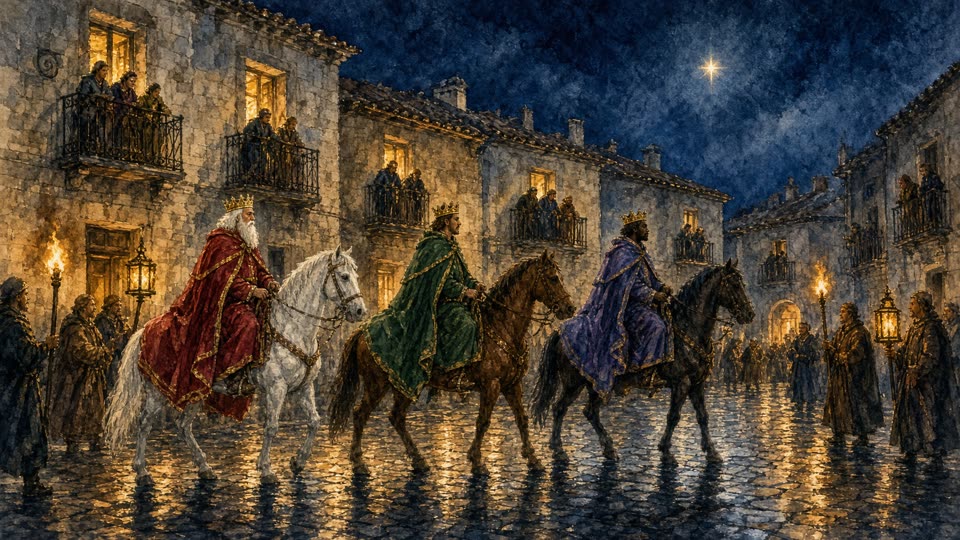
Los Reyes Magos — the Three Kings Melchor, Gaspar y Baltasar
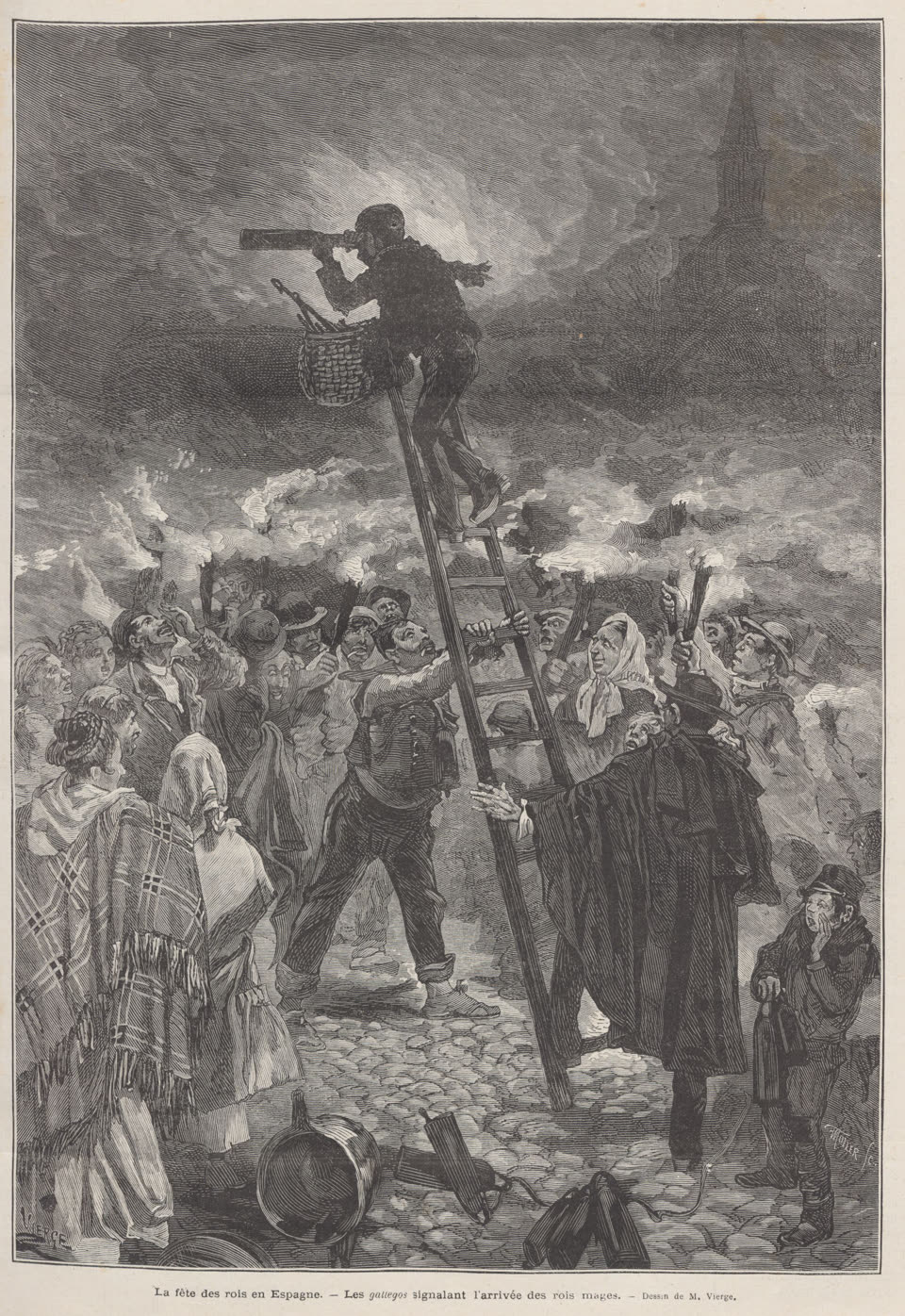
The main event, and the reason Spanish children go back to school later than most of Europe. The Kings come on the night of 5 January, leave the presents by morning, and leave coal for the ones who have not behaved.
They are not as old in this role as they feel. The Galician mythographer Antonio Reigosa puts their popularity at the nineteenth century and credits a push by the Church: «Semella que levamos cos reis desde sempre, pero na realidade comezaron a se popularizar no século XIX, por un esforzo da Igrexa. Anteriormente estaba San Nicolao.» Before the Kings, in other words, Spain had Saint Nicholas, like everywhere else.
The newcomer, and he did not replace the Kings so much as get added in front of them. Plenty of Spanish households now open something on the 25th and the rest on the 6th.
The sequence is documented for the Basque Country, where an ethnographer writing in the 2000s lists the gift bringers in the order they arrived: «los 'tres' Reyes Magos, los clásicos hasta mediados de siglo, Santa Claus o Papá Noël (Père Noël), posteriormente, e intentando hacerlos coincidir en el tiempo» — the Kings classic until the middle of the twentieth century, Santa afterwards, and an effort to make the two fit in the same calendar.
El carbonero Olentzero y el obispo (San) Nicolás — Emilio Xabier Dueñas, in «Olentzeroren tradizioa Lesakan eta Euskal Herriko Eguberrietan», Lankidetzan 41, Eusko Ikaskuntza — Sociedad de Estudios Vascos
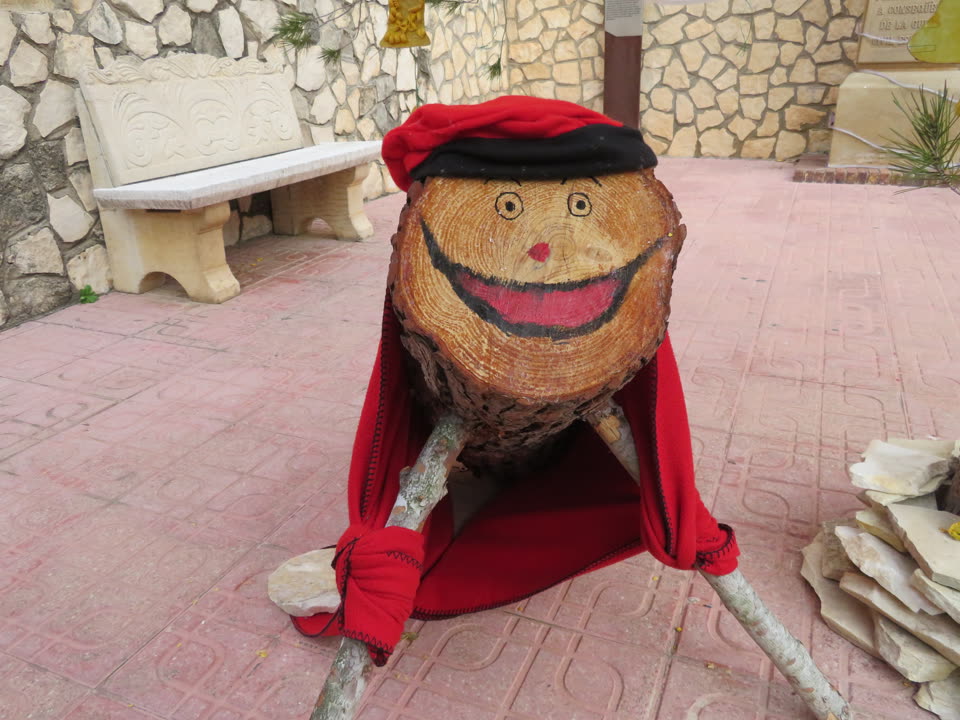
El Tió de Nadal — the Christmas log Tió de Nadal, Cagatió
A log that is fed for days, covered with a blanket, and then beaten with sticks until it produces sweets. Catalan children sing at it while they hit it, and the oldest recorded form of the order is the plainest: «Tió, caga torró!»
The dictionary that records that line also records the mechanism, which is the part adults forget: the torró was «preparat convenientment darrera el tronc, de manera que la mainada no el vegi fins que el tió ha rebut les bastonades» — put behind the log in advance, so that the children see it only after the beating has been administered.
Generated illustration (Grok Imagine) —
Category:Olentzero holds fifteen files on Commons and not one of them clears the licence allowlist at 1600px. The archive is not empty; the licences are wrong, and that is a refusal rather than an absence.
País Vasco
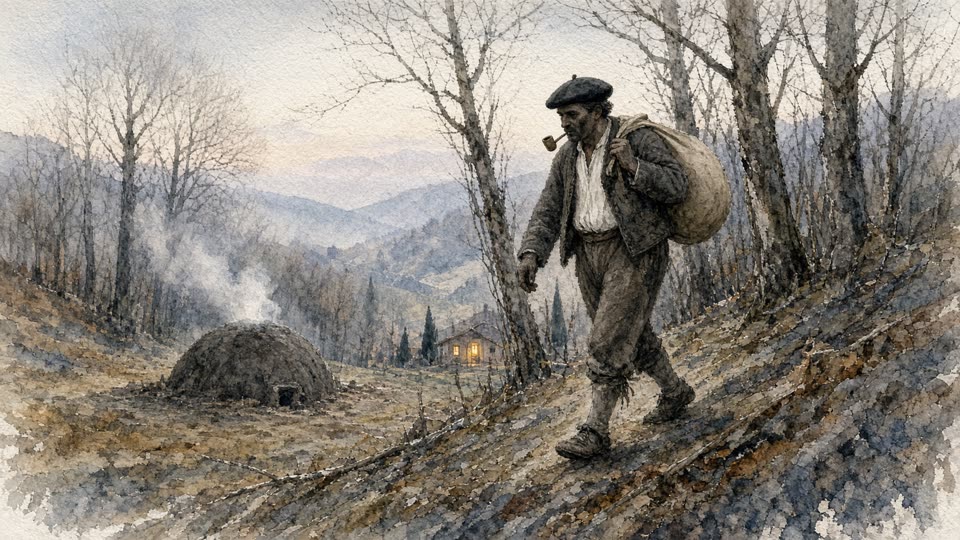
Olentzero
A charcoal burner who comes down from the mountains on Christmas Eve with a pipe, a big head and presents. He is carried through Basque towns on a chair by groups who sing at the doors, and in some places he is burned at the end of the night.
He was a log first. The same word named the trunk put on the hearth fire at Christmas, and a man born in 1914 in Amezketa told an ethnographer in 1988 what his own father had called it: «Antes en Nochebuena... se ponía un tronco en la chimenea. Al tronco se le llamaba Olentzago.» The figure and the firewood have one name because they were one thing.
El carbonero Olentzero y el obispo (San) Nicolás — Emilio Xabier Dueñas, in «Olentzeroren tradizioa Lesakan eta Euskal Herriko Eguberrietan», Lankidetzan 41, Eusko Ikaskuntza — Sociedad de Estudios Vascos
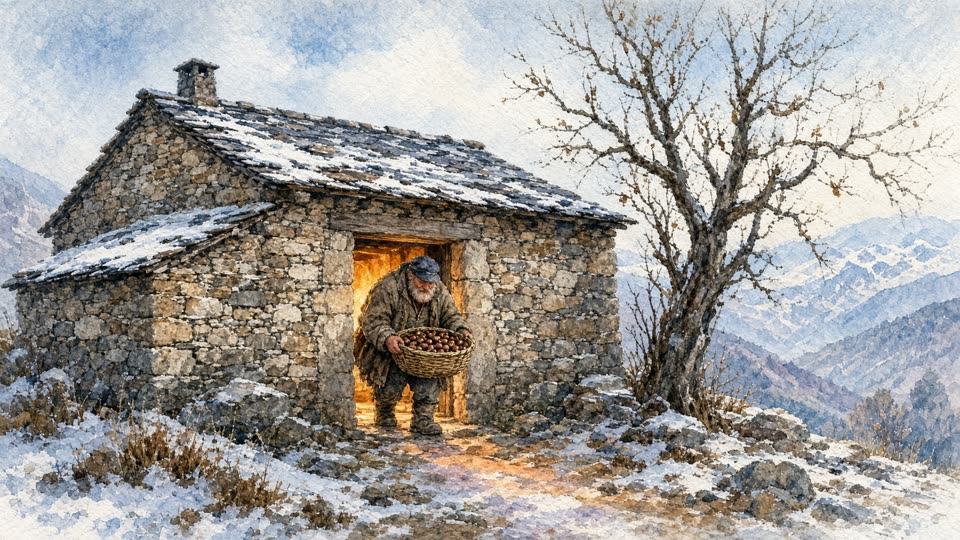
Generated illustration (Grok Imagine) —
The only publishable Apalpador on Commons is a modern clip-art vector on a transparent background, drawn for the revival campaign. It would be the one piece of clip art on the site.
Galicia
O Apalpador Apalpador, Pandigueiro
A giant charcoal burner from the mountains of eastern Galicia who comes down on Christmas Eve, feels the children's bellies to find out whether they have eaten enough, and leaves chestnuts and a wish for a year without hunger.
He is the honest case on this page, and the source says so itself. Antonio Reigosa: «Non hai moita documentación, pero si abonda para certificar que existía ese personaxe que baixa do bosque e lle dá comida a nenos» — not much documentation, but enough to certify that the figure existed. What has changed is the job. He fed hungry children; the modern Apalpador brings presents, which Reigosa calls «complicado», because the figures he is being asked to compete with have multinationals and advertising behind them.
Nochebuena is the meal, and the Misa del Gallo is at midnight
Christmas Eve carries the weight in Spain, as it does in most of Catholic Europe. The family eats late and long, and the devout go on to the Misa del Gallo, the rooster's mass, at midnight.
A Catalan dictionary compiled before the war records the timing more exactly than any modern description does: matins first, then the mass at midnight, «i a certes comarques a les cinc del matí del dia 25» — in some districts at five in the morning instead.
The fish on many Spanish Christmas Eve tables is a leftover of a rule rather than a taste. Antonio Reigosa: the Church imposed a vigil through Advent and allowed no meat until after the Misa do Galo, «isto durou ata 1918», and that is why the night belongs to salt cod and sea bream.
El Gordo: the whole country listens to children sing numbers for four hours
On 22 December the Sorteo Extraordinario de Navidad is drawn in Madrid, and Spain stops. Pupils of the Colegio de San Ildefonso sing the numbers and the prizes in pairs, in a chant with no tune to speak of, for about four hours, and the broadcast runs all morning in bars, offices and kitchens.
The scale is the part that does not translate. In 2025 the draw issued 198 series of 100,000 tickets at 20 euros a tenth — an emission of 3,960 million euros, of which 70 per cent, 2,772 million, went back out in 30,301,920 prizes. It is not a lottery with a big winner so much as a lottery with a very large number of small ones, which is why a whole village can share one number.
At midnight on 31 December Spain eats one grape at each of the twelve strokes of the clock, racing to finish, usually in front of a television showing the clock on the Puerta del Sol in Madrid.
The custom is older than its famous origin story. A Madrid newspaper reported it as already general on 2 January 1894, reprinting a piece from El Imparcial of the day before: «Hasta hace pocos años eran muy contadas las personas que comían uvas el 31 de Diciembre al sonar la primera campanada de las doce de la noche. Hoy se ha generalizado esta práctica salvadora.» The 1894 writer had no idea where it came from either, and guessed France.
The Cabalgata de Reyes, and the ladders at the balconies
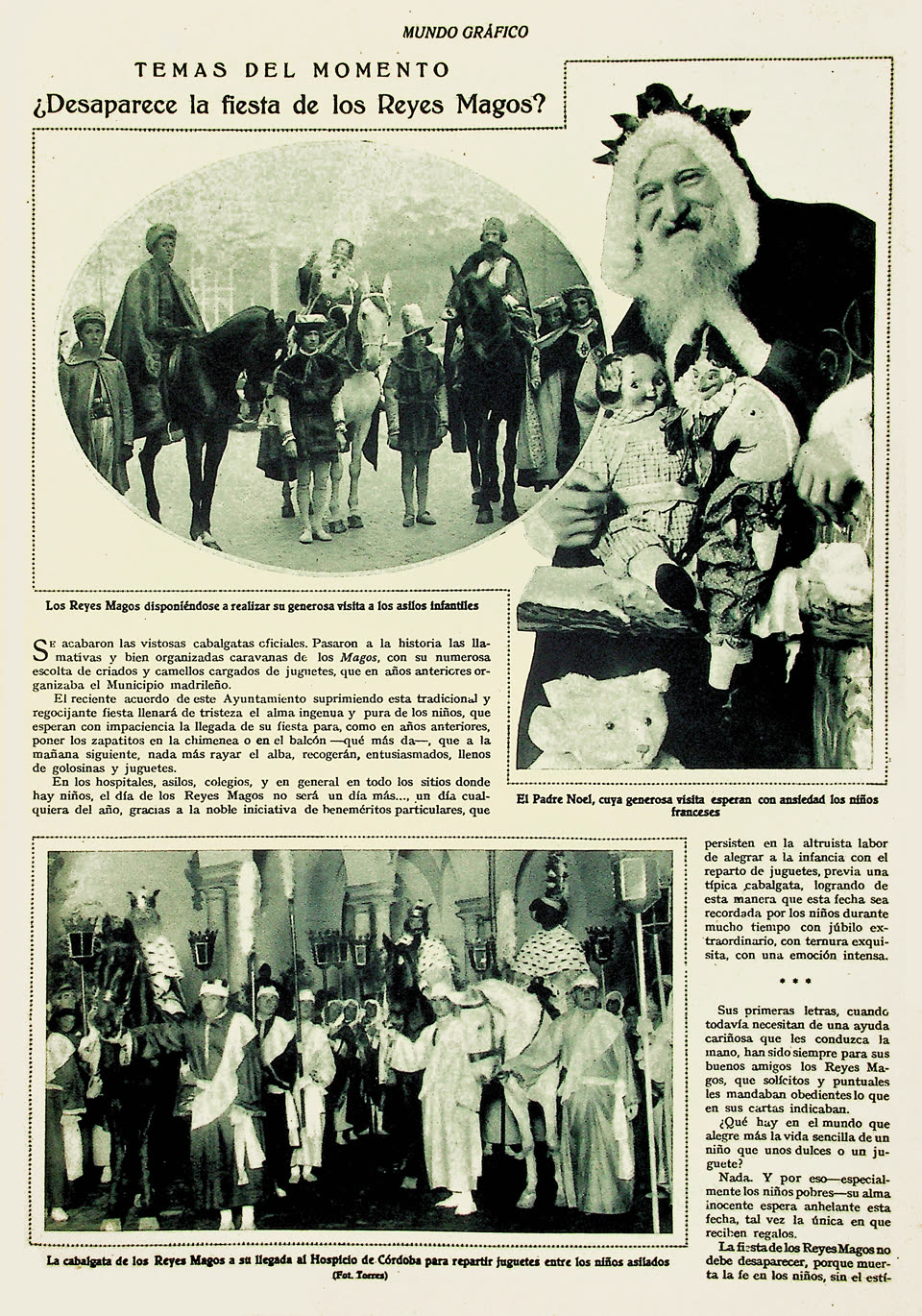
On the evening of 5 January every Spanish town of any size parades its Three Kings through the streets, throwing sweets to the crowd. The oldest is at Alcoy in Alicante, run continuously since 1885 with documentary traces back to 1866, and it does something no other does: a legion of pages carries long ladders, climbs to the balconies of the houses, and hands the presents in through the windows.
The parade ends in the Plaça d'Espanya, where the Kings dismount and walk to the nativity scene for the Adoration, with fireworks and Handel's Messiah over the loudspeakers.
The pages of the Cabalgata are played in blackface, and it is contested
In Alcoy and in hundreds of other Spanish towns, the Kings' pages — and in many places King Balthazar himself — are played by white performers with their faces blacked. The Alcoy council's own description of its parade names them: «una legión de pajes -els negres-».
The objection is made by Black Spaniards. The organisation Afroféminas campaigns for Alcoy to redesign the figure, calling the pages «una burda parodia de los esclavos negros de la época colonial: un blackface con labios rojos», and stating plainly that it is the representation of the pages they are against and not the parade. They cite the European Parliament, which on 19 June 2020 adopted a resolution whose paragraph 16 «calls on the Member States to denounce and refrain from racist and Afrophobic traditions, such as the black face practice».
Some Spanish cities have cast Black performers or dropped the makeup. Alcoy, at the last Epiphany before this record was written, had not.
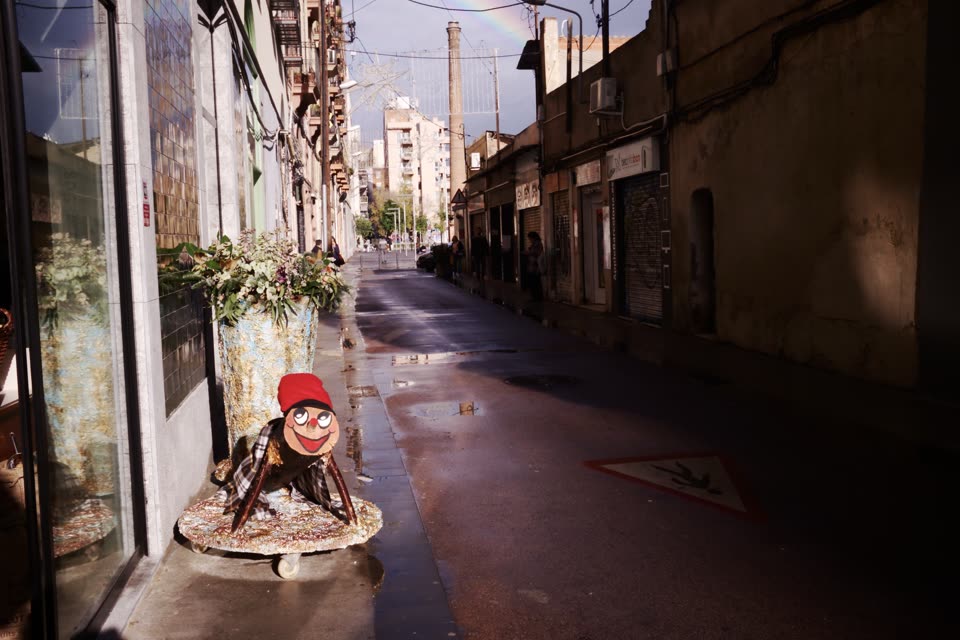
The Catalan log is brought into the house in early December, covered with a blanket, given something to eat each night, and on Christmas Eve or Christmas Day beaten with sticks by the children until it delivers sweets, nougat and small presents.
It used to be a different scene. The oldest person in the house presided and sometimes blessed the log with wine; the children were sent to another room to say a Paternoster first; the tió itself was a bare trunk with no face, and after Christmas it was burned and its ashes scattered on the field.
What spread it was school. The custom was rural and domestic, and the anthropologist Josefina Roma points out that in the cities the presents came from the Kings while in the villages «només es feia cagar la soca». After 1975 the schools became the main channel for Catalan popular tradition, the tió went with them, and it acquired the painted eyes, nose and legs it now has.
D'on ve la tradició de fer cagar el tió? — 3Cat — Corporació Catalana de Mitjans Audiovisuals, 23 December 2023, quoting Josefina Roma i Riu, emeritus professor of anthropology at the Universitat de Barcelona
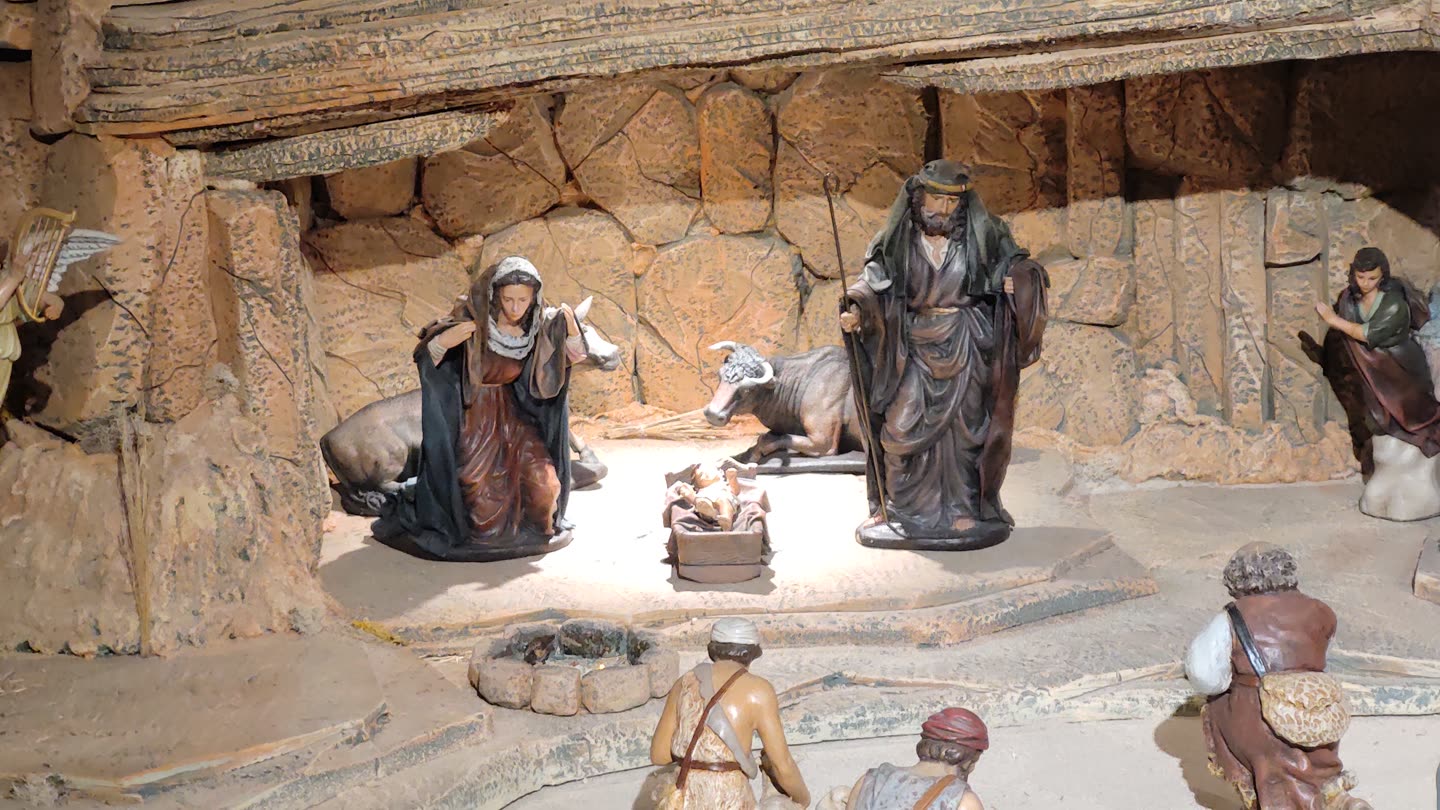
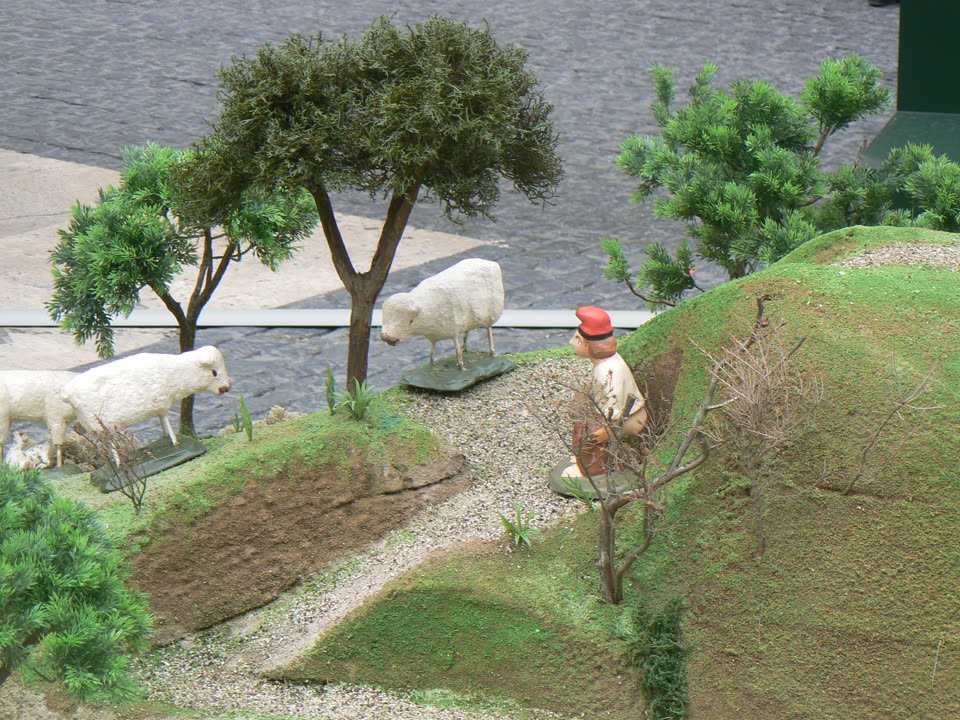
The Catalan nativity scene is built out of moss, cork and butcher's broom, and it is populated well beyond the Gospel: the woman washing, the old woman spinning, a fisherman, and some frank anachronisms — a priest with an umbrella, a Civil Guard, a hunter.
Among them, hidden somewhere at the back, squats the caganer: a man in a barretina with his trousers down, smoking a pipe or reading the newspaper, sometimes with a piglet sniffing at him. He appears in Catalan cribs from the end of the seventeenth or the start of the eighteenth century, and he is not unique to Catalonia — Murcia, Portugal and Naples have their own.
Barcelona's crib trade is old enough to have an association: the Associació de Pessebristes de Barcelona was founded in 1863, and the Fira de Santa Llúcia has sold the pieces since the eighteenth century.
El Cant de la Sibil·la, sung by a child with a sword
At matins on the night of 24 December, in churches across Mallorca, a boy or girl sings the Sibyl's prophecy of the end of the world, unaccompanied except for the organ between the verses.
The singer walks up through the church to the chancel holding a sword upright in front of their face, with altar servers carrying candles on either side, and at the end of the song draws a cross in the air with the sword. The chant was sung across medieval Europe, was suppressed after the Council of Trent, and survived in Mallorca.
Chant of the Sybil on Majorca — UNESCO, Representative List of the Intangible Cultural Heritage of Humanity, inscribed 2010 (5.COM)
Andalucía
La Zambomba: a friction drum, a bonfire, and singing until dawn
In Jerez de la Frontera and Arcos de la Frontera, Christmas is a gathering around a zambomba — a friction drum made of a skin stretched over a jar with a cane through it, played by rubbing rather than striking.
The zambombas run from the Immaculate Conception on 8 December to Christmas Eve, getting denser as the month goes on. The day's work is part of it: lighting the fire and making the pestiños, buñuelos and roscos together is how the thing opens. Then the singing, from late afternoon until the small hours, in a repertoire that mixes old ballads and lyric song with flamenco.
It began in the shared courtyards and farm workers' houses of the Jerez countryside, and has moved out of them into the streets and the bars, which the regional government's own decree describes as a move «de lo privado a lo público».
Olentzero comes down from the hills, and is sometimes burned
On 24 December Basque towns carry Olentzero through the streets — a straw-and-rag figure on a chair, or a man dressed as a charcoal burner — stopping at houses to sing for money or food. Children do the rounds by day and adults by night.
The songs disagree about his trade along an exact line: inland they make him a charcoal burner, on the coast a sailor.
In Lesaka the figure is burned at the end. The ethnographer who traced that detail found something more interesting than the bonfire: Barandiaran's first article on Olentzero, in 1922, does not mention Lesaka or any burning; Caro Baroja reports it in 1946 from an informant speaking around 1928; Barandiaran repeats it in 1956 crediting Caro Baroja, and then in 1972, 1973 and 1980 repeats it without crediting anyone. A single testimony had become a fact by being cited.
El carbonero Olentzero y el obispo (San) Nicolás — Emilio Xabier Dueñas, in «Olentzeroren tradizioa Lesakan eta Euskal Herriko Eguberrietan», Lankidetzan 41, Eusko Ikaskuntza — Sociedad de Estudios Vascos
Castilla y León
The Autos de Reyes, played by the neighbours
In villages across Castilla y León, on the afternoon of 5 January or the morning of the 6th, people gathered to watch Los reyes — the Epiphany story acted by their own neighbours.
The casting was pointed. Herod was played by the fiercest man available. The wise men of Jerusalem wore glasses, to show that they had studied, and black, for seriousness. The Innocents were played by actual one- and two-year-olds, borrowed from their parents, at whom Herod's men advanced to mime the beheading — producing, as the account dryly records, a tantrum from the children and general disapproval from the audience.
Spain's April Fools' Day falls on 28 December, the feast of the Holy Innocents, and the word for the prank has its own entry in the academy's dictionary: an inocentada is «broma o chasco que se da a alguien en el día de los Santos Inocentes».
Newspapers run invented stories, television reports things that did not happen, and in Catalonia the specific form is the llufa — a paper figure stuck to the back of somebody who has not noticed.
The Galician Christmas table runs to salt cod with greens on the Eve and capon on the day, and both are consequences of the same rule. No meat was allowed until after the midnight mass, so the Eve went to fish that keeps.
The capon is the exception that was granted. According to Antonio Reigosa, in the ninth century the Church accepted the castrated cockerel as an exemption from the vigil, and that is the origin of eating capon at Christmas; the Feira do Capón at Vilalba, held in the days before Christmas, is what the exemption grew into. Similar fairs existed in Catalonia and in southern France.
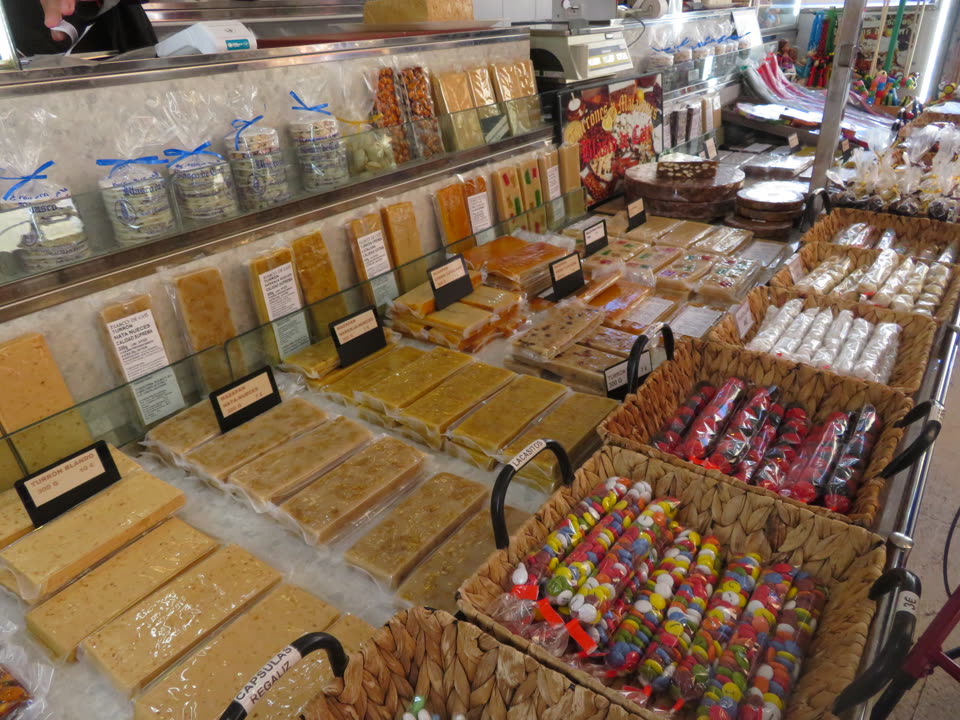
Soft nougat of ground toasted almonds and honey, the colour of wet sand, sold in a tablet and eaten in slivers after the meal. Its harder cousin, Turrón de Alicante, keeps the almonds whole.
It is a protected name with a legal recipe. To be labelled Calidad Suprema a tablet must be at least 64 per cent toasted almond and at least 10 per cent pure bee honey; Calidad Extra drops the almond to 50. Everything, including the cooling, moulding and cutting, has to happen inside one municipality: Jijona/Xixona, in the province of Alicante.
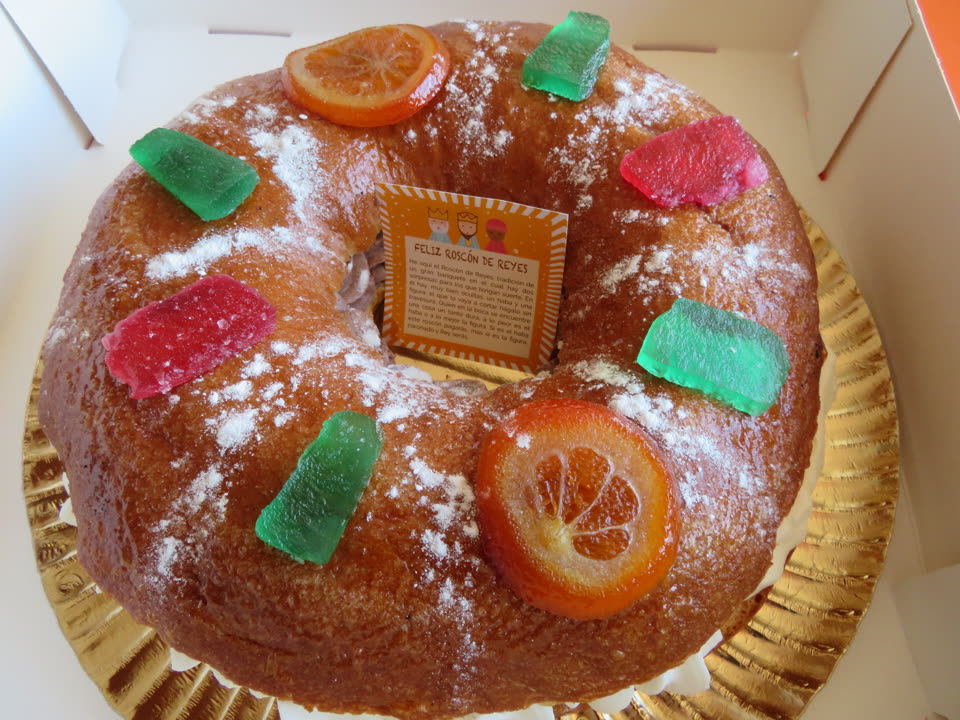
A ring of soft sweet bread, scented with orange-flower water and crowned with candied fruit, eaten on the morning of 6 January and cut at the table. Two things are hidden inside: a small figure, and a dried broad bean. Finding the figure makes you king of the day; finding the bean means you pay for the cake.
The bean is the older half. From the Middle Ages the Castilian court chose a rey de la haba by lot, the lot being a bean baked into a cake, and the real monarch granted the finder favours for the start of the year. The custom attached itself to Epiphany later, and in some places the surprise is still called the haba whatever it is actually made of.
The Catalan Christmas Day meal, and effectively two courses out of one pot: a broth with big pasta shells, the galets, followed by the meat and vegetables that made it.
The day after has its own dish. What is left of the carn d'olla is chopped and rolled into canelons for Sant Esteve on 26 December, which in Catalonia and the Balearics is a holiday rather than a working day — one of the few places in Spain where the second day of Christmas still is.
The fried sweets of an Andalusian Christmas: pestiños, dough fried and glazed with honey or sugar, alongside buñuelos and roscos.
Making them is not preparation for the party, it is the start of it. The decree that protects the zambomba describes the fire being laid and the sweets made collectively as the opening of the night's ritual, before any singing begins.
A castrated cockerel, fattened for months and stuffed for Christmas, and the centre of a Galician Christmas dinner.
The Feira do Capón at Vilalba, in Lugo, is held in the days before Christmas and sells the birds live. The dish exists because the Church made an exception for it in the ninth century, when capon was allowed through the Advent fast that excluded other meat.
Widely repeated claims about Christmas in Spain that do not survive
checking. Each one says what is actually the case, because a correction
with nothing in its place leaves you worse off than before.
Contradicted
The twelve grapes of New Year's Eve were invented in 1909, when growers in Alicante had a surplus harvest and needed to shift it.
What is actually the case. The custom was already general in Madrid fifteen years earlier. On 2 January 1894 a Madrid daily reprinted a piece from El Imparcial reporting that until a few years before very few people ate grapes at midnight on 31 December, and that «hoy se ha generalizado esta práctica salvadora».
What 1909 can have done is make it bigger, and the Alicante growers are a real part of the story of how a Madrid habit became a national one. They are not where it started, and the 1894 writers did not know where it started either — their guess was that it came from France and had «adquirido entre nosotros carta de naturaleza».
In Spain the Three Kings are the ancient native tradition, and Papá Noel is the modern American import pushing them out.
What is actually the case. Papá Noel is indeed the newer of the two in Spain, and he does now take a share of the presents. But the Kings are not immemorial either.
Antonio Reigosa dates their popularity to the nineteenth century and attributes it to an effort by the Church, noting that the gift bringer before them was Saint Nicholas — the same figure Papá Noel descends from. In the Basque Country an ethnographer lists the Kings as «los clásicos hasta mediados de siglo» and Santa as arriving afterwards.
So the sequence is Saint Nicholas, then the Kings, then Santa Claus coming back round in a red suit. What Spain is defending is roughly two centuries old, not two thousand.
The tió de Nadal is an unbroken Catalan tradition, handed down intact from pre-Christian times.
What is actually the case. The log on the hearth is genuinely old and genuinely widespread — the same custom, under other names, runs across Europe, and the Catalan government's own account lists the Yule Log, the Scottish Yeel Carline and the French bûche de Noël beside it.
But the thing in Catalan houses today is a revival with a visible seam. These customs declined across Europe at the end of the nineteenth century; in Catalonia the tió survived domestically and was then spread deliberately after 1975, largely through schools, from the villages to the cities where the presents had come from the Kings. The face is part of that: «inicialment el tió era un simple tronc buit, sense cara», and the eyes, nose and legs were added to humanise it.
The pre-Christian origin is a reasonable hypothesis rather than a documented descent. The sources that offer it say so — «pot tenir l'origen en les tradicions precristianes», with a pot.
Boxing Day is a holiday in two of Spain's nineteen territories. The 2026 labour calendar marks 26 December, Sant Esteve, only in Illes Balears and Catalunya; everywhere else it is a working day. And in the Val d'Aran, which is inside Catalonia, it is traded away — Sant Esteve is replaced there by the Festa d'Aran on 17 June.
Epiphany is the national holiday that every Spanish region was allowed to abolish and none did. Spanish law divides national holidays into those the autonomous communities may not touch and those they may swap for a local feast. 6 January is in the second group — and all nineteen territories kept it.
The Christmas lottery was born in a city under siege. The first draw was held on 18 December 1812 in Cádiz, as a way of raising money for a state at war without raising taxes. It has been drawn every year since, which means it has outlasted the constitution it was invented under, two monarchies, a republic and a dictatorship.
In Galician, and in the Catalan of Alghero, the word for Christmas is also the word for December. The Royal Galician Academy gives nadal three senses: the feast, the days around it, and the month — with the example «Espero verte en Nadal», which in Galician means I hope to see you in December.
Spanish Christmas nougat has a legal minimum almond content, and it is 64 per cent. A tablet of Turrón de Jijona may only be labelled Calidad Suprema if at least 64 per cent of the finished product is toasted almond and at least 10 per cent is pure bee honey.
Whether Olentzero is a charcoal burner or a sailor depends on how far you are from the sea. The begging songs sung with the figure name his trade, and the ethnographic record notes the split cleanly: charcoal burner inland, sailor on the coast.
El carbonero Olentzero y el obispo (San) Nicolás — Emilio Xabier Dueñas, in «Olentzeroren tradizioa Lesakan eta Euskal Herriko Eguberrietan», Lankidetzan 41, Eusko Ikaskuntza — Sociedad de Estudios Vascos
Sources
Every claim on this page carries its own citation. They are collected
here so you can see what this page is built on, and how much of it comes from where.
D'on ve la tradició de fer cagar el tió? — 3Cat — Corporació Catalana de Mitjans Audiovisuals, 23 December 2023, quoting Josefina Roma i Riu, emeritus professor of anthropology at the Universitat de Barcelona. Retrieved 2026-10-13. archived 23 April 2024Roma's explanation of the food offerings is the part worth keeping: the ancestors took «la part espiritual dels aliments» and what remained was eaten by the descendants, «sobretot els nens». The log also goes by other names — soca in western Catalonia, xoca or tronca in the parts of Aragón that share the custom.
Reactivamos campaña en Change.org para eliminar el blackface de la Cabalgata de Reyes de Alcoy — Afroféminas, 13 December 2025. Retrieved 2026-10-13. archived 12 May 2026Afroféminas draws the parallel with Zwarte Piet in the Netherlands themselves, and the comparison they make is about the defence rather than the costume: that people who consider themselves anti-racist decline to see it, «por conflicto identitario». They are explicit that they are not asking for the Cabalgata to stop — «No estamos en contra de la Cabalgata de Reyes de Alcoi, sino en contra de la representación de los pajes» — and propose a design competition for a new figure.
Cabalgata — Navidad y Reyes Magos — Ajuntament d'Alcoi / Ayuntamiento de Alcoy. Retrieved 2026-10-13. archived 14 March 2026The council's own account: «Su celebración se viene realizando de forma continuada desde 1885, si bien sus antecedentes documentales se remontan al año 1866.» It claims to be one of the oldest in Spain «y, posiblemente, en el mundo», which is the organiser's claim rather than an independent finding. Declared a Fiesta de Interés Turístico Nacional in November 2001. More than a thousand people take part, with three town bands.
Caganer — Personatges i elements festius — Ajuntament de Barcelona, Cultura Popular. Retrieved 2026-10-13. archived 25 June 2024The city calls him «el contrapunt pragmàtic de tota la representació i la mística del misteri de Nadal». The parallels it names are cagones in Murcia, cagões in Portugal and cacone or pastore che caca in Naples. The figure was not invented for the crib: «les antigues rajoles dels oficis ja l'havien representada».
«nadal», Diccionari català-valencià-balear — Antoni M. Alcover and Francesc de B. Moll; Institut d'Estudis Catalans, online edition. Retrieved 2026-10-13. archived 1 December 2025Gives the pronunciations quoted here — nəˈðaɫ in the eastern and Balearic dialects, naˈðaɫ in the western and Valencian, naɾˈal in Alguerès — and derives the word from Latin natale, 'day of birth'. Its second sense is the month of December, in the Catalan of Alghero.
Resolución de 17 de octubre de 2025, de la Dirección General de Trabajo, por la que se publica la relación de fiestas laborales para el año 2026 — Boletín Oficial del Estado — BOE-A-2025-21667, published 28 October 2025. Retrieved 2026-10-13. archived 23 July 2026The annex is a grid of nineteen columns, one per autonomous community and for Ceuta and Melilla, and three of its rows are the Spanish Christmas in miniature.«25 Natividad del Señor» carries a single asterisk in all nineteen, which the key defines as Fiesta Nacional no sustituible — a national holiday the regions are not permitted to swap. «6 Epifanía del Señor» carries a double asterisk in all nineteen, and that means something different: a national holiday the regions may substitute, in every one of which the power was not used. Nobody in Spain gave up the Kings.«26 San Esteban» is the surprise. It is marked in two columns out of nineteen — Illes Balears and Catalunya — so the second day of Christmas is a working day in most of Spain. The clarifying note at the foot narrows it once more: in the Val d'Aran, Sant Esteve is replaced by the Fiesta de Arán on 17 June.
O noso estraño Nadal — Antonio Reigosa indaga na orixe e nas tradicións destas celebracións no noso país — culturagalega.gal, Consello da Cultura Galega, 22 December 2011. Retrieved 2026-10-13. archived 23 June 2025Reigosa is a mythographer rather than an enthusiast, and the value of the passage is that he states the thinness of the record in the same breath as the defence of it. He wants the figure known «no sentido de dar a coñecer a súa existencia, a súa función e contribuír a representar un Nadal menos uniforme» — to show that Christmas has more than one shape.
Celebrem el tió i la cultura popular. Bones Festes! — Direcció General de Cultura Popular i Associacionisme Cultural, Departament de Cultura, Generalitat de Catalunya, 1 December 2025. Retrieved 2026-10-13. archived 1 December 2025A government body writing about a tradition it promotes, and still recording the modern face and the institutional push. That is what makes it usable here.
«eguberri», Elhuyar hiztegia (Basque–Spanish dictionary) — Elhuyar Fundazioa. Retrieved 2026-10-13. archived 17 January 2025Lists «Eguberri on!» as a set phrase and glosses it «¡Feliz Navidad!». The same entry gives eguberri-kanta for a carol and Eguberrietako loteria for the Christmas lottery, and notes that the plural form covers the days between Christmas and Epiphany.
El carbonero Olentzero y el obispo (San) Nicolás — Emilio Xabier Dueñas, in «Olentzeroren tradizioa Lesakan eta Euskal Herriko Eguberrietan», Lankidetzan 41, Eusko Ikaskuntza — Sociedad de Estudios Vascos. Retrieved 2026-10-13.A conference paper from the Lesaka meetings, with notes the author added at Christmas 2006. It is cited here for the ORDER of arrival rather than for a date — it describes the Basque Country, and this record has not found a study that measures when Papá Noel reached Spain as a whole.
Costums i tradicions (Conèixer Catalunya series) — Eulàlia Barrasetas and Rafael Català; Departament de Cultura, Generalitat de Catalunya, 1992. Retrieved 2026-10-13.Gives the whole Christmas menu as one list — «canelons; escudella de galets i carn d'olla; capons i pollastres amb prunes i pinyons; neules i torrons; i cava» — and the proverb that explains the day: «Per Nadal, cada ovella al seu corral», every sheep in its own fold.
Reis Magos — Almanaque de Tradición — Fundación Joaquín Díaz, Urueña (Valladolid). Retrieved 2026-10-13. archived 14 October 2025Matthew's gospel calls them magi and never counts them; three gifts produced three men. The names come later and they wobble — this account gives Melkón, Baltasar and Gaspar from the Armenian Infancy Gospel, and says they were only treated as kings from Caesarius of Arles onwards. The coal in the shoes is in the same article, mentioned in passing as the thing the Spanish Kings share with the Italian Befana.
«Las uvas bienhechoras», El Siglo Futuro, Madrid, 2 January 1894, n.º 5.663, p. 2 — Hemeroteca Digital, Biblioteca Nacional de España. Retrieved 2026-10-13.A Catholic daily reprinting a liberal one in order to disapprove of it. The paper's own comment is that people who eat grapes for luck will go on to call Christians superstitious, and «cuando no cree en Dios, cree en el diablo». The sneer is why the notice exists, and it is what makes it good evidence: nobody invents a custom in order to complain about it.Quotations here follow the library's text layer, which carries the scan's own spelling and its occasional slip.
Algunas curiosidades históricas del Sorteo Extraordinario de Navidad — Loterías y Apuestas del Estado (SELAE), 20 December 2024. Retrieved 2026-10-13. archived 25 December 2024«El primer Sorteo de Navidad se celebró el 18 de diciembre de 1812 en Cádiz.» The wooden balls arrived the following year; the name did not arrive until 1892, and only reached the tickets themselves in 1897. The first televised draw was in 1957 and the first sung in euros in 2002.
Datos curiosos del Sorteo Extraordinario de Navidad 2025 — Loterías y Apuestas del Estado (SELAE), 5 December 2025. Retrieved 2026-10-13. archived 22 January 2026The operator's own figures for the 2025 draw, held at the Teatro Real. Two drums: 100,000 balls for the numbers, 1,807 for the prizes. «Tiene una duración aproximada de cuatro horas» is theirs as well.
Pliego de condiciones de la IGP «Jijona» — Ministerio de Agricultura, Pesca y Alimentación, Spain; specification dated 5 September 2023. Retrieved 2026-10-13.The specification argues the product's history as well as its chemistry, and the history it gives is not a Spanish one: it credits «los árabes o los judíos» with bringing a paste called Halva or Al.lajú to the town then called Sexona, and with the use of sugar, honey and nuts that the local recipe grew out of. A legal document that says the national Christmas sweet came from somewhere else.
«navidad», Diccionario de la lengua española — Real Academia Española and Asociación de Academias de la Lengua Española, 23rd edition. Retrieved 2026-10-13. archived 25 May 2026Three senses: the feast, the day, and «Tiempo comprendido entre Nochebuena y la festividad de los Reyes Magos». The third one is the Spanish Christmas season defined by a dictionary — it begins on the evening of the 24th and ends on 6 January.
«inocentada», Diccionario de la lengua española — Real Academia Española and Asociación de Academias de la Lengua Española, 23rd edition. Retrieved 2026-10-13. archived 26 May 2024The dictionary's other two senses show where the word travelled: a guileless remark, and the ridiculous trap somebody falls into through inattention. The day named the gullibility, not the other way round.
«nadal», Dicionario da Real Academia Galega — Real Academia Galega. Retrieved 2026-10-13. archived 7 November 2024Three senses, and the third is worth the visit: in Galician, nadal is also the month of December. «Espero verte en Nadal» is the dictionary's own example — in English it would read as a season and in Galician it is a month.
Chant of the Sybil on Majorca — UNESCO, Representative List of the Intangible Cultural Heritage of Humanity, inscribed 2010 (5.COM). Retrieved 2026-10-13. archived 17 May 2026«The chant of the Sybil is performed at matins on the night of 24 December in churches throughout Majorca», sung by a boy or girl with two or more altar servers, a cappella, in a white or coloured tunic often worn with a cape.


.jpg)

.jpg)

