A synthesised voice — not a recording of a person — saying Geseënde Kersfees
in af-ZA.
Afrikaans, and it is not the same wish as the English line printed beside it: «geseënde» is blessed rather than merry. One mayor's message carries both.
isiXhosa, from the third column of the same municipal message, where the mayor wishes Christian residents «iKrisimesi eMyoli». It is an official translation of the English wish, published by the municipality itself rather than taken down from speech.
A synthesised voice — not a recording of a person — saying Ukhisimusi omuhle
in zu-ZA.
isiZulu, the language with the most first-language speakers in South Africa. The attested form is the one a KwaZulu-Natal provincial minister used at a Christmas lunch in December 2025 — «ukhisimusi omuhle ophephile, onokuthula», a good, safe and peaceful Christmas. The spoken clip is synthesised in zu-ZA.
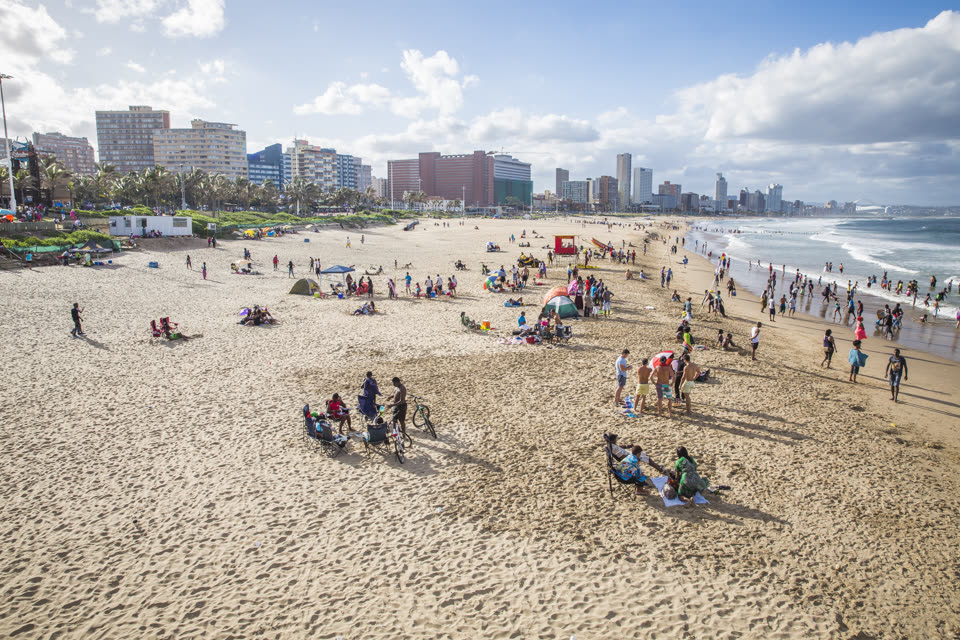
The day after Christmas is a coast day, and in 1984 a picnicking group was chased off a North Coast beach
The Dictionary of South African English dates its citations, and the two it carries for the Day of Goodwill are from the same decade and say very different things about the same day.
The first is ordinary. A Grahamstown paper in 1982: «Sport certainly takes a backseat this weekend, with .. the Day of Goodwill not likely to see much sport as locals either head for the coast or spend a restful day with the family.»
The second is not. The Sunday Times, 1 January 1984: «An outing on the Day of Goodwill turned sour when a picnicking group were chased from a North Coast beach.» The sentence does not say who chased them or why, and the dictionary records it without comment. It is a South African beach in 1984, and the Separate Amenities Act was four years from repeal.
Day of Goodwill — Dictionary of South African English, Rhodes University
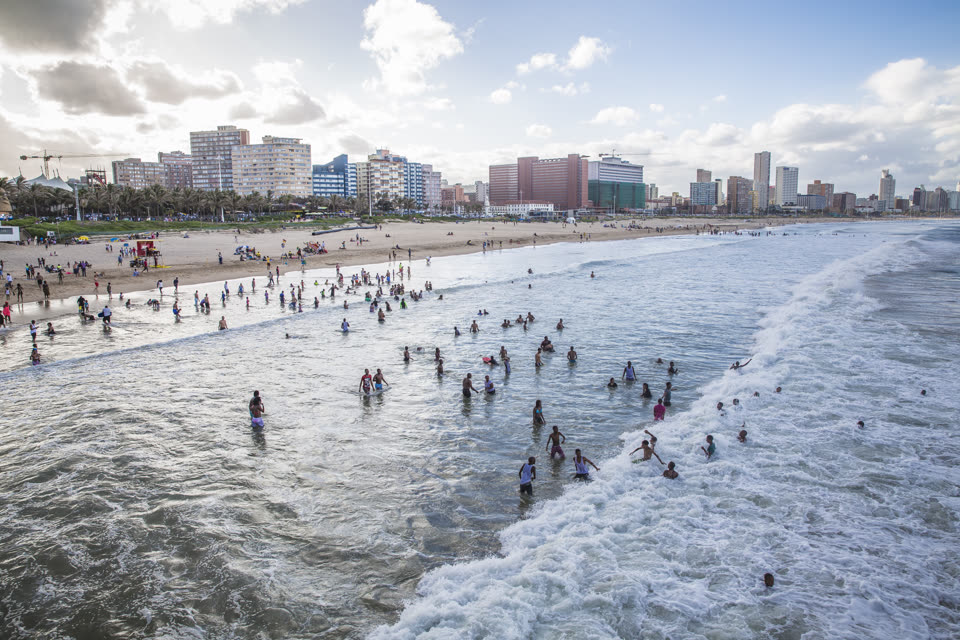
In Durban people spend Christmas Day on the beach, and some of them have driven down from Johannesburg to do it
The public broadcaster has filed the same story from the same city in more than one year, and it is worth reading as what it is: people at a beach, speaking for themselves.
In 2018: «It’s our family ritual. We come and spend a day have a picnic. As you can see, it’s a family thing.» Another holidaymaker in the same report explains the drive — «I am mostly in Jo’burg and we don’t have the beach in Jo’burg. So, we could not wait for December to come down and enjoy the beach.»
In 2019, a named holidaymaker at a Durban picnic spot: «Every year in December I come here with my family and friends to pray and also enjoy Christmas festivities in Durban.» The same report notes that many people spent the day at home instead.
Cape Town's carols by candlelight are sung without candles
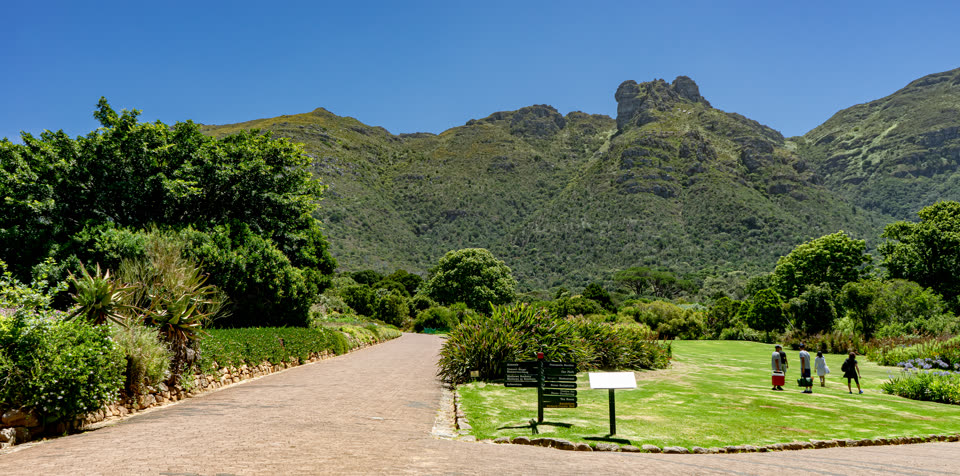
The Rotary Club of Kirstenbosch runs a carol evening in the botanical garden, and its own frequently asked questions answer the obvious question about an event whose traditional name is Carols by Candlelight.
«Will there be candles to sing by candlelight?» — «Updated fire and safety rules prohibit us from hosting the event by candlelight. You are welcome to bring your own glowsticks, or you may use your smartphone torch to add ambiance to the experience.»
A carol evening in a December hot and dry enough for the fire rules to bite is a southern-hemisphere sentence, and the substitute light is a phone.
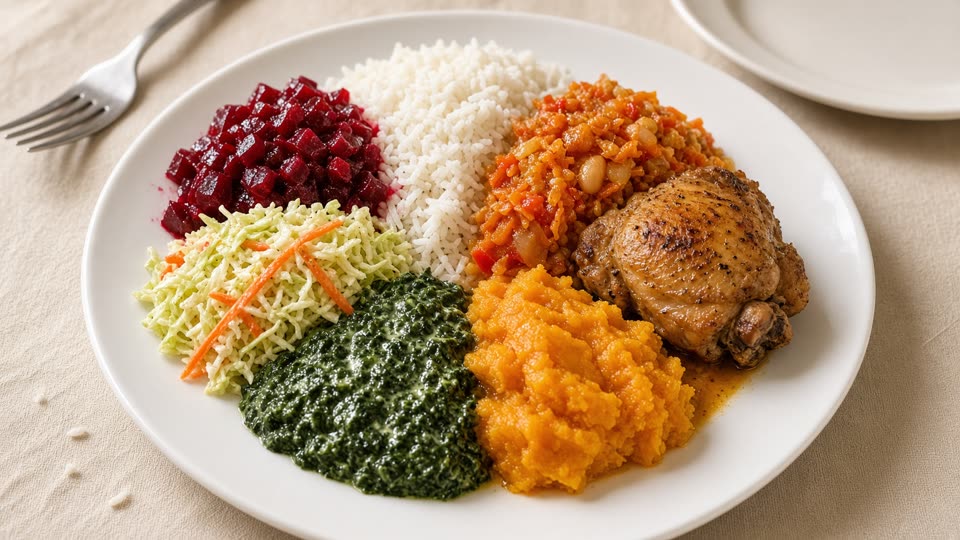
The South African festive plate is not a dish, it is a count. Seven colours — also called Sunday kos — is a plate assembled so that at least seven different colours are on it at once, and at Christmas it is the plate.
Eyewitness News, on Christmas Eve 2025, asking Johannesburg cooks what they would be making: «From kitchens filled with spice and steam to tables layered with “seven colours”, the festive meal is often where stories of family, heritage and love come together.» The chef Nompumelelo Nkosi gives the shape of hers: «A mutton curry with rice, seven colours and a roast is definitely my go-to, it reflects my personal brand because that is what we always had at home» The curry is not optional — «You always need a curry, whether you eat it later in the day or serve it at lunch, it has to be there» — and the roast is gammon, beef or a rack of lamb.
The Mail & Guardian describes the plate itself, and where it comes from in the week: it is the lunch after the church service, and the Mail & Guardian gives the reason for the name in one line: «The weekly ritual derives its name from the colours of the food on the table during the meals.» Its list of the classic version is «rice, accompanied by choices of chicken or beef, and complemented by sides like pumpkin, sweet potatoes, beetroot, cabbage, bean salad, potato salad, chakalaka and coleslaw».
The count is falling. The same report follows a household in Mangweni, Tembisa, where Thembisile Mthembu — who lives with four children and five grandchildren — has gone from seven colours to two: «It’s increasingly difficult to replicate the colourful meals we used to enjoy years ago. Food has become extremely expensive» What is left is pap, cabbage and roast chicken. A meal whose name is a number is a meal that can be measured against what it used to be, and that is what makes it worth recording.
Widely repeated claims about Christmas in South Africa that do not survive
checking. Each one says what is actually the case, because a correction
with nothing in its place leaves you worse off than before.
Oversimplified
In South Africa, 26 December is Boxing Day
What is actually the case. It is what most people call it, and it has not been its legal name since 1980. The Public Holidays Act of 1952 was amended that year «by the substitution for the words ‘Boxing Day’ of the words ‘Day of Goodwill’», and Schedule 1 of the Public Holidays Act of 1994 still lists the Day of Goodwill against 26 December. The Dictionary of South African English carries both names in one entry and quotes newspapers using each, which is the accurate position: one day, two names, one of them statutory.
Day of Goodwill — Dictionary of South African English, Rhodes University
South Africa is about as Christian as a country gets by self-description, and the number moves a long way depending on where you stand. Census 2022 reports that «the results show that the majority of the population reported Christianity (85,3%) as their chosen affiliation/belief, followed by Traditional African religion (7,8%)».
By province the spread is wide: the Northern Cape is 97,8% and «KwaZulu-Natal (74,9%) reported the lowest», and the same province reports the country's highest shares of Traditional African religion (13,6%) and Hinduism (4,2%). By population group the gap is wider still — more than four in five white, black African and coloured South Africans identify as Christian, «while only a third of Indians/Asians identified as Christians».
None of that says who keeps Christmas. It is a question about affiliation, asked once, in 2022.
26 December stopped being Boxing Day in South African law in 1980, and the old name outlived the change. The Dictionary of South African English quotes the amendment itself — «1980 Act 72 .. by the substitution for the words ‘Boxing Day’ of the words ‘Day of Goodwill’» — and then goes on quoting newspapers that use both. The 1994 Act, written by a different South Africa, kept the new name: Schedule 1 lists the Day of Goodwill against 26 December.
The dictionary's own note is the honest summary of where the language actually is: «Also known as ‘Boxing Day’, as in Britain.»
Day of Goodwill — Dictionary of South African English, Rhodes University
A South African public holiday that lands on a Sunday is not lost — «The Act determines whenever any public holiday falls on a Sunday, the Monday following on it shall be a public holiday». The rule names Sunday and no other day, so a Christmas or a Day of Goodwill that falls on a Saturday is simply a Saturday.
Every claim carries its own citation. They are collected below, so you
can see what the page rests on and how much of it comes from where.
Day of Goodwill — Dictionary of South African English, Rhodes University. Retrieved 2026-10-29.It defines the term as «The 26th of December, observed as a public holiday» and notes «Also known as ‘Boxing Day’, as in Britain». Its earliest citation is the amending act itself: «1980 Act 72 in Govt Gaz. Vol.180 No. 7060, 3 To amend the Public Holidays Act, 1952.. 2..(e) by the substitution for the words ‘Boxing Day’ of the words ‘Day of Goodwill’.»
George Municipal Newsletter, Volume 70, November 2023 — message from the Executive Mayor — George Municipality, Western Cape. Retrieved 2026-10-29. archived 20 May 2024English: «To our Christian residents and visitors, I would like to wish you all a very Merry Christmas as you observe the birth of our Lord and Saviour.» Afrikaans: «Aan ons Christen-inwoners en besoekers wil ek julle almal ’n baie Geseënde Kersfees toewens terwyl julle die geboorte van ons Here en Verlosser vier.» isiXhosa: «Kubahlali bethu abangamaKristu kunye neendwendwe, ndingathanda ukuninqwenelela iKrisimesi eMyoli njengoko nijongene nokuzalwa kweNkosi noMsindisi wethu.»
Public Holidays Act, 1994 (Act No. 36 of 1994), Schedule 1 — Government Gazette No. 16136, 7 December 1994, as the Parliament of South Africa publishes it. Retrieved 2026-10-29.Schedule 1 is set as two columns — twelve names against twelve dates, in the same order — and the two that matter read «Christmas Day» against «25 December» and «Day of Goodwill» against «26 December». The same list carries «Day of Reconciliation» against «16 December», which is why December holds three public holidays and not one.
Khumbulekhaya wesifunda sasoThukela — KwaZulu-Natal Department of Education, 18 December 2025. Retrieved 2026-10-31.The provincial education department's own isiZulu page for a Christmas lunch for elders at Phayikeni, where the MEC, Sipho Hlomuka, closes by wishing the whole community «ukhisimusi omuhle ophephile, onokuthula emndenini yonkana siphinde sibonane siphila ngonyaka ozayo» — a good, safe and peaceful Christmas in every family, and to see one another alive again next year. The page dates the event «18 ku Zibandlela 2025».
Cape Town Carols at Kirstenbosch — Rotary Club of Kirstenbosch, the organisers. Retrieved 2026-10-29. archived 12 July 2026The organisers' own page, answering their own frequently asked question — «Will there be candles to sing by candlelight?» — with «Updated fire and safety rules prohibit us from hosting the event by candlelight. You are welcome to bring your own glowsticks, or you may use your smartphone torch to add ambiance to the experience.»
Holidaymakers flock to the beaches on Christmas Day — SABC News, the South African public broadcaster. Retrieved 2026-10-29. archived 8 December 2023The people in it are not named and they are quoted directly: «It’s our family ritual. We come and spend a day have a picnic. As you can see, it’s a family thing.»
Public holidays — South African Government (gov.za). Retrieved 2026-10-29. archived 20 October 2026The government's own page, which states the rule for a holiday that lands on a weekend: «The Act determines whenever any public holiday falls on a Sunday, the Monday following on it shall be a public holiday.»
Census 2022 Statistical Release P03014 — Statistics South Africa. Retrieved 2026-10-29. archived 25 October 2026The national statistics office, reporting what people said about themselves: «The results show that the majority of the population reported Christianity (85,3%) as their chosen affiliation/belief, followed by Traditional African religion (7,8%).»