Christmas Day in Ecuador is 25 December. It is a public holiday.
How to say it
Spanish
Feliz Navidad
Feliz Navidad
say it: feh-LEES nah-vee-DAHD
A synthesised voice — not a recording of a person — saying Feliz Navidad
in es-EC.
Spanish is the official language and the one the state greets in. Kichwa and Shuar are official for intercultural relations, and Kichwa carries a Christmas of its own: in Imbabura the novena is prayed in it and the carols are sung in it.
Cuenca's Christmas Eve procession is called the city's fifth river
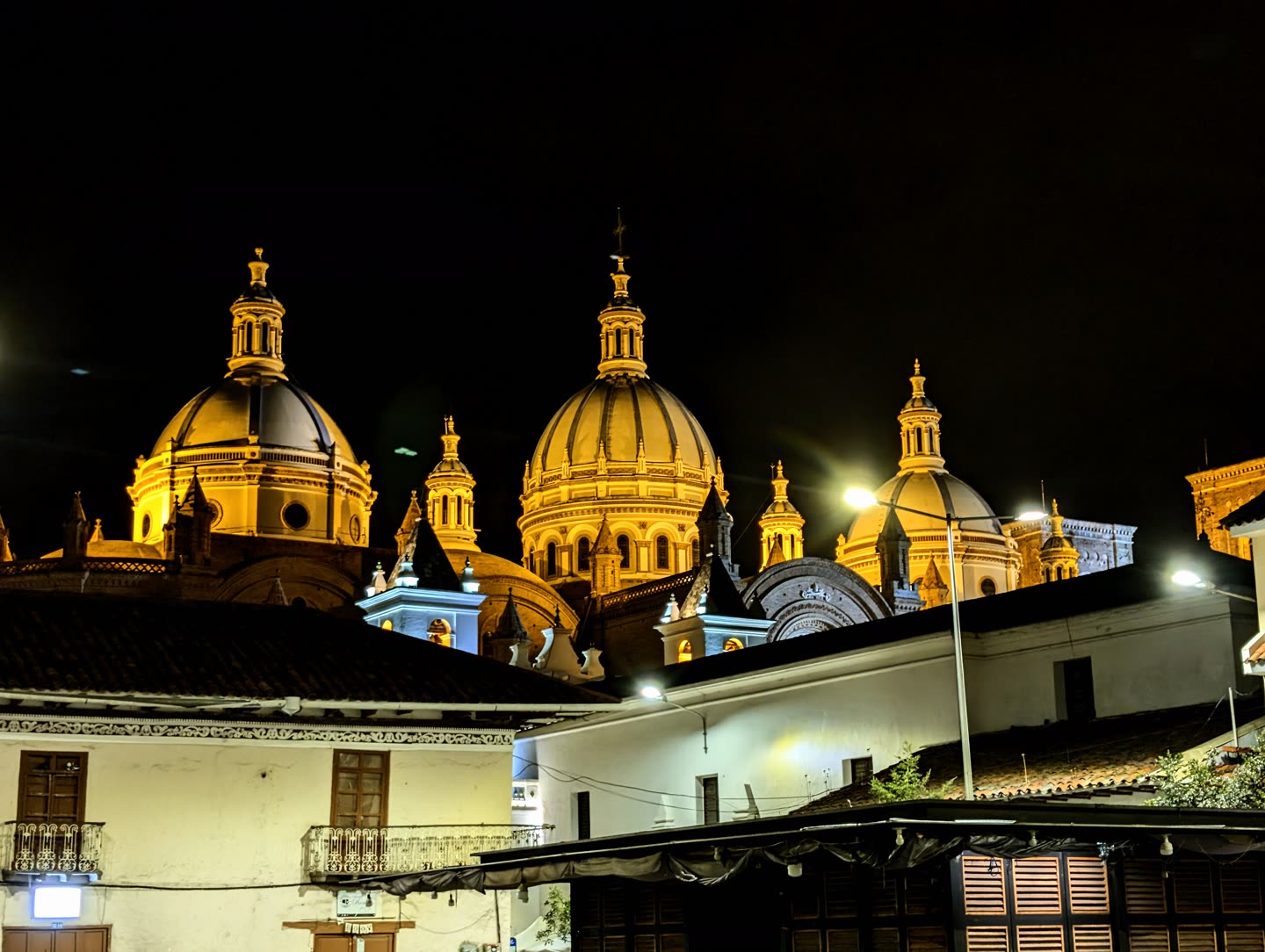
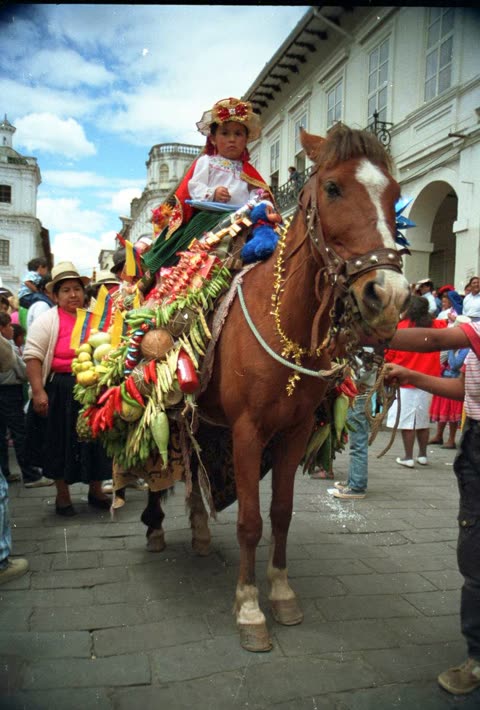
On 24 December a single image of the Christ child is carried the length of Cuenca, down calle Bolívar to the Parque Calderón, under police escort, and the crowd that walks with it turns a short route into several hours. The city stands on four rivers. The procession has been named the fifth.
The invitation is a loaf, and taking it commits you
The procession is convened by bread. The organisers bake the pan del Niño in a range of shapes and designs and hand it out, and the understanding is firm: if you have accepted the bread you are in the pasada. For decades the baking was done by one woman and her devotees, and the obligation it created is how a household procession became the largest festival in the country.
One family has been giving away the chicha for three generations
Thousands of litres of chicha are handed out free along the route on the 24th, and the making of it has stayed in one line of the same family that started the procession. The son of the founder began it; after his death in 2022 his daughter took it on, and her grandchildren are already in it.
The tree and the crib go up together, on 8 December
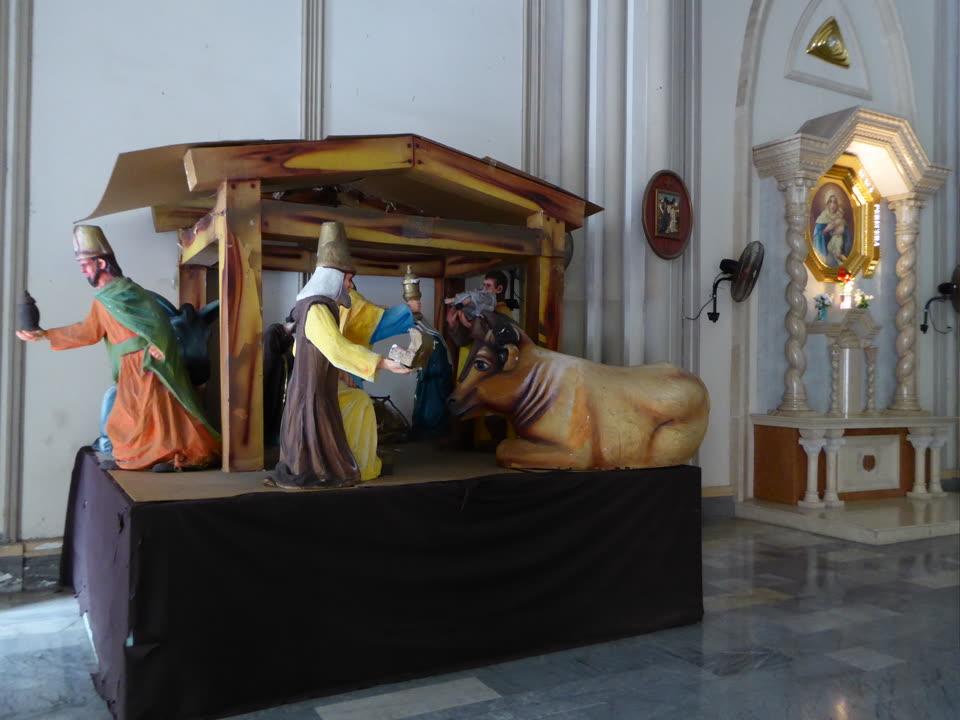
The date is not arbitrary and it is not Advent's first Sunday: Ecuadorian families wait for the feast of the Immaculate Conception and put up the tree and the pesebre on the same day. The carols have already been playing since the end of November.
Nine nights of novena, and the children are in costume for them
The nine days before Christmas are prayed at home at the end of the day, the family together, the same prayers to Mary, Joseph and the child each evening with a different meditation. Children and adults dress for it — Mary, Joseph, the shepherds — and the petitions and the food are shared round.
In Otavalo the carols are dubbed into Kichwa, deliberately, one in ten
Christmas is not an Andean feast and the people translating the carols say so first. What they want is for the language to be inside the thing the children are already doing: a Kichwa-teaching centre spends from October dubbing villancicos into a unified Kichwa everyone can follow, and the ask is modest and exact — of ten carols sung, let at least one be in Kichwa.
In Imbabura the novena is prayed in two languages, and the diocese prints it that way
Where Kichwa and Spanish live side by side the novena is said in both, and the church publishes it so. A bilingual booklet carries the nine days under a Kichwa title, and at the villancico festival the children of one school sing in the dress of their own people while an Afro-Ecuadorian group from the Chota valley sets the same child to drums and maracas.
The turkey is the centre of the Nochebuena table and it arrived from somewhere else — the habit grew under Anglo-Saxon influence. What was Ecuadorian about it was the handling: in the sierra the bird was raised at home or bought in the square, part-boiled first so the broth could be taken off it, and only then put into the wood oven. The par-boiling has largely gone; the bird goes into a plastic bag now to speed it up.
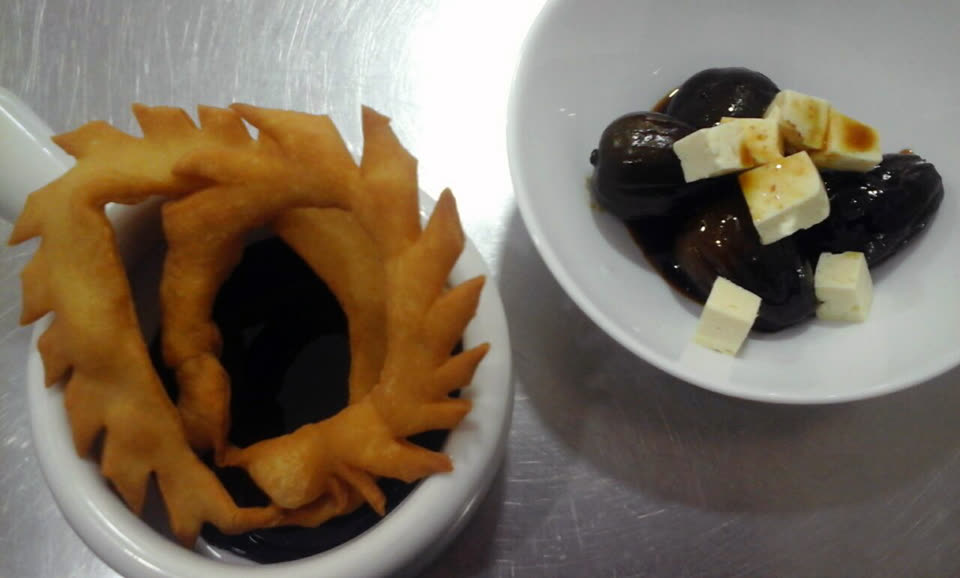
Rings and rosettes of dough, fried and then drowned in honey — panela syrup, or fig. They are the sweet of the Ecuadorian sierra at Christmas, Spanish inheritance crossed with indigenous roots, and the name is a local descendant of the Spanish pestiño.
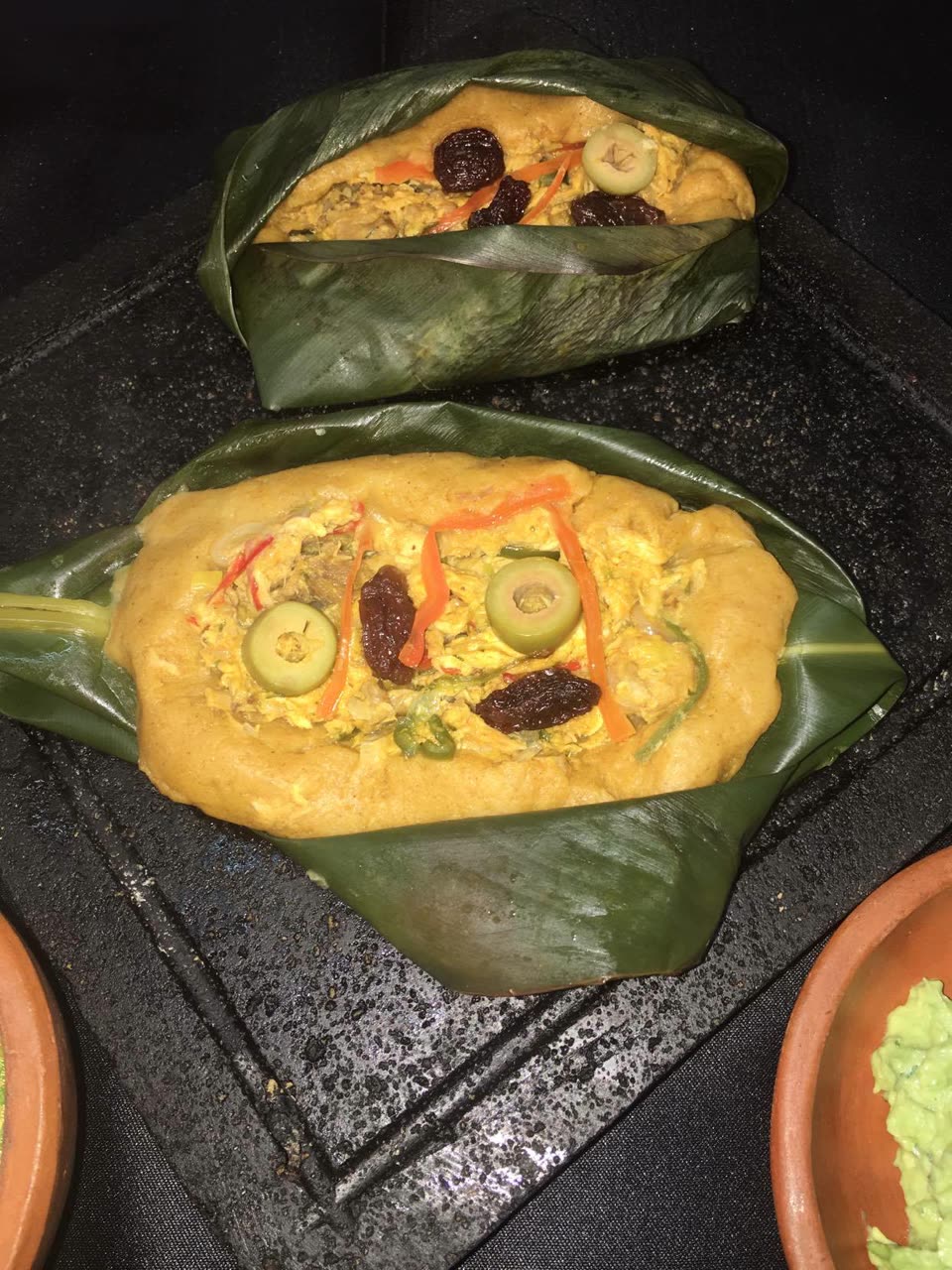
Ground maize worked with lard or pork broth, filled generously with pork or chicken and wrapped in achira leaves, then steamed. Every city has its own version of the same base and most households have one distinguishing thing in theirs. The flour is the part people are particular about: the maize ground for it, not the kind bought in a shop.
The labour code shunts a Tuesday holiday back to the Monday and a Wednesday or Thursday one forward to the Friday, which is how the country manufactures its long weekends. Three days are named as exceptions and have to be kept where they fall: New Year's Day, Carnival Tuesday and 25 December.
The figure carried through Cuenca was carved in 1823. It became the Niño Viajero — the travelling child — in 1961, after a year in which it went to Spain, Italy, Egypt and Palestine and was blessed in Rome before coming home. The person who named it was Rosa Palomeque, who had been borrowing a different image for her own small procession until the nuns refused her one year. Cuenca's own archbishop puts the authorship plainly: this came from below.
The province that is most associated with Kichwa in Ecuador has lost twenty per cent of the speaking of it, by the reckoning of the Otavalo cabildo itself. The response includes dubbing Christmas carols: the children sing them, the parents hear the children and start using the language more themselves.
Every claim carries its own citation. They are collected below, so you
can see what the page rests on and how much of it comes from where.
Descubre la historia del Pase Niño Viajero en Cuenca — Diario El Mercurio (Cuenca). Retrieved 2026-11-18.Of Rosa Pulla Palomeque, who took over the procession after her mother's death in 1971: «Una de las claves de la convocatoria era la invitación que hacía Rosa. Elaboraba, junto a los devotos, el “pan del Niño”, un alimento con diversas formas, diseños. Los panes se entregaban como invitación. Si alguien recibía el pan, estaba ya comprometido con la pasada.» The paper's own summary: «La organización del pueblo cuencano, liderado por las mantenedoras, ha llevado a que el Pase del Niño Viajero sea la fiesta más grande del Ecuador cada 24 de diciembre.»
En Otavalo la esencia de los villancicos se escucha en kichwa — Diario El Norte (Ibarra, Ecuador). Retrieved 2026-11-18.Ten children aged three to eight from the organisation Riksichishun Con Más Fuerza sang «Ñuka pampa ushukuwan Belén llaktaman rini» — the carol known in Spanish as «Burrito Sabanero», dubbed into Kichwa. Janeth Otavalo, who runs the organisation, began the translation in October «usando un kichwa unificado, que todos pueden entender»; the dubbing project is called Urpikukuna. Her reasoning, in her words: «A pesar de que la Navidad no es parte del mundo ni de la cosmovisión andina» — the paper's framing — «La Navidad está, los niños esperan ese momento, entonces, preferiblemente, darle una parte de lo que nosotros somos en toda esa globalización», and «si van a cantar villancicos, que de 10, al menos uno, sea en kichwa». Classes are held at the Cabildo Kichwa de Otavalo, whose secretary-general Lizeth Imbaquingo gives the reason: «en Imbabura se ha perdido el 20% del habla del kichwa y, para nosotros, es importante dejar sembrado esto en los niños».
Pase del Niño Viajero, patrimonio cultural desde 2008, llenó de fe y esperanza a Cuenca — El Universo (Ecuador). Retrieved 2026-11-18.The paper records the Pase as Patrimonio Cultural Inmaterial de la Nación since 2008, with its origin in 1961 «aunque la imagen, figura central de esta manifestación, data de 1823». «La imagen recorrió la calle Bolívar hasta llegar al parque Calderón», a short distance «que suele durar varias horas debido a la multitud que se concentra por calles y avenidas y que lo acompaña», with a police guard on the image. The name «quinto río de Cuenca» is El Mercurio's, in its account of the same procession on 24 December 2023.
Navidad multicultural se celebró en Imbabura — El Universo (Ecuador). Retrieved 2026-11-18.«En este evento intercultural, la Diócesis de Ibarra presentó un folleto bilingüe español-kichwa, denominado Navidad Iskunniki Mañanakuna (Novena de Navidad 2015).» Children of the Unidad Educativa Monseñor César Antonio Mosquera at Peguche in Otavalo «vistieron sus trajes tradicionales del pueblo kichwa Otavalo para interpretar el villancico Ñuka Mishki Jesús (Dulce Jesús mío)». The Afro-Ecuadorian pastoral group came from the Valle del Chota, «donde al ritmo de tambores y maracas han creado alabanzas al “niño Dios”»; Feliciana Caicedo, wearing a pollera and a headscarf, described their music as a mixture of arrullos esmeraldeños and the bomba del Valle del Chota. The paper's closing line on the province: «la novena es rezada en kichwa y español».
Código del Trabajo, artículo 65 — Días de descanso obligatorio — Ministerio de Defensa Nacional del Ecuador, consolidated text of February 2023. Retrieved 2026-11-18.«Art. 65.- Días de descanso obligatorio.- (Reformado por el Art. 1 de la Ley s/n, R.O. 906-S, 20-XII-2016).- Además de los sábados y domingos, son días de descanso obligatorio los siguientes: 1 de enero, viernes santo, 1 y 24 de mayo, 10 de agosto, 9 de octubre, 2 y 3 de noviembre, 25 de diciembre y los días lunes y martes de carnaval.» The article then sets out how holidays are moved to make long weekends — a Tuesday holiday is taken on the Monday before, a Wednesday or Thursday one on the Friday of the same week — and exempts three days from it by name: «Se exceptúan de esta disposición los días 1 de enero, 25 de diciembre y martes de carnaval.»
El Presidente Correa y el Vicepresidente Glas dan su mensaje de Navidad a los ecuatorianos (Video) — Presidencia de la República del Ecuador. Retrieved 2026-11-18.It closes «Con el deseo de “una feliz navidad y un extraordinario 2016 a todas y a todos”». The Vice-President's line reaches past the borders: «Que este momento de alegría llegue a cada rincón de nuestra querida patria y a todos nuestros hermanos migrantes.» The page carries no date of its own; the wish for «un extraordinario 2016» places the message in December 2015. The respelling is Latin American Spanish, in which the z of «feliz» is an s rather than Castilian's th.
Villancicos, postres y pesebres: estas son algunas de las tradiciones ecuatorianas de la Navidad — Primicias (Ecuador). Retrieved 2026-11-18.«Las familias ecuatorianas esperan con ansias que se acerque el 8 de diciembre para que juntos armen el árbol de Navidad con el pesebre.» On the music: where the United States has Mariah Carey, «los ecuatorianos escuchan desde finales de noviembre los conocidos» villancicos, and the piece names the brothers known as los Pibes Trujillo and the line «Ya viene el Niñito jugando entre flores».
Cinco platos típicos para disfrutar la Navidad en Ecuador — Primicias (Ecuador). Retrieved 2026-11-18.«La investigadora cuenta que, décadas atrás, las familias cuencanas llevaban al horno de leña un pavo que criaban en su propia casa o compraban en la plaza. Eso ocurría, principalmente, en las ciudades de la Sierra. “Pero antes de hornearlo, le cocinaban un poco para sacar el caldo. Eso ya no se hace ahora, pues la gente le pone en fundas plásticas para acelerar el proceso”, cuenta con nostalgia Vásquez.» The paper adds that «El consumo del pavo creció por influencia de la cultura anglosajona», that pernil was easier to come by and is therefore equally rooted, and that both must be marinated at least a day ahead — in the season the roasting businesses are overwhelmed.