_(5239936290).jpg)
Papai Noel
Papai Noel — Wikipédia (Portuguese)
A country-by-country atlas of how Christmas is actually kept

All countdowns · South America
Next: Friday 25 December 2026
Feliz Natal
say it: feh-LEESS nah-TOW
A synthesised voice — not a recording of a person — saying Feliz Natal in pt-BR.
Plain, universal and unceremonious — the ordinary thing one Brazilian says to another in December. «Natal» is the feast; it is also, on its own, the word for a birth, which is why the city founded on Christmas Day 1599 is called Natal and why a search for one finds the other. The respelling is for a Brazilian mouth rather than a Portuguese one: final -al closes to a w, so Natal is «nah-TOW», not «nah-TAL».
Feliz Natal — Wikcionário (Portuguese Wiktionary)
Papai Noel — Wikipédia (Portuguese)
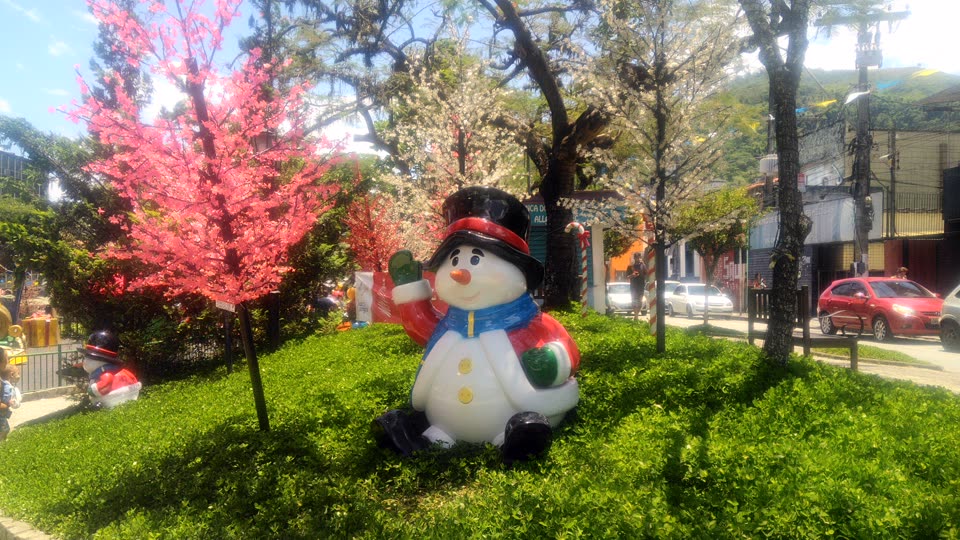
Brazil keeps Christmas three or four days into summer. The austral summer solstice falls around 21 December, so where a European Christmas sits just inside the shortest days of the year, a Brazilian one sits just inside the longest — same date, same church, opposite ends of the earth's tilt. It is not a footnote to the celebration; it is the shape of it. The supper waits until the heat has gone out of the day and then runs past midnight. The tree is plastic because there are no firs. The iconography — the snow, the pine, the fur-trimmed coat, the robin — arrived from a hemisphere where December means darkness, and is kept in a country where it means the beach.
Verão — Wikipédia (Portuguese)
The meal is the event, and it is not a lunch on the 25th. The ceia de Natal is served late on Christmas Eve — commonly around ten or eleven at night — so that the family is at the table when the 24th becomes the 25th. Presents are opened at midnight, not in the morning. What is on it is a layered thing. Roast turkey or a Chester; salt cod; farofa, the toasted cassava-flour dish that goes beside almost everything Brazilian; fresh fruit; rabanada for afterwards. The Portuguese inheritance, the African inheritance and the twentieth-century supermarket are all on one table at once, and nobody thinks of them as separate.
Observance of Christmas by country — Brazil — English Wikipedia
Midnight mass on Christmas Eve is the Missa do Galo, the Mass of the Cock. The name belongs to the Latin countries — Portugal, Spain, France and Brazil — and the explanations for it are legends rather than history: that a cock crowed extraordinarily at midnight to announce the Messiah, or, in a Toledo version, that farmers killed a cock before the midnight vigil. The quiet modern joke is that the mass has moved. With the congregation at the ceia and in no hurry to leave it, priests in Brazil have brought the service forward to six, seven or eight in the evening of the 24th — so the Mass of the Cock is now commonly said while it is still light, hours before any cock would crow.
Missa do Galo — Wikipédia (Portuguese)
Before the family supper there is the workplace and the extended family, and for those there is the amigo oculto: everyone's name into a hat, each person draws one, keeps it secret, and buys for that person alone. A price ceiling is agreed in advance so that nobody is embarrassed in either direction. The name is regional and the variants are used interchangeably across the country: amigo secreto, amigo oculto, amigo X, amigo invisível. The etymology is tidy — Latin *amicus*, friend, and *secretum*, set apart, hidden — and the same root gives Portuguese its word for a secretary, a person whose job description is keeping things to themselves.
Amigo secreto — Wikipédia (Portuguese)
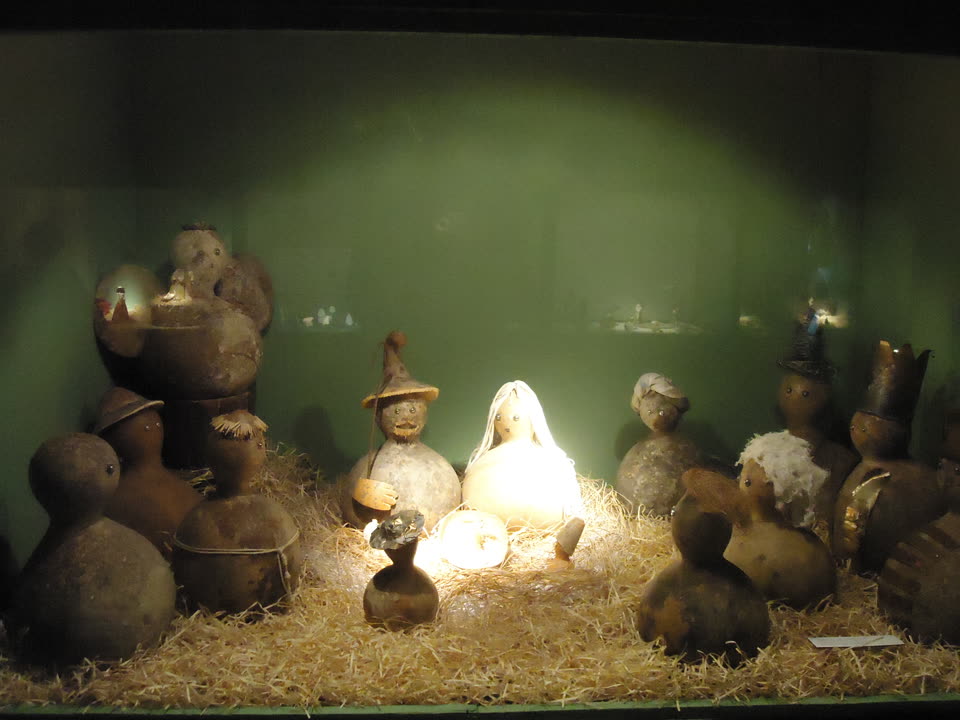
The nativity scene is set up in houses, churches, squares and shopping centres, and in a great many Brazilian homes it is the principal decoration rather than an accompaniment to the tree. The form descends from the living nativity attributed to Francis of Assisi at Greccio in 1223, carried to Brazil by the Portuguese and then built upon.
Presépio — Wikipédia (Portuguese)
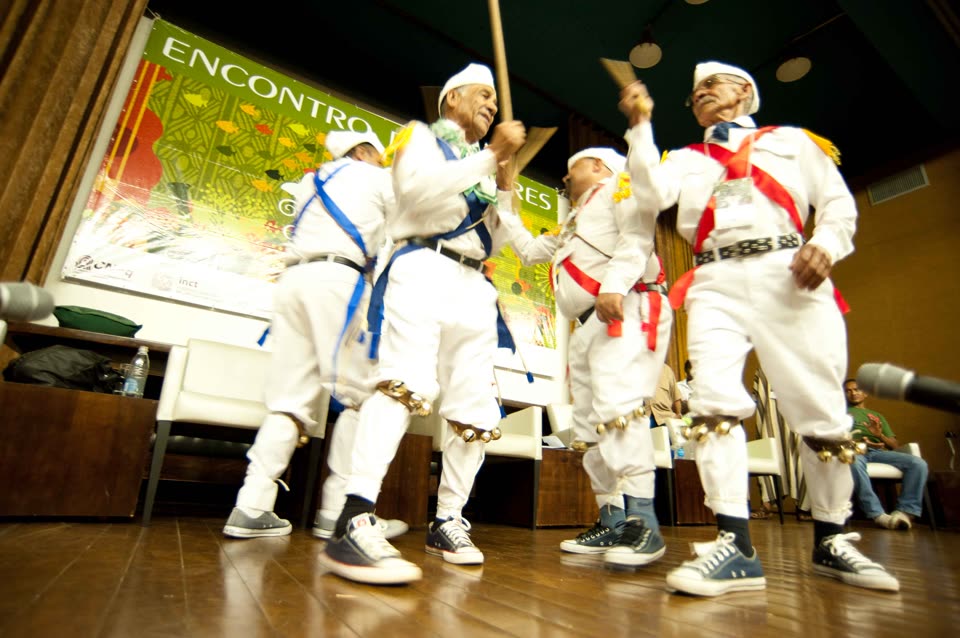
In the interior, and in small towns across much of the country, companies of singers and players go from house to house between Christmas and Epiphany. They carry a banner, they sing verses — religious, or comic, or both — they are given food and drink and coins, and they move on. The clowns of the group wear masks and carry staves, mark the banner's arrival and departure with a whistle, and collect coins thrown on the ground in front of them. It is the Adoration of the Magi, kept as a travelling house-visit rather than a service, and it ends on the Dia de Reis, 6 January.
Folia de Reis — Wikipédia (Portuguese)
The bird at the centre of a great many Brazilian Christmas tables is not a species. Chester is a registered trademark, owned by one company, applied to a chicken bred so that the breast and thighs carry about seventy per cent of the meat — and the name is simply the English word *chest* with *-er* on the end. It is sold for Christmas and very largely only for Christmas. The brand's own site runs a *Calculadora de Ceia* — a supper calculator, to work out how much bird a given number of guests requires — beside its Christmas recipes and its table-decoration ideas. A product invented by a food company has become the thing a Brazilian family expects to find at the centre of the table on the night of the 24th, which is a thing that has happened in exactly one other country on this site.
Bruster, chester, peru e outros nomes — Ari Riboldi, for the Prefeitura Municipal de Porto Alegre (Natal Portoweb)
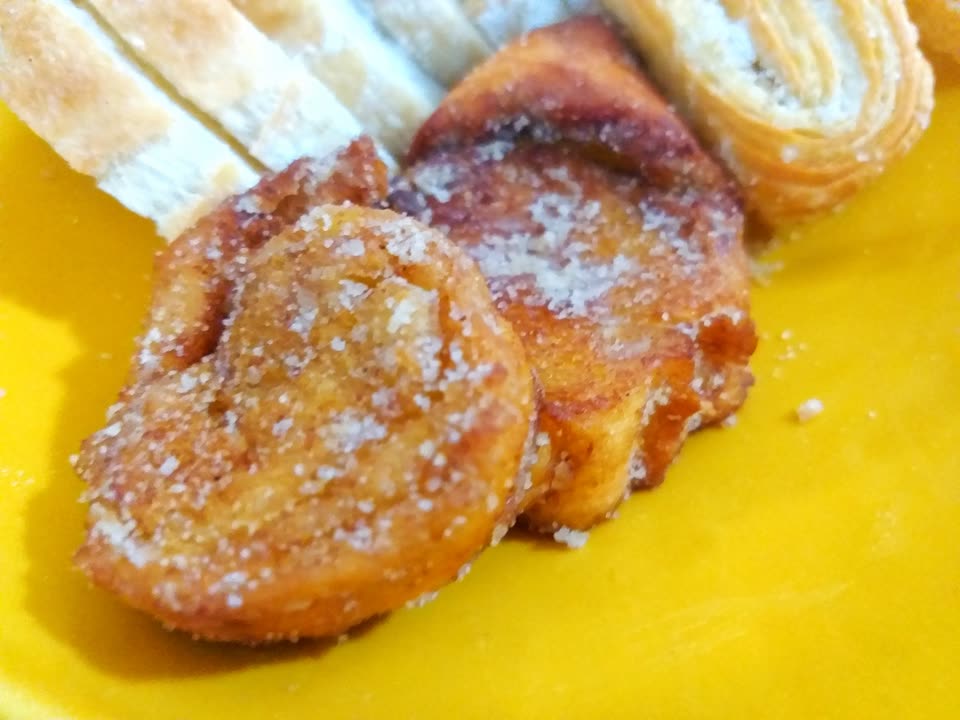
Stale bread, soaked in milk or wine or sugar syrup, turned in beaten egg, fried, and finished with cinnamon sugar. It is the Christmas dessert, and it came from Portugal, where the same thing sits on the consoada table on Christmas Eve. Brazil then did something to it that Portugal does not: after frying, the slice is dipped again — in fruit juice, or in condensed milk. Portuguese Wikipedia records the difference in one clause, and it is the clearest small example on this page of a colonial dish being kept and then altered.
Rabanada — Wikipédia (Portuguese)
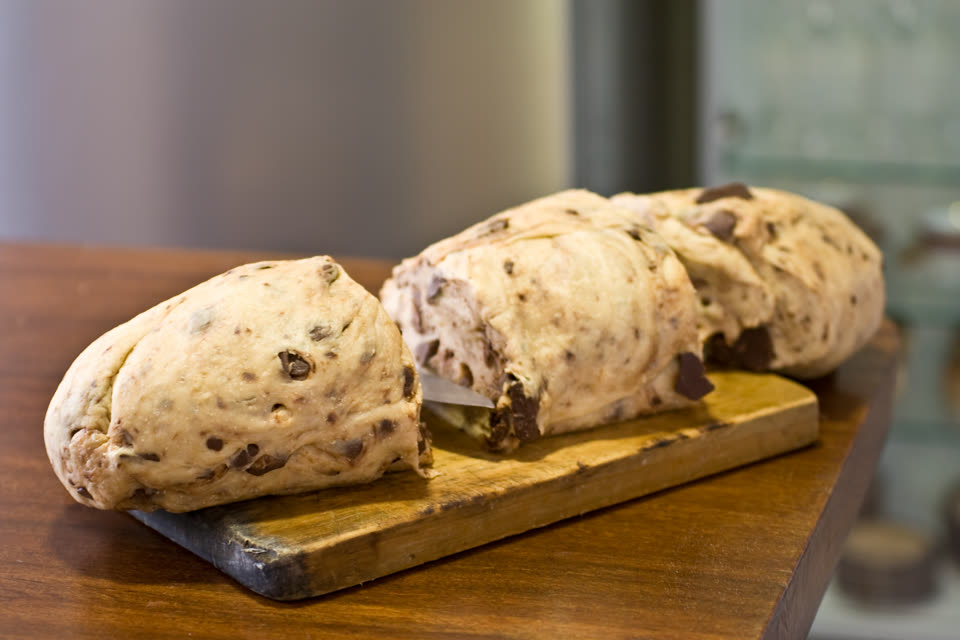
A Milanese Christmas bread, eaten across Brazil, and it arrived with people rather than with an empire. Italian immigrants crossed to South America between the end of the nineteenth century and the middle of the twentieth; the first company to make and sell panettone in Brazil was Bauducco, founded by the Italian-Brazilian Carlo Bauducco, which began production in the mid-1950s and did more than anyone to put it in every supermarket in the country. The chocolate version, the chocotone, is a Brazilian invention of the same house.
Panetone — Wikipédia (Portuguese)
Widely repeated claims about Christmas in Brazil that do not survive checking. Each one says what is actually the case, because a correction with nothing in its place leaves you worse off than before.
Oversimplified
What is actually the case. It is a trademark. Chester is a brand name owned by one food company, applied to a chicken bred so that the breast and thighs carry about seventy per cent of the meat, and the company sells it exclusively. The word is English — *chest*, plus *-er* — and was coined for the product. The «oversimplified» rather than «false» verdict is deliberate and the distinction is the interesting part: there IS a real bird under the trademark, and it is a real chicken, so somebody buying a chester is not being sold a fiction. What is not true is the thing most people assume, which is that it names a species the way peru and pato do. It names a product.
Bruster, chester, peru e outros nomes — Ari Riboldi, for the Prefeitura Municipal de Porto Alegre (Natal Portoweb)
Contested
What is actually the case. The same reference work gives two accounts and does not choose between them. One says the Reis festivities were introduced by the Jesuits around 1559, after the arrival of Tomé de Sousa as the first Governor-General, as song, dance and staging used in catechism and teaching. The other, a few lines later, puts the origin of the Folia de Reis as a popular practice at the end of the EIGHTEENTH century, beginning on the coastal sugar mills and cattle ranches and moving inland afterwards. Those are two centuries apart and they are not obviously the same claim — one is about a missionary method, the other about a folk practice. The article also records that the deeper origin is «controversa e plural», with researchers finding European references and, explicitly without proof, African ones. So: the 1559 date is in the literature, it is not the only date in the literature, and anybody repeating it alone is repeating half a source.
Folia de Reis — Wikipédia (Portuguese)
Brazil has a Papai Noel in green. A version of him dressed in green rather than red became popular through television advertising for the soft drink Dolly, alongside its mascot Dollynho, from the 2000s onward — recoloured to the green and yellow of the Brazilian flag, as a kind of patriotism. He is a soft-drink company's character and he is widely recognised, which makes Brazil one of the few countries to have produced a nationally known alternative Santa and done it through an advertising campaign.
Papai Noel — Wikipédia (Portuguese)
Brazilian workers are paid a Christmas bonus by law, and it is called one. The décimo terceiro salário — the thirteenth salary, also known as the gratificação natalina — was created under João Goulart by Lei 4.090 of 13 July 1962 and regulated by Decreto 57.155 of 3 November 1965. It is one twelfth of a month's pay for each month worked, paid in up to two instalments before the year ends, and calculated against December. An entire country's December spending is underwritten by a statute, which is why Christmas commerce in Brazil has a shape that nothing in the northern hemisphere quite matches.
Décimo terceiro salário — Wikipédia (Portuguese)
There is a Brazilian city called Christmas, founded on Christmas Day, which the Dutch renamed New Amsterdam. Natal, now the capital of Rio Grande do Norte, was founded on the Natal of 1599 on the banks of the Potengi, and was held by the Dutch from 1633 to 1654, during which it was called Nova Amsterdã. There is also a municipality in Mato Grosso called Feliz Natal — Merry Christmas — so the greeting on this page is, in Brazil, also a place you can drive to.
Natal (Rio Grande do Norte) — Wikipédia (Portuguese)
The side dish on the Christmas table has an African name. Farofa — toasted cassava or maize flour, turned in fat or butter, with whatever else the cook adds — takes its name from the Kimbundu *falofa*, from the Bantu language of what is now Angola. Cassava itself is indigenous to the Americas and was eaten here long before any Portuguese ship arrived. The dish is therefore an Indigenous staple, prepared by a method and under a name carried across the Atlantic by enslaved Angolans, served at a Portuguese Catholic feast, beside a bird invented by a food company in the twentieth century.
Farofa — Wikipédia (Portuguese)
Brazilian Christmas pop is barely thirty years old. Portuguese Wikipedia dates the commercial arrival of the Brazilian Christmas album to the 1990s and to one record — Simone's *25 de Dezembro* — quoting a contemporary line that she «quebrou um tabu», broke a taboo, because unlike in the United States and Europe, Brazilian singers did not release Christmas records in December. The international standards were translated and are enormously streamed, especially in children's versions; the home-grown catalogue is recent.
Natal — Wikipédia (Portuguese)
The turkey is named after the wrong country, and so is the Portuguese word for it. English speakers call the bird a turkey because it was thought to have come through Turkey. The Portuguese called it a peru because they believed it came from Peru — at a time when Peru stood in Portuguese usage for Spanish America generally. Both are wrong by the same kind of error: the bird is from Mexico and what is now the United States, and it reached Europe from neither Turkey nor Peru.
Bruster, chester, peru e outros nomes — Ari Riboldi, for the Prefeitura Municipal de Porto Alegre (Natal Portoweb)
Every claim on this page carries its own citation. They are collected here so you can see what this page is built on, and how much of it comes from where.


.jpg)