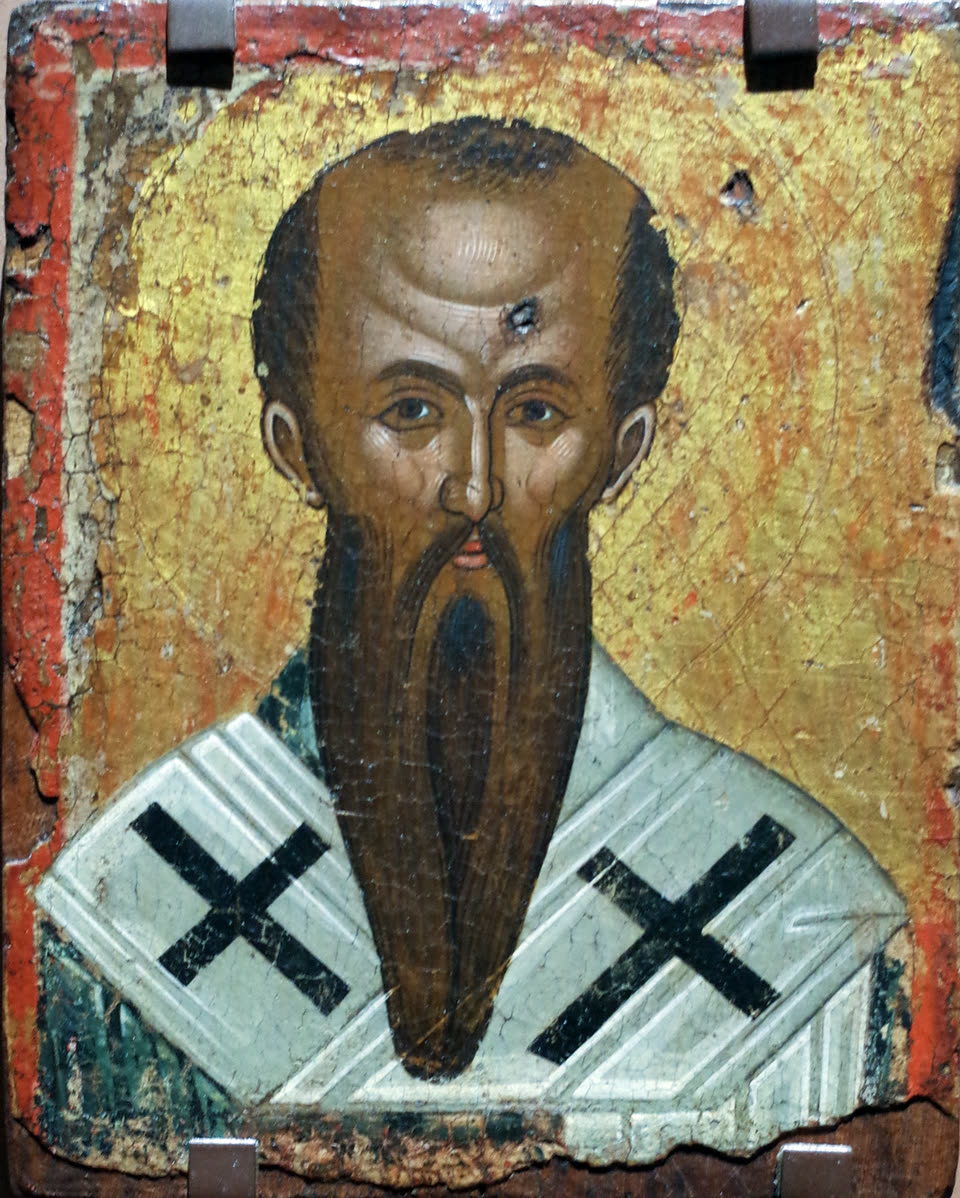
Saint BasilΆγιος Βασίλης · Agios Vasilis · arrives 1 January
—days
—hrs
—min
—sec
Next: Friday 25 December 2026
When is Christmas in Greece?
Christmas Day in Greece is 25 December. It is a public holiday.
How to say it
Greek
Καλά Χριστούγεννα
Kalá Christoúgenna
say it: kah-LAH khree-STOO-yeh-nah
A synthesised voice — not a recording of a person — saying Καλά Χριστούγεννα
in el-GR.
Four syllables of the second word carry the whole difficulty: the χ is the ch of Scottish loch, and the γ before ε is a palatal that English has only as the y of yes. Χρόνια πολλά — many years — does the same work on any feast day and is not specific to Christmas.
Basil of Caesarea, whose feast is 1 January. That is why the new year’s pie is named after him, and why the state’s record of the masquerade at Kleisoura dates the gathering to the afternoon of «της παραμονής της εορτής του Αγίου Βασιλείου» — the eve of the feast of Saint Basil — rather than to New Year’s Eve.
The Academy of Athens has him in its folklore archive doing exactly this job, and the entry is dated. A collector wrote it down at Metsovo in Epirus in 1951: «Είναι ο άγιος, που ορίζει τον τυχερό της χρονιάς και ο μεγάλος και καλός παππούς των παιδιών» — he is the saint who appoints the lucky one of the year, and the great and good grandfather of the children. The Academy’s proverb archive takes the arrival back further still, to a collection made in Epirus in 1879: «Αη Βασίλης έρχεται, Γενάρης ξημερώνει» — Ai-Vasilis is coming, January is dawning. His coming and the turn of the year are the same event.
What keeps it current is the post office. Hellenic Post has been answering letters addressed to him since 1991: «Ήταν το 1991 όταν οι υπάλληλοι των ΕΛΤΑ πήραν την πρωτοβουλία να μην αφήσουν αναπάντητα τα γράμματα που έφτασαν στα χέρια τους με παραλήπτη τον Άγιο Βασίλη» — the letters had reached them addressed to Saint Basil, and the staff decided not to leave them unanswered. The letters came first and the campaign was the reply; it is now the largest social-responsibility action the company runs. Its privacy notice is the plainest statement of the arrangement, because a privacy notice has to name the real recipient: «Αποστολείς των εν λόγω επιστολών είναι παιδιά αλλά και ενήλικες, ενώ ο πραγματικός παραλήπτης είναι τα ΕΛΛΗΝΙΚΑ ΤΑΧΥΔΡΟΜΕΙΑ».
The day is the part that has moved. The pie and the proverb belong to 1 January, but the letters are collected «τις ημέρες των Χριστουγέννων» — over the days of Christmas. The name stayed Greek and the season drifted west.
«Άγιος Βασίλης» — Αρχείο Παροιμιών, αρ. 319 — Κέντρον Ερεύνης της Ελληνικής Λαογραφίας, Ακαδημία Αθηνών (Hellenic Folklore Research Centre, Academy of Athens), digital repository item 506331
How Christmas is kept
Four of the nine days the whole country must close fall inside these two weeks
Greek labour law fixes nine days of compulsory closure for every business and every kind of work. Four of the nine are between Christmas and Epiphany: 1 January, Theophany on 6 January, the Nativity on 25 December, and 26 December. Nothing else in the Greek year is dense like that — the remaining five are spread across March, Easter, May, August and October.
The law is new and the money in it is old. The Labour Code was published in July 2025; the premium for working one of those days is 75 per cent, and the Code does not set the figure itself. It points back to a joint decision of the Ministers of Finance and Labour numbered 8900/1946, as that decision was «authentically interpreted» by another numbered 25825/1951. A wage rule written the year after the occupation ended is still what a Greek shift on Christmas Day is paid by.
The twelve days have their own name, and something comes up through them
The stretch from Christmas to Epiphany is the δωδεκαήμερον, the twelve-day period, and in Greek folk belief it is when the kallikantzaroi are above ground. The rest of the year they are below it, gnawing at the tree — or in other accounts the column, or columns — that holds the world up. Each Christmas they have nearly got through it. Then they are called up to the surface for twelve days, and while they are away the supports mend themselves.
John Cuthbert Lawson collected this in Greece and published it in 1910. The description is his record of what he was told; the explanation he builds on it — that these creatures are the ancient Centaurs — is his own argument and belongs to the comparative folklore of his day, not to the evidence.
The defence was a sieve, because they cannot say three
The household charms Lawson recorded in 1910 run from church to field in one breath. A cross marked in black on the house door on Christmas Eve, the same sign on the jars the food is kept in and on the forehead of an unbaptised infant; incense if they get in; three Paternosters if you meet them outdoors. Then the other kind: the fire kept alight through all twelve days so nothing comes down the chimney, with one huge log stood on end in it to burn the whole period, and thistle, hyssop or asparagus hung at the door.
The best of them is arithmetic. In the stories a woman keeps them busy by making them count the holes in a sieve, and they never finish, because they dare not say the word «three» — so they count one, two, one, two, until the cock crows and they have to go.
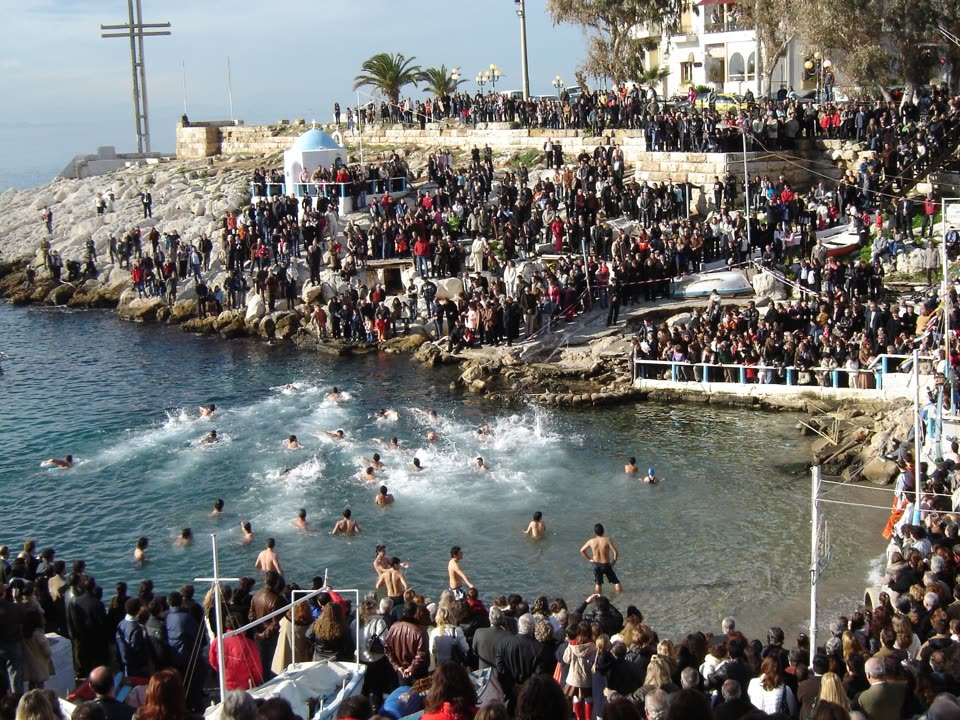
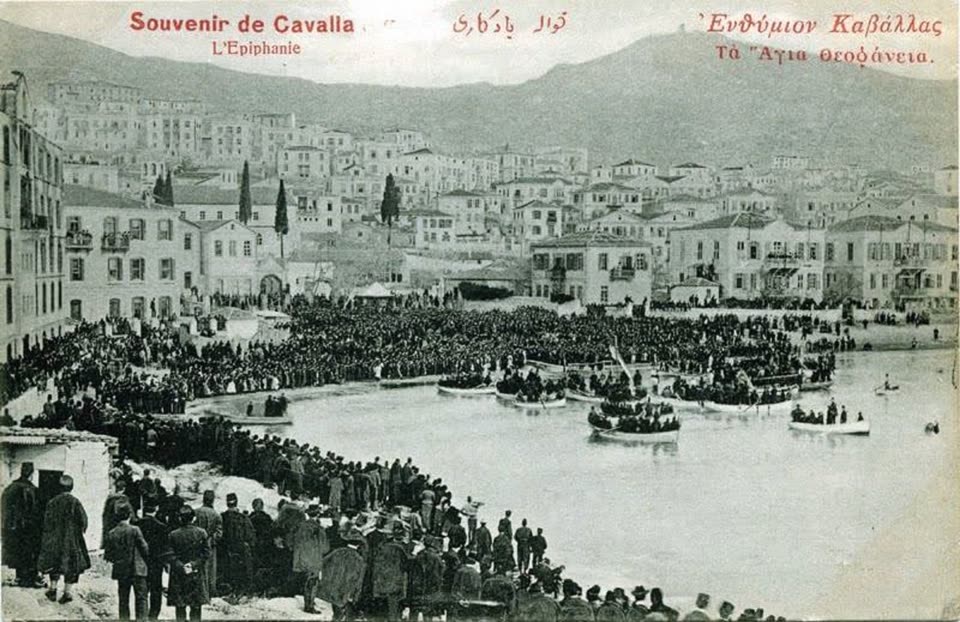
Epiphany ends it by throwing a cross in the water, and the Navy has a regulation for that
What sends them back down is the blessing of the waters on the morning of 6 January: a cross carried in procession to the sea, a river, a village well, and thrown in. In 1910 Lawson wrote that the belief that this hallowing is the signal for the kallikantzaroi’s final departure was held throughout Greece.
The rite is not folklore on the state’s side of the line. The Hellenic Navy’s own standing regulations list the immersion of the Holy Cross at Theophany on 6 January as one of its permanently established ceremonies: the Navy takes part in the Piraeus service and, through its naval region commands, in every other coastal area of the country, working with the local religious and civil authorities. And the regulation on honours puts the moment the cross goes into the water in the same short list as the Resurrection and the unveiling of a monument to the dead — the only occasions on which troops present arms and the band plays the Flag march and the National Anthem once through.
Piraeus is where the national ceremony happens. On 6 January 2026 the President of the Republic and the Archbishop of Athens were both on the quay.
The Twelve Days custom on the UNESCO list came off a boat in 1923
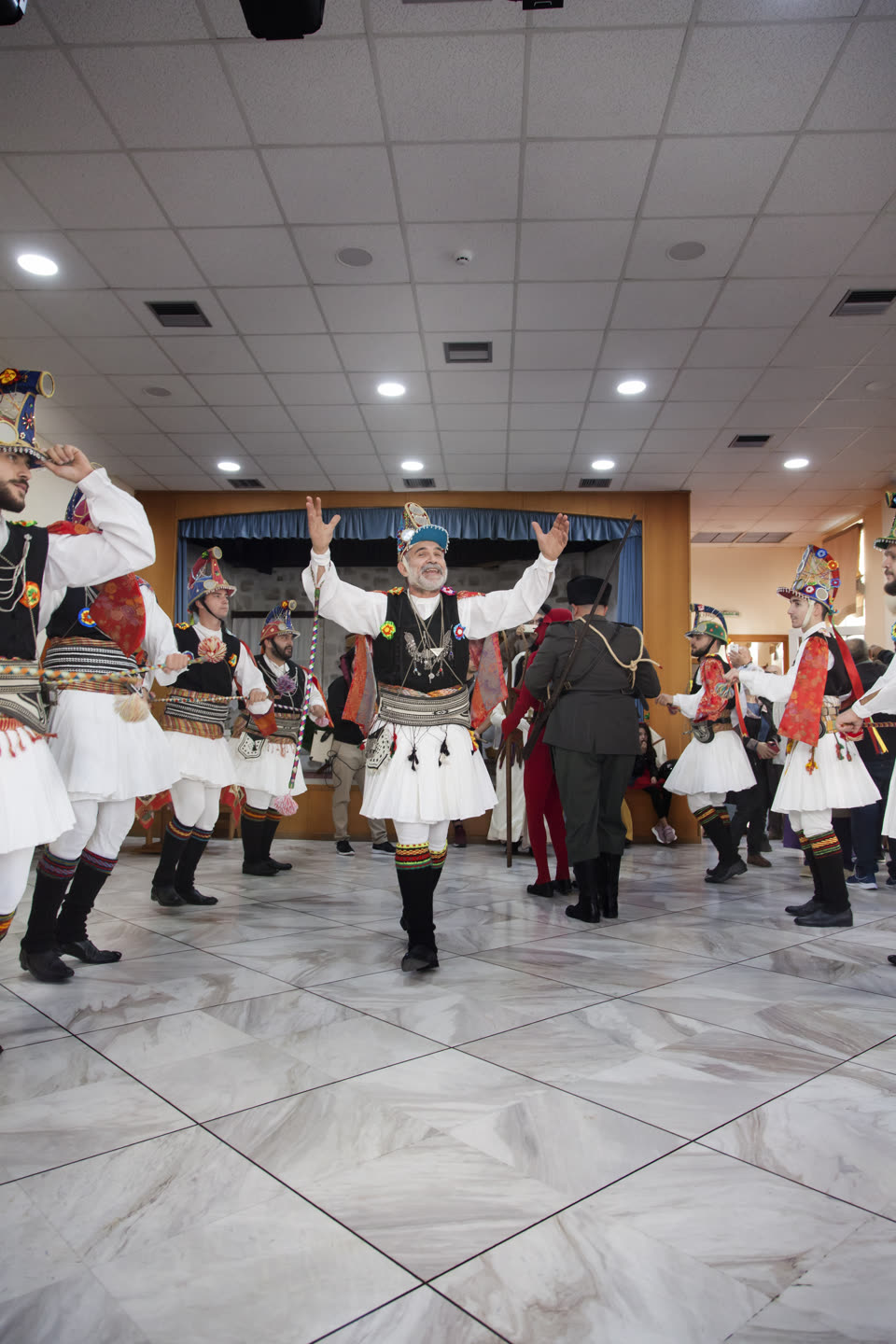
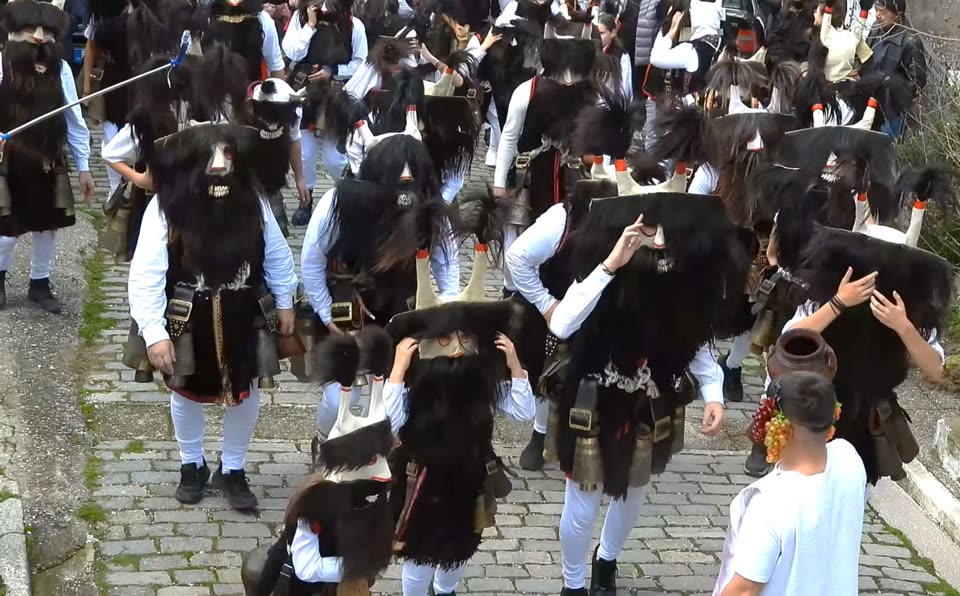
Momoeria is a troupe of about thirty men — dancers under a leader, a theatrical company, and musicians on lyra, bagpipe and drum — who work their way through the streets and into the houses of eight villages in the Kozani district between 25 December and 5 January. They wear helmets hung with beads, little mirrors and ribbons, pleated skirts, and carry cut sticks of cornel or hazel wound with coloured ribbon and bells. The dance is to persuade the powers of nature not to ruin the villagers’ living.
It is not a Kozani custom by origin. The Greek state’s own inventory record says the variant that survives unbroken is the one from the village of Liverá in the mountains behind Trebizond, brought over in the 1923 exchange of populations, and that among the few objects the Pontic refugees carried to Greece were Momoeri breastplates and helmets. It has been performed here since 1924–25, missing only a handful of years, one of them 1940. More than fifty variants of the custom were recorded; this is the one that never stopped.
The cast list is a history of the place it came from. Two brides whom the crowd tries to steal and has to pay to return, an old man, an old woman, the devil, a bear, a doctor who examines the bride — and the tsandarmas, which the inventory entry glosses as a gendarme of the Ottoman period.
The carollers are auditioned at the door, and the door stays shut if they are bad
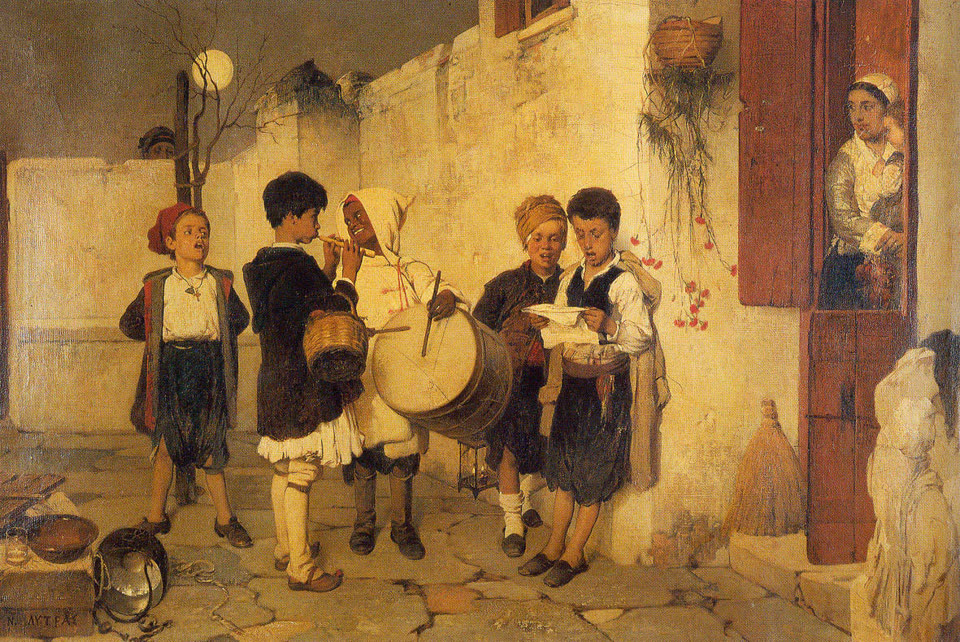
At Kalampaki in Drama the carols are sung by groups of unmarried young men, antiphonally, through the night of Christmas Eve until dawn. Each group splits into two half-choirs and the second overlaps the last syllables of the first. They start rehearsing at the beginning of December, because there are many songs and which ones are sung depends on who lives in the house.
Outside the gate they announce themselves with the song called «Χριστός». That one is always sung, even at a house in mourning, where nothing else will be. Then, at a front door that is still shut, they sing the second song, and the household decides. If they judge the group sings properly and has good voices they open the door and call them in; if not, there is a small tip and a drink at the entrance and no further.
The visits run in a fixed order, so some houses are reached at first light. At the last house there is chicken soup. When every group has finished they meet in front of the church at dawn and sing the final song together.
Most of Kalampaki’s people came from Kryoneri in Eastern Thrace, and the carols came with them; they were then taken up by the other refugee groups settled in the same village, Cappadocians and people from Kalfa outside Constantinople.
At Nea Vyssa the carols come with frame drums and a camel
The Tempelekia are the traditional carols of Nea Vyssa in Evros, and the inventory files them as an agermic men’s performance of the Twelve Days, done on 25 and 26 December. The young men of the community sing them to ντέφια — frame drums — and the custom is accompanied by animal disguise, the «Καμηλάρης», the camel-man.
It is a living thing rather than a revival: a community event brought three generations of Tempelektsides together to sing, grandfathers, sons and grandsons, and the third generation of the refugee families learned the drum stroke and the way the praise verses were sung from men who had belonged to different troupes.
Across the north the Twelve Days are a season of masks, bells and wooden weapons
At Monastiraki in Drama the Arapides are a band of masked young men in black capes and tall pointed masks made of goat hide, bells at the waist and a wooden sword in hand. They move through the settlement dancing, with other masked figures around them — the Pappoudes, the Gkiligkes, the Tsoliades — to three-stringed pear-shaped lyres and frame drums. The record’s alternative name for the whole thing is simply «the Theophany performances».
At Philippoupoli near Larisa, a village of refugees from Eastern Rumelia, the Camels and the Ntivitzides are what the inventory calls the most important Twelve Days performance that community has. The point of it is to wake the earth so that it will bear, and the way the Ntivitzis does that is by striking the ground with his topouzi, a wooden weapon the inventory entry describes as phallic in shape.
Both of those words are Turkish and the Turkish state dictionary is blunter about one of them than the Greek entry is: a deveci is the man who drives a camel caravan, and a topuz is an old weapon with a ball on the end of it.
The state changed calendar in 1923 and the Church waited a year, so 10 March 1924 was followed by 23 March
Greece has had this argument in public and the paperwork survives. The state adopted the Gregorian calendar in 1923, as a civil calendar only, and the Julian one stayed in force for the Church. The Church of Greece moved in 1924: 10 March became 23 March, and the thirteen days went.
What it moved to was not the Gregorian calendar. At an Orthodox congress in Constantinople in May 1923 the Serbian mathematician Milutin Milanković had proposed a revised Julian calendar, astronomically more accurate than the Gregorian and keeping the old rule that Easter must not fall with the Jewish Passover. That is what was adopted, which is why the fixed feasts agree with the rest of Europe and Easter does not.
The Holy Synod put its case to the country in a circular of 8 March 1924, printed in the Church’s own official bulletin that April. Its argument was that nothing had been touched: no change had been made to the festal calendar, Pascha had not been corrected, and the saints were being kept on the days the Fathers had appointed. A body of clergy and laity refused anyway. They had no bishops until 1935, when three joined them and consecrated four more; by 2026 the Church’s own summary counts around fifteen separate Old Calendarist churches.
In one village it was the goblins who brought the presents
The kallikantzaroi are the Twelve Days’ nuisance everywhere else in Greek folklore, and at Agia Anna in Euboea they were the gift bringers. A collector wrote the belief down there in 1941. They arrive «Τα σκαλικαντζούρια έρχονται την άλλη μέρα του Χριστού» — the day after Christmas — and then: «Φέρνουν δώρα στα μικρά παιδιά κάθε βράδυ ως του Φωτιστή», they bring presents to the small children every evening until Epiphany.
The household still tries to keep them out, and the collector was precise about why that fails: «Κάνουν σταυρό σ’όλες τις πόρτες του σπιτιού, για να μη μπούν μέσα. Αλλ’ αυτά μπαίνουν απ’ τον πυρόμαχο» — a cross is made on every door of the house so they cannot get in, but they come in by the firedog. The hearth is the one opening nobody can sign against. At Epiphany they leave, and the house is swept, the fireplace whitewashed, and the ashes thrown out at its four corners.
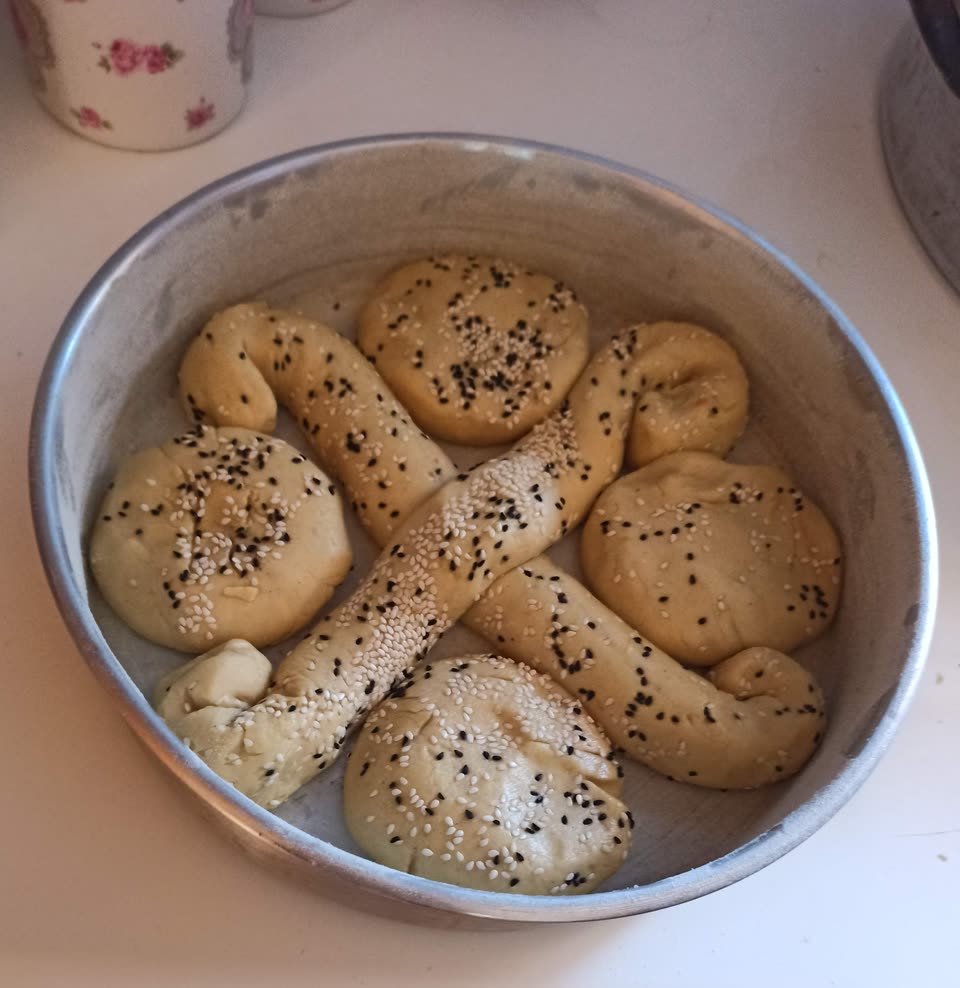
A decorated loaf cut in honour of Christ at the festive table. At Varnavas in Attica, where the craft of embroidered bread is on the national heritage inventory, the christopsomo carries nuts pressed into it — walnuts and almonds — a cross worked at the centre, and around that flowers, birds, leaves and grapes.
The inventory record is specific about whose craft it is. The embroidering of bread at Varnavas has stayed a women’s affair and a part of how the women of the community are social with one another, taught by grandmothers and mothers and still being handed on. The village is an Arvanite one, with its own cultural identity, and the bread is named as one of the things that identity is made of.
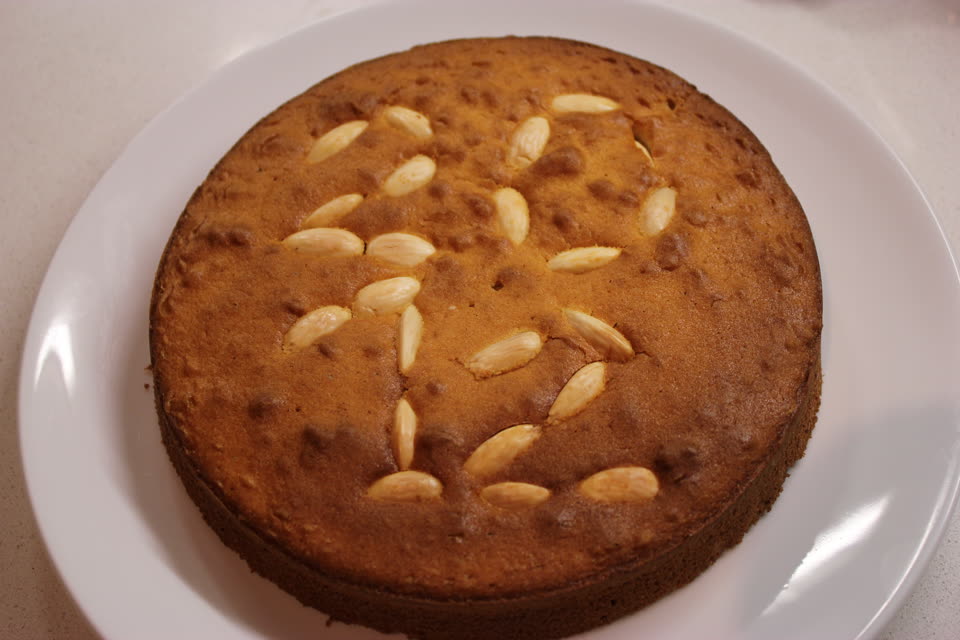
The new year’s pie, named for Saint Basil, whose feast is 1 January — one of the four days in this fortnight on which the whole country must close.
The thing everyone outside Greece knows about it is the coin baked inside. The Varnavas record describes a different centre: a walnut, fixed in the middle, with relief designs radiating out to it — the householder’s house, the hand of the Virgin, the animals of the yard, and the tools or emblems of whatever trade the householder followed, the grape, the ploughshare, the ear of wheat. The last three were the wish for a good harvest. The ear of wheat on the vasilopita stands, as the red egg does on the Easter loaves, for birth and the beginning of life. In the village the pie is also called Βασίλα.
Not a festive dish so much as the end of a shift. The carollers at Kalampaki sing all night in a fixed order of houses, which means the last houses are reached at first light, and at the last one there is chicken soup waiting for them — in the inventory’s own phrase, to mend their insides.
Widely repeated claims about Christmas in Greece that do not survive
checking. Each one says what is actually the case, because a correction
with nothing in its place leaves you worse off than before.
Oversimplified
Greece switched to the Gregorian calendar, so Greek Christmas is the same 25 December as everybody else’s and the Julian question does not arise there.
What is actually the case. Christmas is 25 December in Greece, and the rest of the sentence is wrong in three places.
The 1923 change was the state’s and it was civil only; the Julian calendar stayed in force as the religious one. When the Church of Greece did move, in March 1924, it did not adopt the Gregorian calendar — it adopted the revised Julian calendar proposed by Milutin Milanković at the Constantinople congress of May 1923, which is astronomically more accurate than the Gregorian and which deliberately keeps the old Paschal rule. That is why Greek Easter still moves on the old reckoning while Greek Christmas does not; the Synod’s own circular of 8 March 1924 says in the same breath that no change was made to the festal calendar and that Pascha was not corrected.
And the question did not close. Clergy and laity who refused the change had no bishops at all until 1935, when three joined them and consecrated four more. The Church’s own catechetical summary counts around fifteen separate Old Calendarist churches by 2026, and for them 25 December arrives thirteen days after everyone else’s.
Μωμόγεροι means «Momos-old-men», so the Kozani figures are old men.
What is actually the case. The Greek state’s inventory record stops to correct this in its own parenthesis: we are in the habit of calling them Μωμόγεροι, but they are not old men, they are the priests of Momos — and the entry lists Μωμόγεροι among the variant names as the form produced by inserting a euphonic γ into Μωμο’εροι.
The age is not invented, though, and the place it comes from is the custom’s other name. The same entry lists «Οι Κοτσαμάν’» as a name for them, says it is of Turkish origin, and glosses it as big-bodied men, venerable men. The Turkish state dictionary gives kocaman as both «very large» and «greater in years». One name carries the size and the age together; the reading of the other name as age is what the inventory entry rejects.
Greek children get nothing on Christmas morning — the presents come on 1 January, from Saint Basil rather than from Santa Claus.
What is actually the case. The figure is right and the exclusivity is not. Saint Basil really is the one addressed: Hellenic Post has answered letters sent to him since 1991 and calls itself his helpers. But the post office collects those letters «τις ημέρες των Χριστουγέννων, τα ΕΛΛΗΝΙΚΑ ΤΑΧΥΔΡΟΜΕΙΑ δέχονται χιλιάδες επιστολές από όλη την Ελλάδα προς τον Άγιο Βασίλη» — over the days of Christmas, not at New Year. The saint kept the role and the western season took the date, so the two traditions sit on top of each other instead of one having replaced the other. What is unambiguous is that 1 January is his: the pie is named for his feast, and the state’s record of the Kleisoura masquerade calls 31 December «της παραμονής της εορτής του Αγίου Βασιλείου».
For one season in Greece, New Year came before Christmas. The state moved to the Gregorian calendar in 1923 and the Church did not follow until 23 March 1924, so for that one winter the civil 1 January fell before the Church’s 25 December, which was the 7 January following. The Holy Synod’s circular of March 1924 listed exactly that among the confusions the change had just removed.
Saint Nicholas is in the Greek Christmas season, and he is there as a sailor. The Hellenic Navy’s standing regulations fix two ceremonies in this stretch of the calendar: the anniversary of the naval battles of the Balkan Wars, held on 6 December and celebrated together with the feast of Saint Nicholas, patron of sailors, with the President of the Republic invited — and the immersion of the Holy Cross on 6 January.
The Twelve Days in the Greek state’s inventory of intangible heritage are largely a refugee inheritance. Momoeria came from Liverá behind Trebizond with the 1923 exchange of populations. The carols of Kalampaki came from Kryoneri in Eastern Thrace, and were then taken up by Cappadocians and by people from Kalfa outside Constantinople who were settled in the same village. The Tempelekia of Nea Vyssa are sung by the third generation of refugee families. The Camels and Ntivitzides are the Twelve Days performance of Eastern Rumelia, kept at Philippoupoli near Larisa. Four separate places on the other side of a border, and the custom that survived the crossing in each case was a midwinter one.
A camel walks with the carollers in the Thracian masquerades of the Twelve Days, and in at least one place it is explained as the saint’s transport. The state inventory’s record of the Eastern Rumelian version reports the reading given at Thourio Didymoteichou, citing a 1969 account: «ότι παριστάνει τον ερχομό του Αϊ-Βασίλη, ο οποίος στα χρόνια εκείνα, που έλειπαν τα συγκοινωνιακά μέσα, ταξίδευε με καμήλα» — that it represents the coming of Ai-Vasilis, who travelled by camel in those years, when there was no transport. The same record is careful to say that on the origin and purpose of the masquerade «υπάρχουν διιστάμενες απόψεις» — opinions diverge.
The oldest dated description of a kalikantzaros was written in Cyprus, by an American missionary, and the creature in it is stranger than the modern one. Lorenzo Warriner Pease, 26 January 1838: it is «part man and part donkey, but can turn itself into a large man, a child, a flea and a multitude of shapes besides», it is not especially malicious «except that it does not like to have people work nights, especially before Christmas», and it is «a special enemy to cotton». The priest's sprinkling at τα φώτα was already the way to be rid of it. And catching one was worth the trouble: «If you can catch it and tie its ear with a linen thread or tie it in any other part you can make it your willing servant.»
Every claim carries its own citation. They are collected below, so you
can see what the page rests on and how much of it comes from where.
John Cuthbert Lawson, Modern Greek Folklore and Ancient Greek Religion: A Study in Survivals, 1910 — Cambridge University Press, 1910; Project Gutenberg ebook 66116. Retrieved 2026-10-26. archived 9 February 2026And: «The rest of the year they live in the lower world, and occupy themselves in trying to gnaw through or cut down the great tree (or in other accounts the one or more columns) on which the world rests. Each Christmas they have nearly completed their task, when the time comes for their appearance in the upper world, and during their twelve days’ absence, the supports of the world are made whole again.»
American Missionary Lorenzo Warriner Pease commented on the local folklore tale of the kalikantzaros (καλικάντζαρος) — History Today, dateline 26 Jan 1838 — Centre of Visual Arts and Research (CVAR), Costas and Rita Severis Foundation, Nicosia, Cyprus — publishing an extract from the Pease diaries it holds. Retrieved 2026-11-10. archived 9 September 2024The diary entry in full: «The people have an idea that there is a kind of hobgoblin which frequents houses whose usual shape is part man and part donkey, but can turn itself into a large man, a child, a flea and a multitude of shapes besides. It does not seem to have a very malicious disposition, except that it does not like to have people work nights, especially before Christmas. It is a special enemy to cotton. The Greek priests sprinkle all parts of the house, even the roof and the yard at τα φώτα for the purpose of expelling it. If you can catch it and tie its ear with a linen thread or tie it in any other part you can make it your willing servant.»
Güncel Türkçe Sözlük: deveci, topuz, kocaman — Türk Dil Kurumu (sozluk.gov.tr). Retrieved 2026-10-26. archived 31 October 2026The Turkish state dictionary, for the two borrowed words: deveci is «Deve kervanını güden kimse», and topuz is «Ucu top biçiminde eski bir silah».
Momoeria, New Year’s celebration in eight villages of Kozani area, West Macedonia, Greece — UNESCO, Representative List of the Intangible Cultural Heritage of Humanity, inscribed 2016 (11.COM 10.b.16), file no. 01184. Retrieved 2026-10-26. archived 14 July 2026The inscription’s English description: «From December 25 to January 5 in Kozani (north-western Greece), dancers, actors and musicians can be seen performing in village streets and visiting people’s homes to celebrate the coming of the new year.» and, on what the dance is for: «dancing under their leader’s command to convince the powers of nature not to endanger the livelihood of villagers».
«Παλαιό (Ιουλιανό) ημερολόγιο και παλαιοημερολογιτισμός» — βασικά σημεία, 11 Μαρτίου 2026 — Αποστολική Διακονία της Εκκλησίας της Ελλάδος. Retrieved 2026-10-26.On the congress and the proposal: «Στο Ορθόδοξο Συνέδριο στην Κωνσταντινούπολη το Μάϊο του 1923 προτείνεται από τον Σέρβο μαθηματικό Μιλούτιν Μιλάνκοβιτς ένα ακόμη νεότερο ημερολόγιο, ακριβέστερο αστρονομικά του Γρηγοριανού». On the jump: «Εισάγεται στην Εκκλησία της Ελλάδος το «διορθωμένο Ιουλιανό ημερολόγιο» και η 10η Μαρτίου 1924 γίνεται 23 Μαρτίου 1924.» On the schism: «Το 1935 τρείς Επίσκοποι προσχωρούν στους Παλαιοημερολογίτες. Χειροτονούν άλλους τέσσερεις και συγκροτούν 7μελή σύνοδο.» and «Δημιουργία περίπου 15 «Εκκλησιών ΓΟΧ»».
Με λαμπρότητα και κατάνυξη ο εορτασμός των Θεοφανείων στον Πειραιά, 6 Ιανουαρίου 2026 — Δήμος Πειραιά. Retrieved 2026-10-26. archived 7 January 2026The city’s own account: «Ο Πειραιάς, ως κεντρικό σημείο εορτασμού των Θεοφανείων στη χώρα, καλωσόρισε πλήθος πιστών και επισήμων.» and on who was there: «παρουσία του Εξοχότατου Προέδρου της Ελληνικής Δημοκρατίας κ. Κωνσταντίνου Τασούλα και του Μακαριωτάτου Αρχιεπισκόπου Αθηνών και Πάσης Ελλάδος κ.κ. Ιερωνύμου».
Δελτίο Στοιχείου ΑΠΚ: «Μωμοέρια, ένα έθιμο του Δωδεκαημέρου» — Εθνικό Ευρετήριο Άυλης Πολιτιστικής Κληρονομιάς της Ελλάδας, Υπουργείο Πολιτισμού. Retrieved 2026-10-26. archived 29 August 2026The inventory record’s own identification: «Ευετηριακό και ψυχαγωγικό έθιμο του Δωδεκαημέρου (Χριστούγεννα έως Θεοφάνια) με χορευτική, θεατρική και μουσική ομάδα σε παράλληλη δράση, προερχόμενο από την ορεινή Τραπεζούντα, που επιβιώνει σε οκτώ χωριά του Νομού Κοζάνης.» On the variants: «είναι καταγεγραμμένο σε πενήντα και πλέον παραλλαγές». On the crossing: «Η παραλλαγή που μεταφέρθηκε από τον Πόντο στην Ελλάδα με την ανταλλαγή των πληθυσμών (1923), είναι αυτή του χωριού Λιβερά της ορεινής Τραπεζούντας.» and «Οι Πόντιοι πρόσφυγες, ανάμεσα στα λιγοστά αντικείμενα που έφεραν στην Ελλάδα, ήταν εγκόλπια και περικεφαλαίες Μωμό΄ερων.» On the years: «Πραγματοποιείται από το 1924-25 στην Ελλάδα (ελάχιστες φορές δεν έχει πραγματοποιηθεί, όπως με τον πόλεμο το 1940).» The gendarme is listed as «ο τσανταρμάς (χωροφύλακας επί τουρκοκρατίας)».
Δελτίο Στοιχείου ΑΠΚ: «Τα Κάλαντα του Κρυόνερου Ανατολικής Θράκης στο Καλαμπάκι Δράμας» — Εθνικό Ευρετήριο Άυλης Πολιτιστικής Κληρονομιάς της Ελλάδας, Υπουργείο Πολιτισμού. Retrieved 2026-10-26. archived 10 July 2026The inventory record: «Θρησκευτικού περιεχομένου κάλαντα, που τραγουδιούνται αντιφωνικά στο Καλαμπάκι Δράμας τη νύχτα έως το ξημέρωμα των Χριστουγέννων από ομάδες ανύπαντρων νεαρών ανδρών». On the audition: «Οι οικοδεσπότες, εφόσον κρίνουν πως η ομάδα τραγουδά όπως πρέπει και είναι καλλίφωνοι, θα ανοίξουν τη θύρα προσκαλώντας τους μέσα, αλλιώς θα προσφέρουν ένα μικρό φιλοδώρημα και κέρασμα στην είσοδο.» On the house in mourning: «Το πρώτο τραγούδι («Χριστός») λέγεται πάντα, ακόμη και στην περίπτωση που το σπίτι έχει πένθος και δε θα τραγουδηθούν τα υπόλοιπα.» On the end of the night: «Όταν οι ομάδες τελειώσουν τις επισκέψεις, συναντιούνται το ξημέρωμα μπροστά στην εκκλησία, για να ψάλλουν όλοι μαζί το τελευταίο άσμα.»
Δελτίο Στοιχείου ΑΠΚ: «Τεμπελέκια (παραδοσιακά κάλαντα της Νέας Βύσσας)» — Εθνικό Ευρετήριο Άυλης Πολιτιστικής Κληρονομιάς της Ελλάδας, Υπουργείο Πολιτισμού. Retrieved 2026-10-26. archived 4 October 2026The archive’s own short description: «Τα «Τεμπελέκια» αποτελούν ένα αγερμικό ανδρικό δρώμενο του Δωδεκαημέρου, που πραγματοποιείται στην αστική κοινότητα της Νέας Βύσσας του Έβρου στις 25-26 Δεκεμβρίου.» and «χρησιμοποιώντας ντέφια, αλλά και ζωομορφικές μεταμφιέσεις, όπως αυτή του «Καμηλάρη» που συνοδεύει το έθιμο.» On the three generations: «στην οποία συμμετείχαν και τραγούδησαν μαζί τρεις γενεές Τεμπελεκτσήδων (παππούδες-γιοι-εγγόνια)».
Δελτίο Στοιχείου ΑΠΚ: «Αράπηδες Μοναστηρακίου Δράμας» — Εθνικό Ευρετήριο Άυλης Πολιτιστικής Κληρονομιάς της Ελλάδας, Υπουργείο Πολιτισμού. Retrieved 2026-10-26. archived 10 July 2026The Arapides record: «Οι «Αράπηδες» είναι μια ομάδα νέων μεταμφιεσμένων ανδρών από το Μοναστηράκι», «με μαύρες κάπες και ψηλές οξυκόρυφες μάσκες από γιδοπροβιές, κουδούνια στη μέση και ξύλινο σπαθί στα χέρια», and its other name, «Δρώμενα των Θεοφανείων».
Δελτίο Στοιχείου ΑΠΚ: «Καμήλες και Ντιβιτζήδες στη Φιλιππούπολη Λάρισας» — Εθνικό Ευρετήριο Άυλης Πολιτιστικής Κληρονομιάς της Ελλάδας, Υπουργείο Πολιτισμού. Retrieved 2026-10-26. archived 24 April 2026The Camels record: «Οι Καμήλες και οι Ντιβιτζήδες είναι το πιο σημαντικό δρώμενο του Δωδεκαημέρου της Ανατολικής Ρωμυλίας.» On the striking: «ο Ντιβιτζής χτυπά το τοπούζι (φαλλόμορφο ξύλινο όπλο) στη γη».
Δελτίο Στοιχείου ΑΠΚ: «Η τέχνη του κεντημένου ψωμιού στον Βαρνάβα της Αττικής» — Εθνικό Ευρετήριο Άυλης Πολιτιστικής Κληρονομιάς της Ελλάδας, Υπουργείο Πολιτισμού. Retrieved 2026-10-26. archived 15 April 2026On the loaf: «Καρπούς, κυρίως καρύδια και αμύγδαλα, τοποθετούσαν και στο Χριστόψωμο, που κοβόταν προς τιμήν του Χριστού στο γιορτινό τραπέζι κάθε νοικοκυριού. Εκτός από το θρησκευτικό σύμβολο του Σταυρού στο κέντρο, άλλα διακοσμητικά μοτίβα ήταν τα λουλούδια, τα πτηνά, τα φύλλα και το σταφύλι.» On whose it is: «η τέχνη του κεντήματος του ψωμιού παραμένει «γυναικεία υπόθεση» και συστατικό στοιχείο της γυναικείας κοινωνικότητας εντός της κοινότητας».
«Γράψε ένα γράμμα στον Άγιο Βασίλη»: Τα ΕΛΤΑ ενημερώνουν σχετικά με τη διαχείριση των προσωπικών σας δεδομένων — ΕΛΤΑ — Ελληνικά Ταχυδρομεία (Hellenic Post), data-protection notice. Retrieved 2026-10-26.A privacy notice rather than a seasonal announcement, which is why it states who the letters are addressed to and who actually opens them: «τις ημέρες των Χριστουγέννων, τα ΕΛΛΗΝΙΚΑ ΤΑΧΥΔΡΟΜΕΙΑ δέχονται χιλιάδες επιστολές από όλη την Ελλάδα προς τον Άγιο Βασίλη». The arrangement itself: «Αποστολείς των εν λόγω επιστολών είναι παιδιά αλλά και ενήλικες, ενώ ο πραγματικός παραλήπτης είναι τα ΕΛΛΗΝΙΚΑ ΤΑΧΥΔΡΟΜΕΙΑ».
30 χρόνια μεταφέρουμε τα γράμματά σας στον Άγιο Βασίλη — ΕΛΤΑ — Ελληνικά Ταχυδρομεία (Hellenic Post), press release, 2021. Retrieved 2026-10-26.The origin, in the company’s own words: «Ήταν το 1991 όταν οι υπάλληλοι των ΕΛΤΑ πήραν την πρωτοβουλία να μην αφήσουν αναπάντητα τα γράμματα που έφτασαν στα χέρια τους με παραλήπτη τον Άγιο Βασίλη». On its standing inside the company: «αποτελεί τη μεγαλύτερη δράση κοινωνικής ευθύνης των Ελληνικών Ταχυδρομείων».
Κώδικας Εργατικού Δικαίου (π.δ. 62/2025), Άρθρο 203 «Αργία» — Εφημερίδα της Κυβερνήσεως, ΦΕΚ Α’ 121/11.7.2025. Retrieved 2026-10-26. archived 10 September 2025Article 203 of the Labour Code sets nine days of compulsory closure «για όλες τις επιχειρήσεις, εκμεταλλεύσεις και εργασίες γενικά», and four of the nine are in this season: «α) Η 1η Ιανουαρίου. β) Η εορτή των Θεοφανίων (6η Ιανουαρίου).» at the head of the list and «η) Η εορτή της Γεννήσεως του Χριστού (25η Δεκεμβρίου). θ) Η 26η Δεκεμβρίου.» at its foot.
«βασιλόπιτα», Λεξικό της Κοινής Νεοελληνικής — Κέντρο Ελληνικής Γλώσσας / Centre for the Greek Language, Ινστιτούτο Νεοελληνικών Σπουδών (Ϋδρυμα Μανόλη Τριανταφυλλίδη). Retrieved 2026-10-26.The reference dictionary of standard Modern Greek defines it as «πίτα ειδικά φτιαγμένη για τη γιορτή του Αγίου Βασιλείου, που κόβεται και μοιράζεται τελετουργικά την πρωτοχρονιά» — a pie made specially for the feast of Saint Basil, cut and shared ritually at New Year. Under πρωτοχρονιάτικος the same dictionary lists «Πρωτοχρονιάτικα δώρα» among its ordinary examples, as it lists the Christmas equivalent under the other adjective: the language carries both.
«Άγιος Βασίλης» — Αρχείο Παροιμιών, αρ. 319 — Κέντρον Ερεύνης της Ελληνικής Λαογραφίας, Ακαδημία Αθηνών (Hellenic Folklore Research Centre, Academy of Athens), digital repository item 506331. Retrieved 2026-10-26.Gonios in Epirus in 1879 and filed under the lemma Άγιος Βασίλης: «Αη Βασίλης έρχεται, Γενάρης ξημερώνει». The same drawer holds «Δεν είναι κάθε μέρα τ’ άϊ Βασιλειού».
Παραδόσεις (Λαϊκές αφηγήσεις), Αρχείο Χειρογράφων, Λ. Α. αρ. 1475, σελ. 37, 61 — Κέντρον Ερεύνης της Ελληνικής Λαογραφίας, Ακαδημία Αθηνών (Hellenic Folklore Research Centre, Academy of Athens), digital repository item 538133. Retrieved 2026-10-26.On the presents: «Φέρνουν δώρα στα μικρά παιδιά κάθε βράδυ ως του Φωτιστή». On the timing: «Τα σκαλικαντζούρια έρχονται την άλλη μέρα του Χριστού». On the way in: «Κάνουν σταυρό σ’όλες τις πόρτες του σπιτιού, για να μη μπούν μέσα. Αλλ’ αυτά μπαίνουν απ’ τον πυρόμαχο». The same manuscript also has the flat verdict «Οι σκαλικάντζαροι είναι σαιτάνικα πράγματα» — they are satanic things — on a later page, which is the ordinary view the gifts sit oddly beside.
«Άγιος Βασίλειος» — Παραδόσεις (Λαϊκές αφηγήσεις), Αρχείο Χειρογράφων, Λ. Α. αρ. 2264, σελ. 9 — Κέντρον Ερεύνης της Ελληνικής Λαογραφίας, Ακαδημία Αθηνών (Hellenic Folklore Research Centre, Academy of Athens), digital repository item 540692. Retrieved 2026-10-26.The whole record: «Ο λαός θεωρεί τον Άη Βασίλη ως αλάνθαστο δείχτη της τύχης», and «Είναι ο άγιος, που ορίζει τον τυχερό της χρονιάς και ο μεγάλος και καλός παππούς των παιδιών».
Διατάξεις Πολεμικού Ναυτικού, Κεφάλαιο 26 «Τελετές» — Πολεμικό Ναυτικό / Hellenic Navy. Retrieved 2026-10-26. archived 26 September 2025Article 2603, the Navy’s fixed ceremonies: «β. Η τελετή της καταδύσεως του Τιμίου Σταυρού κατά την εορτή των Θεοφανείων της 6ης Ιανουαρίου.» and «Το Π. Ν. συμμετέχει στην εορτή που λαμβάνει χώρα στον Πειραιά και διά των Διοικήσεων Ναυτικών περιοχών και υφισταμένων τους κλιμακίων στις άλλες παραθαλάσσιες περιοχές της χώρας εν συνεργασία με τις τοπικές θρησκευτικές και πολιτικές αρχές.» Article 2602 is the honours: «Ενώ διαρκεί η τελετή, τα παρατεταγμένα στρατεύματα παρουσιάζουν όπλα και η Μουσική παιανίζει μια φορά το εμβατήριο της Σημαίας ή τον Εθνικό Ύμνο στις εξής περιπτώσεις», and the second of the four is «Κατά την κατάδυση του Τιμίου Σταυρού, το εμβατήριο της Σημαίας και τον Εθνικό Ύμνο.»